
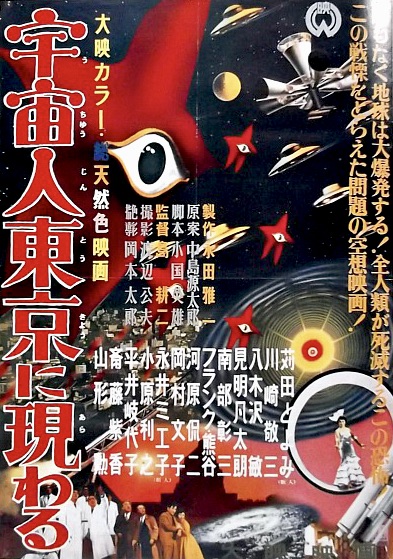
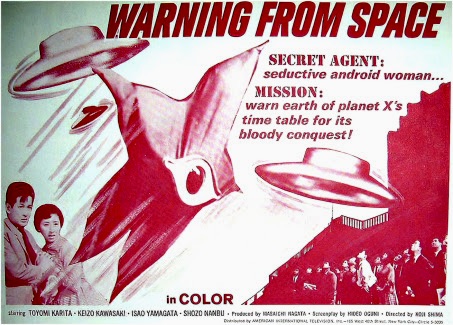
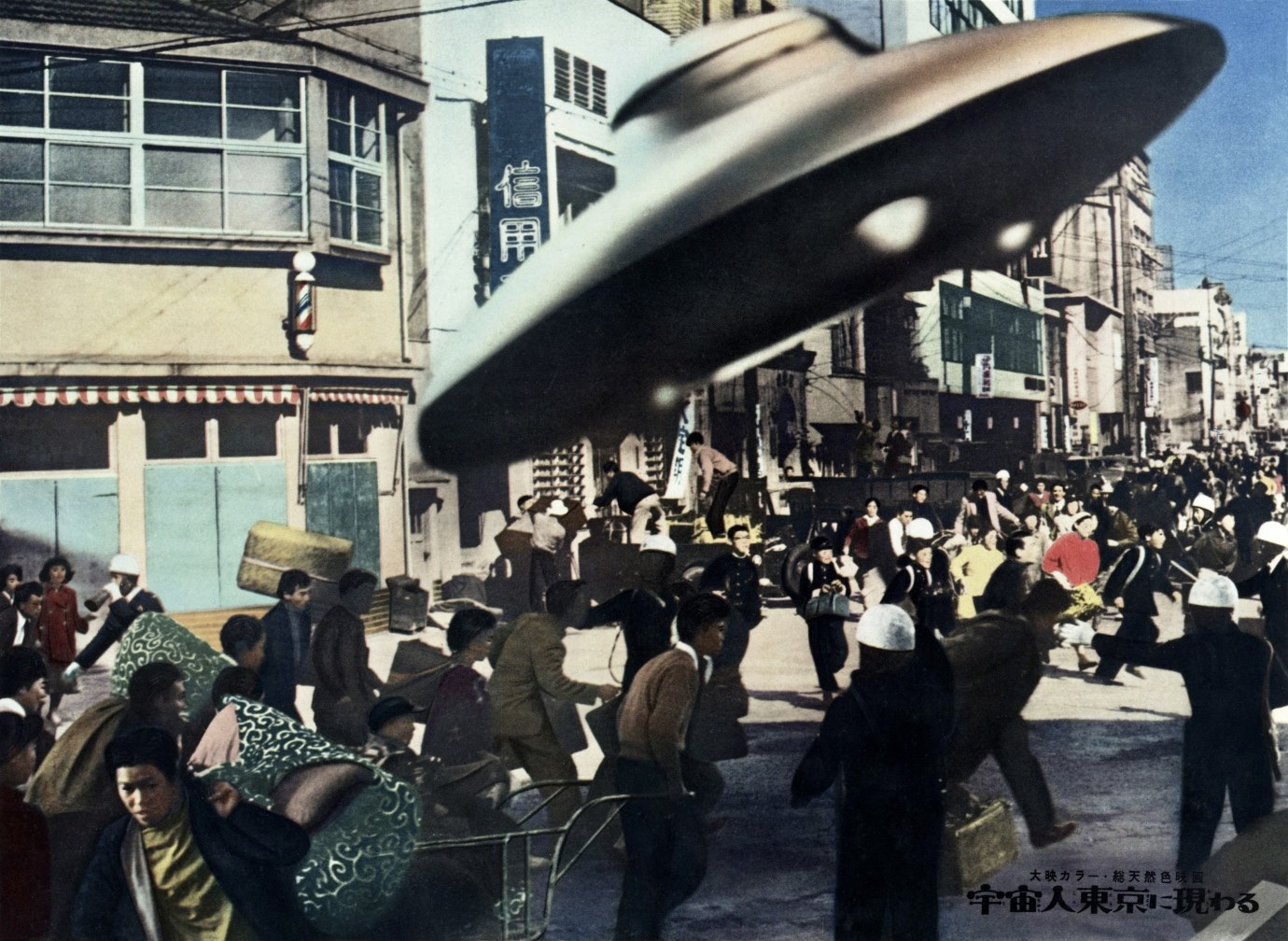
The early 1950s is generally regarded as the time when science fiction truly became a popular and profitable film genre thanks to a number of pioneering efforts from Hollywood such as The Day the Earth Stood Still (1951), The Thing from Another World (1951), The Man from Planet X (1951), It Came from Outer Space (1953) and Invaders from Mars (1954). Other countries quickly followed suit producing their own sci-fi entries but Japan was a latecomer in this regard. It wasn’t until 1956 when Daiei Studios released the first Japanese movie to address the subject of UFOs and extraterrestrials – Uchujin Tokyo ni Arawaru aka Spacemen Appear in Tokyo, directed by Koji Shima. The film was a commercial failure and quickly vanished from cinemas before turning up seven years later on American television screens in an English-dubbed version known as Warning from Space. Unfortunately, this altered version for TV syndication with its pan-and-scan format deviating from the original presentation was intended for juvenile audiences. The original 1956 Japanese version, however, is a fascinating and important genre entry in the development of the science fiction film and deserves to be better known today. (When I refer to Warning from Space throughout the following article, I am talking about the Japanese version).
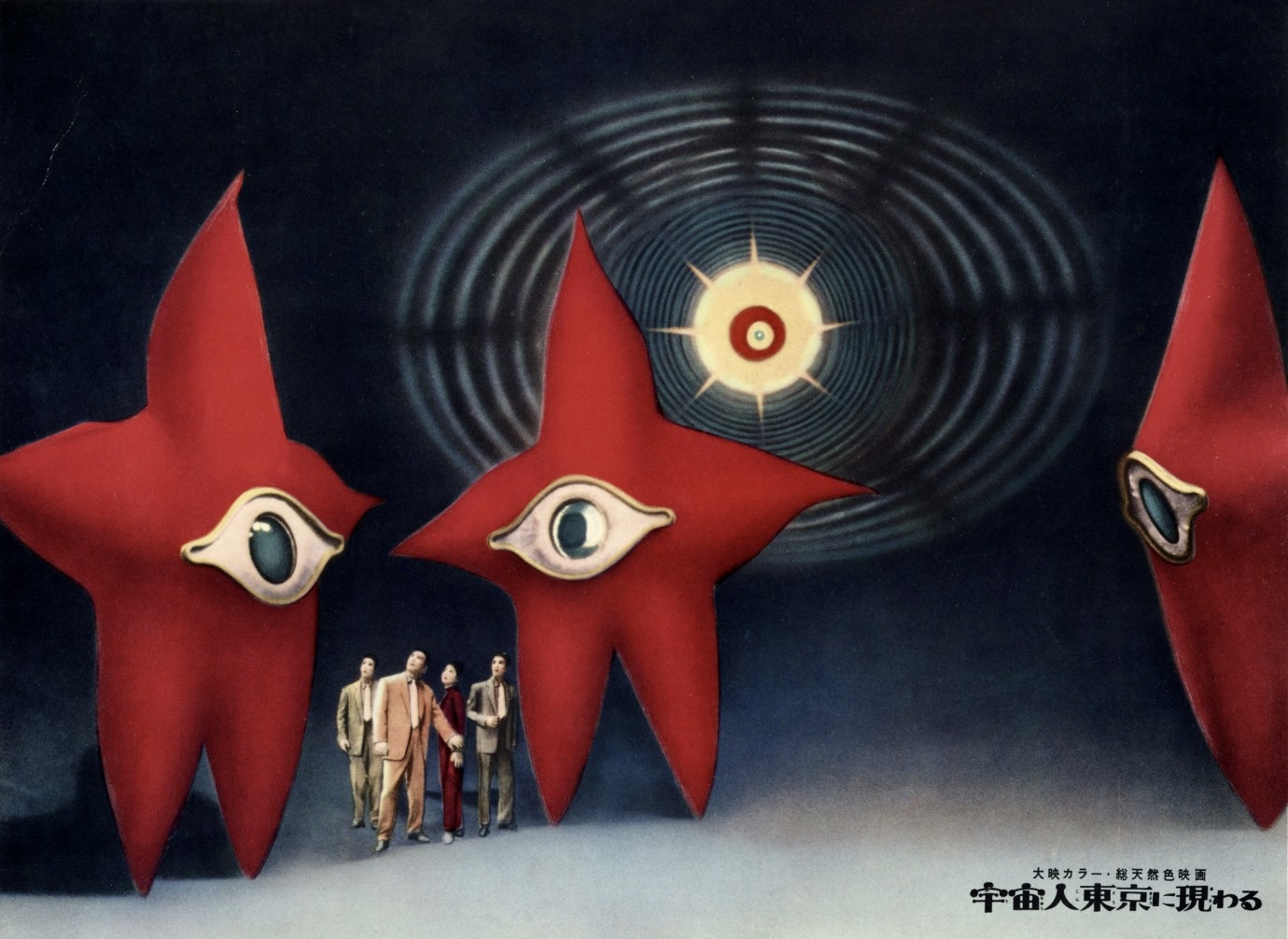
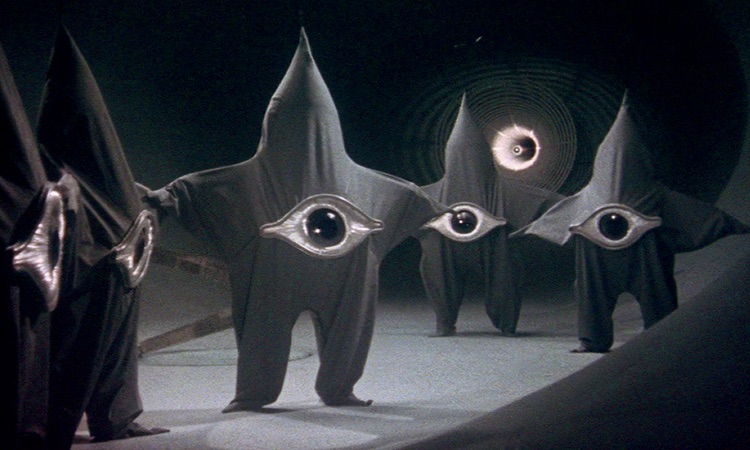
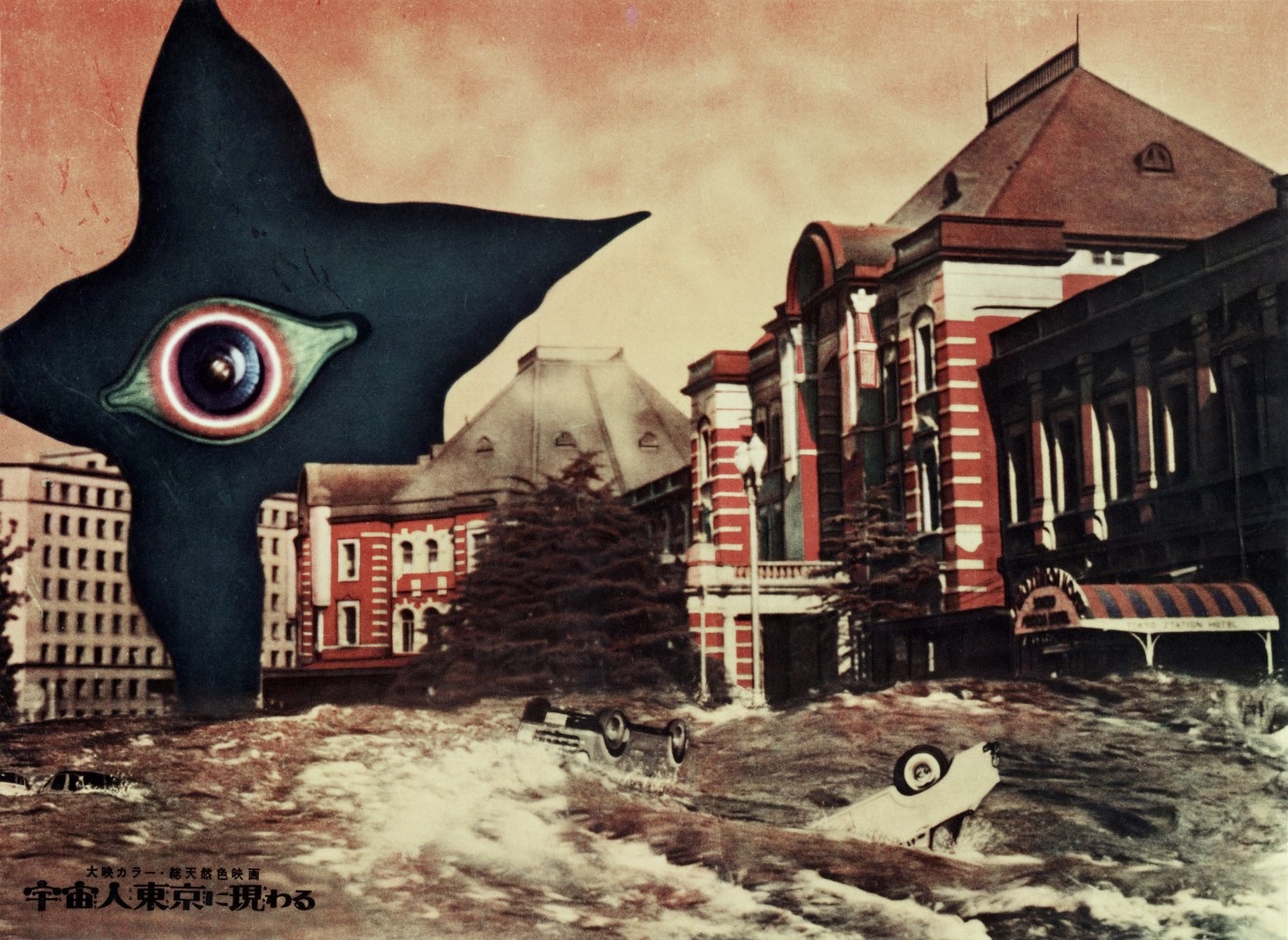
Most of the 1950s sci-fi movies featuring aliens from another galaxy depicted them as aggressively hostile invaders but The Day the Earth Stood Still and It Came from Outer Space stand out as two rare exceptions where extraterrestrials were pacifists and anti-war. Warning from Space, which may have been influenced by those films, treads similar ground but introduces a dizzying number of characters – both human and alien – and enough plot twists for several movies. The eye-popping Eastman color cinematography and innovative-for-the-time special effects by Kenmei Yuasa and Toru Matoba are major assets. But it is the presentation of the other worldly Pairans that make Warning from Space especially memorable. Designed by avant-garde artist Taro Okamoto, the aliens look like oversized starfish with a cyclops-like eye embedded in their center. The effect is both surreal and delightfully nutty at the same time.
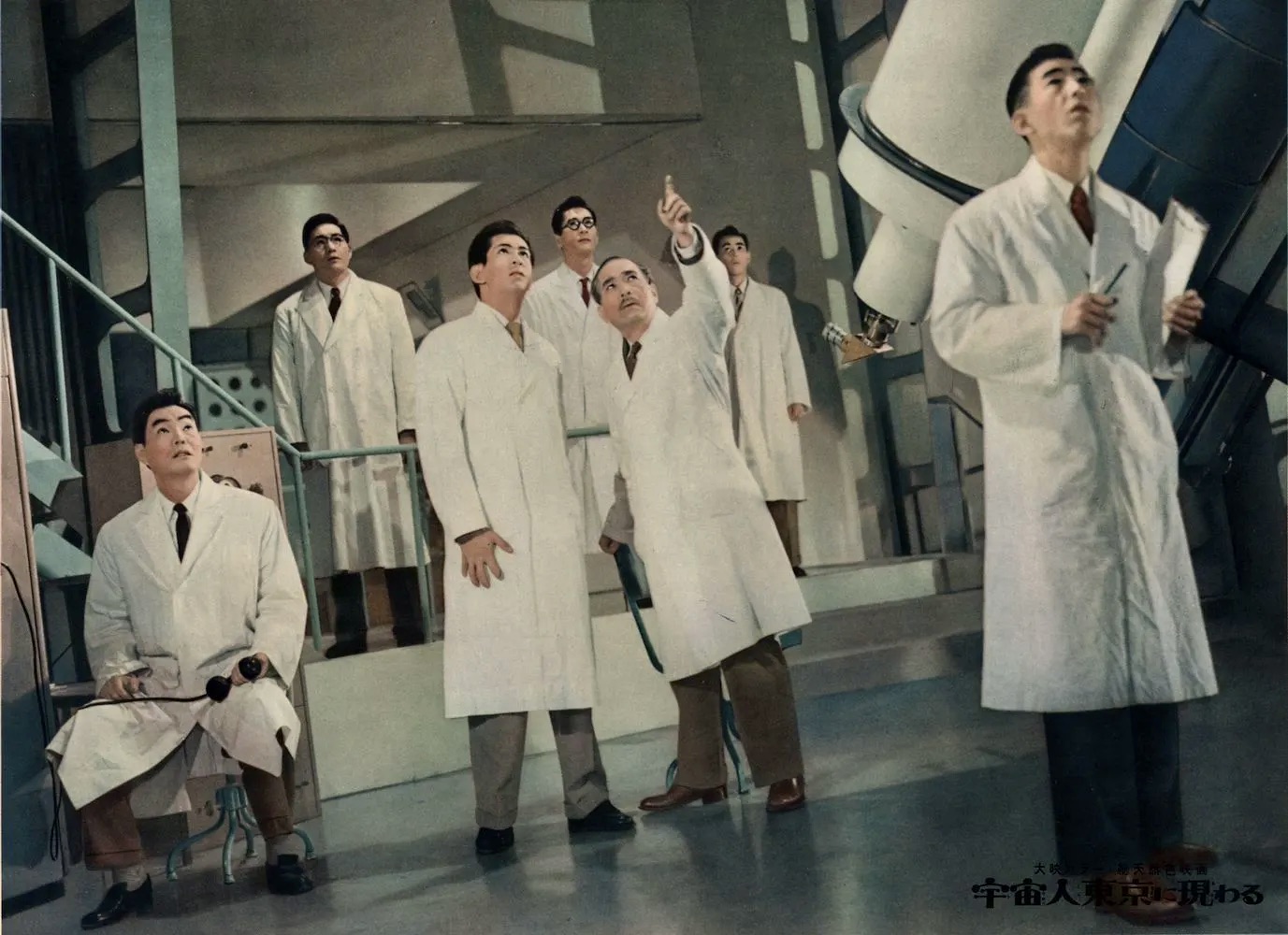
The story begins with Dr. Kamura (Bontaro Miake), an astronomer, joining a friend, Hideno (Toshiyuki Obara), a newspaper reporter, at a Tokyo sake bar. Hideno tries in vain to get Dr. Kamura to comment on the recent UFO sightings in the city but he remains unwilling to go on public record about his concerns. His colleagues, Dr. Matsuda (Isao Yamagata), Dr. Itsobe (Shozo Nanbu) and his son Toru (Keizo Kawasaki) are also conflicted by their discovery of UFOs through their observatory telescope. The objects look too unusual to be satellites or secret weapons from other countries and to tell the press would create panic on an epic scale.
Much more disturbing are eyewitness accounts of local people who have seen “monsters” in their midst – two fishermen at a lake, dock workers at a pier, drunken revelers at a party. Even Taeko (Mieko Nagai), Dr. Kamura’s daughter, spots one of the star creatures outside their home. What is the meaning of it all?
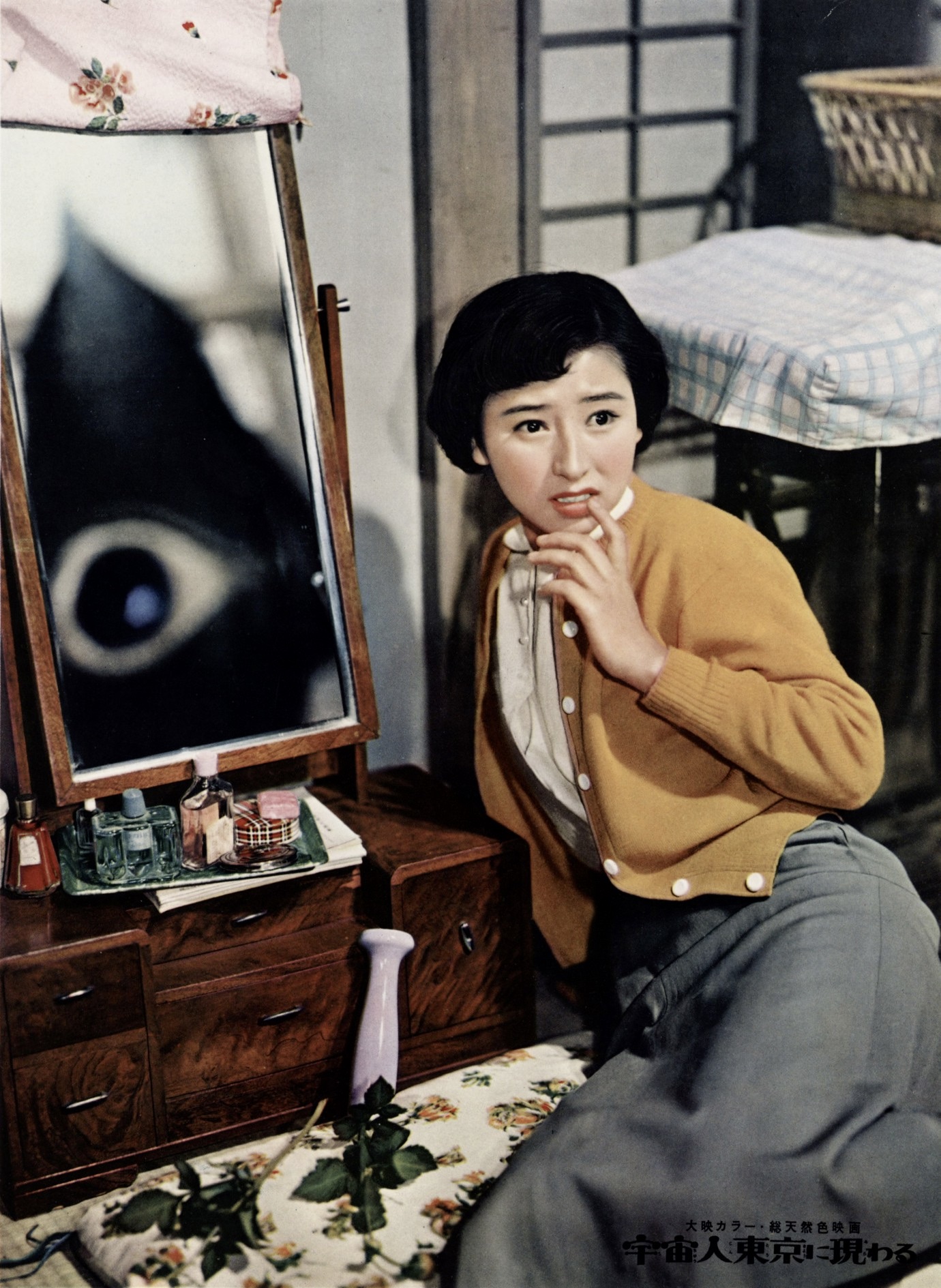
The Pairans have come on a peaceful mission to alert earthlings of an impending catastrophe but their startling appearance has made their initial contact problematic. When the leader of the Pairans asks his messengers, “Have you revealed the reason for our presence?,” one of them answers, “No…as soon as they see us, they scatter in fear as if they had seen something monstrous.” This reaction surprises the leader who asks, “Are we considered hideous? Are they more beautiful than us?” (all of which is rendered in subtitles since the Pairans’ speech is less like a language than lo-fi sound effects).
“It has a very large lump in the center of its face,” the Pairan leader states as he studies a photo of a human, “but we can make immediate contact if we assume the likeness of an earthling.” Almost immediately one of the Pairans is converted to human form, an exact copy of the pop star Hikari Aozora (Toyomi Karita), the woman in the photo. It should be noted that this sequence and several others in the first half of Warning from Space are surprisingly humorous for a serious sci-fi film.
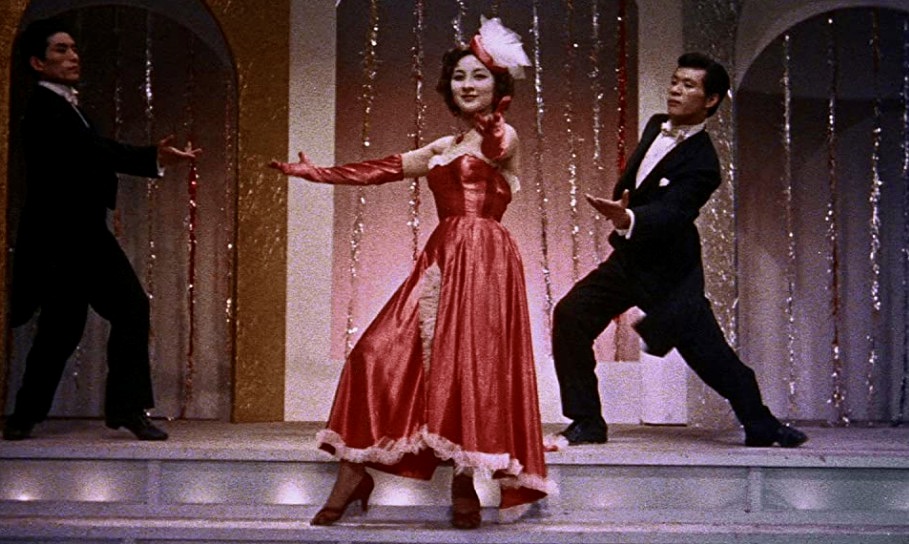
The plot thickens when Toru and his girlfriend Taeko are vacationing at a lake and spot an unconscious woman floating on the water. They rescue her but she appears to be an amnesiac with no memory of who she is and how she got there. They give her a new name – Ginko – but she remains a puzzle to the scientists she meets. Still, for someone with no memory, Ginko proves to be an accomplished tennis player with the ability to leap fifteen feet or more off the ground when returning a volley. Even stranger is the fact that she looks like singing star Hikari’s exact double. When a bunch of teenage schoolgirls mistake Ginko for Hikari and surround her like superfans, she eludes them by passing through a solid wall.
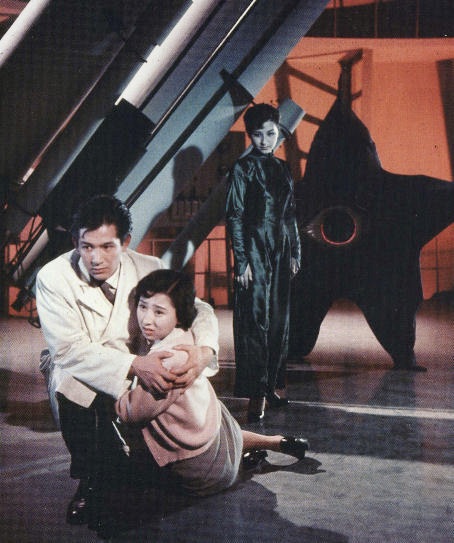
Ginko and her attempts to warn the Japanese people about the dangers of nuclear weaponry is just one of several plot threads. A more pressing concern arrives in the form of a rogue planet that is speeding toward earth. If Planet R (as named by the scientists) is not diverted from its course, it will hit earth and end life as we know it. The Japanese scientific community races against time to convince all of their international allies to launch their nuclear arsenal at the approaching planet before it gets too close.
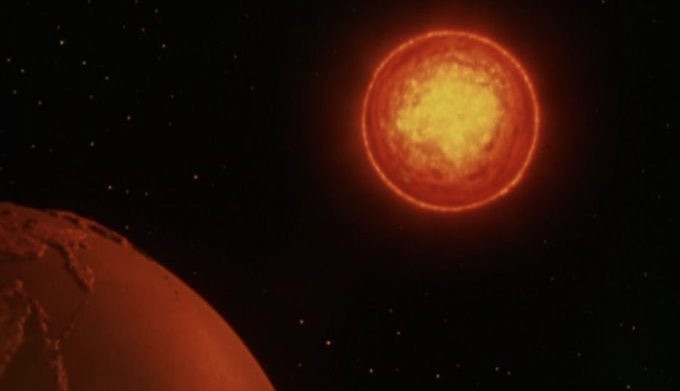
At the same time, Dr. Matsuda has been working on a formula for a nuclear weapon (referred to as “urium”) that has the capability of destroying the planet. When he refuses to sell his formula to a sinister businessman, Dr. Matsuda is kidnapped and held captive in an abandoned building until he changes his mind.
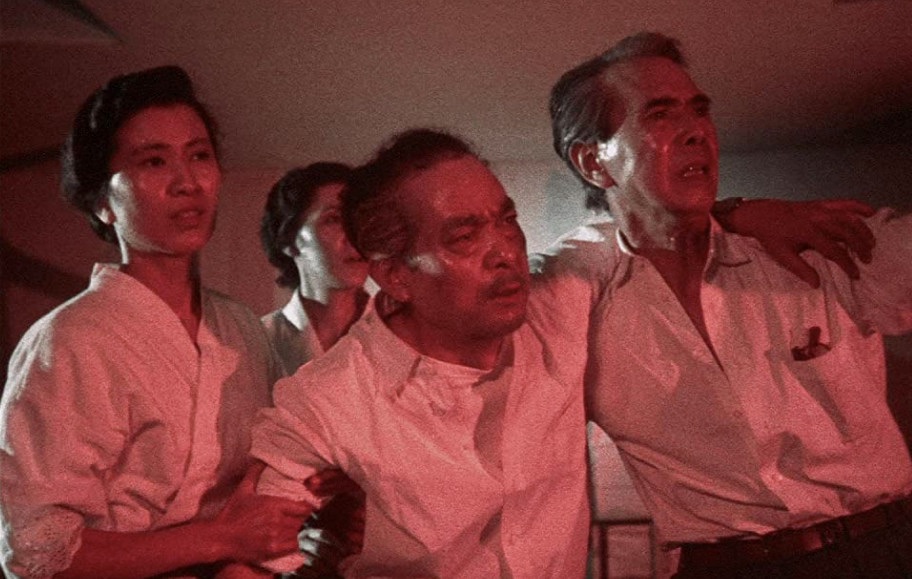
If the first half of Warning from Space is offbeat and eclectic, the second half transitions into a grim, end-of-the-world disaster film with a group of school children taking refuge with the scientists and their families in the observatory. Intense heat, flooding and the widespread death of wildlife (birds, dogs, reptiles) occurs as Planet R seems destined to strike earth. A last minute rescue effort by the Pairans provides a happy ending but it seems anti-climactic after all the drama that has unfolded up to that point. There are also numerous inconsistencies due to too many storylines. Why does Dr. Kamura remain tied up and helpless for days when he is wearing a communication device from the Pairans? Why don’t they come to his rescue? Why doesn’t Hikari and her double Ginko ever meet face to face? (That would have been an amusing encounter).
In addition to some of the muddled plot points, Janne Wass on the website Scifist notes the film’s overt display of patriotism that emerged in 1954 after U.S. forces left Japan. “The film makes no excuses for portraying Japan as the noblest, wisest and most mistreated country in the world. In the original Japanese version the Pairans state that they chose to land in Japan, because the Japanese alone can understand the devastation of nuclear weapons. In the US version the aliens merely state that ”the bay of Tokyo seems best suited for landing”. Much of the film then consists of painting a picture of Japan against the world, as the ”World Congress” repeatedly ignores the pleas of the Japanese scientists.”
Still, what remains timely and unexpected is Warning from Space’s strong anti-nuclear stance which is even more conspicuous than the cautionary tone expressed in Ishiro Honda’s Gojira aka Godzilla from two years earlier, the first in a long series of postnuclear monster films.
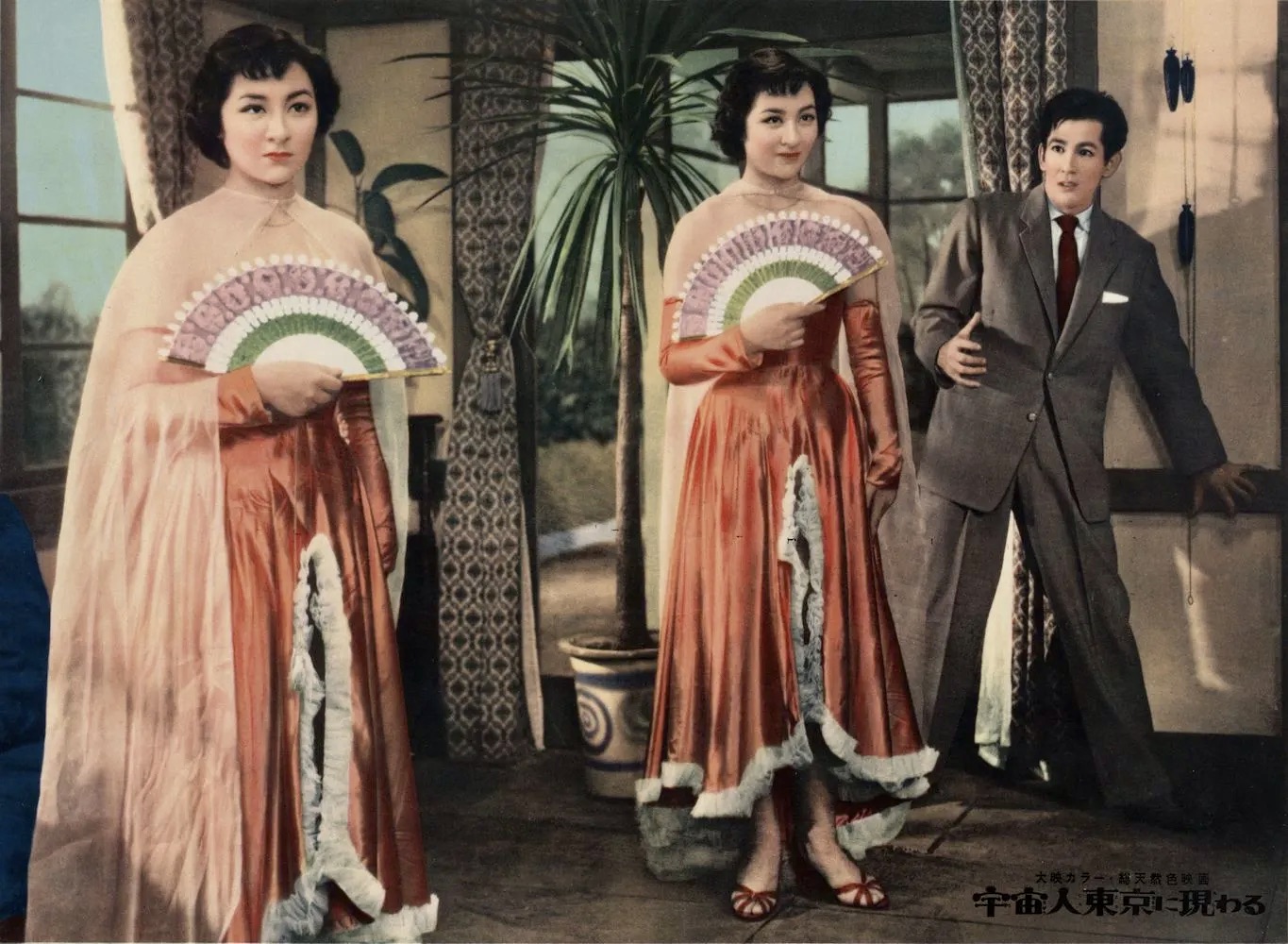
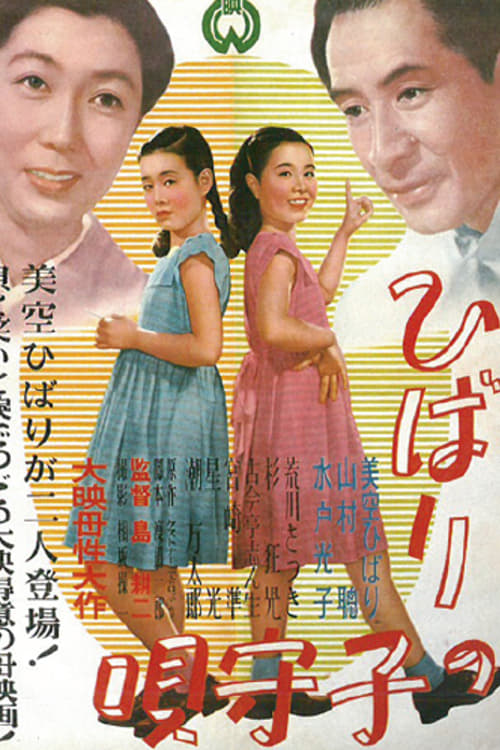
One of the main virtues of Warning from Space is the intelligent screenplay by Hideo Oguni, based on a story by Gentaro Nakajima. Oguni co-wrote numerous scripts for Akira Kurosawa such as Ikiru (1952), I Live in Fear aka Record of a Living Being (1955), The Hidden Fortress (1958) and The Bad Sleep Well (1960) to name a few. With the exception of Masaki Mori’s remake of The Ghost of Yotsuya (1956), co-scripted by Oguni and Torao Tanabe, Warning from Space was a rare foray into the fantasy/sci-fi arena for Oguni. This was also true for actor turned writer/director Koji Shima, who was more famous in Japan for his adult dramas like Lady Chatterly of Japan (1953) and family fare such as Hibari no Komoriuta (1951), based on the German novel Lisa and Lottie, and later adapted for the 1961 Walt Disney film, The Parent Trap.
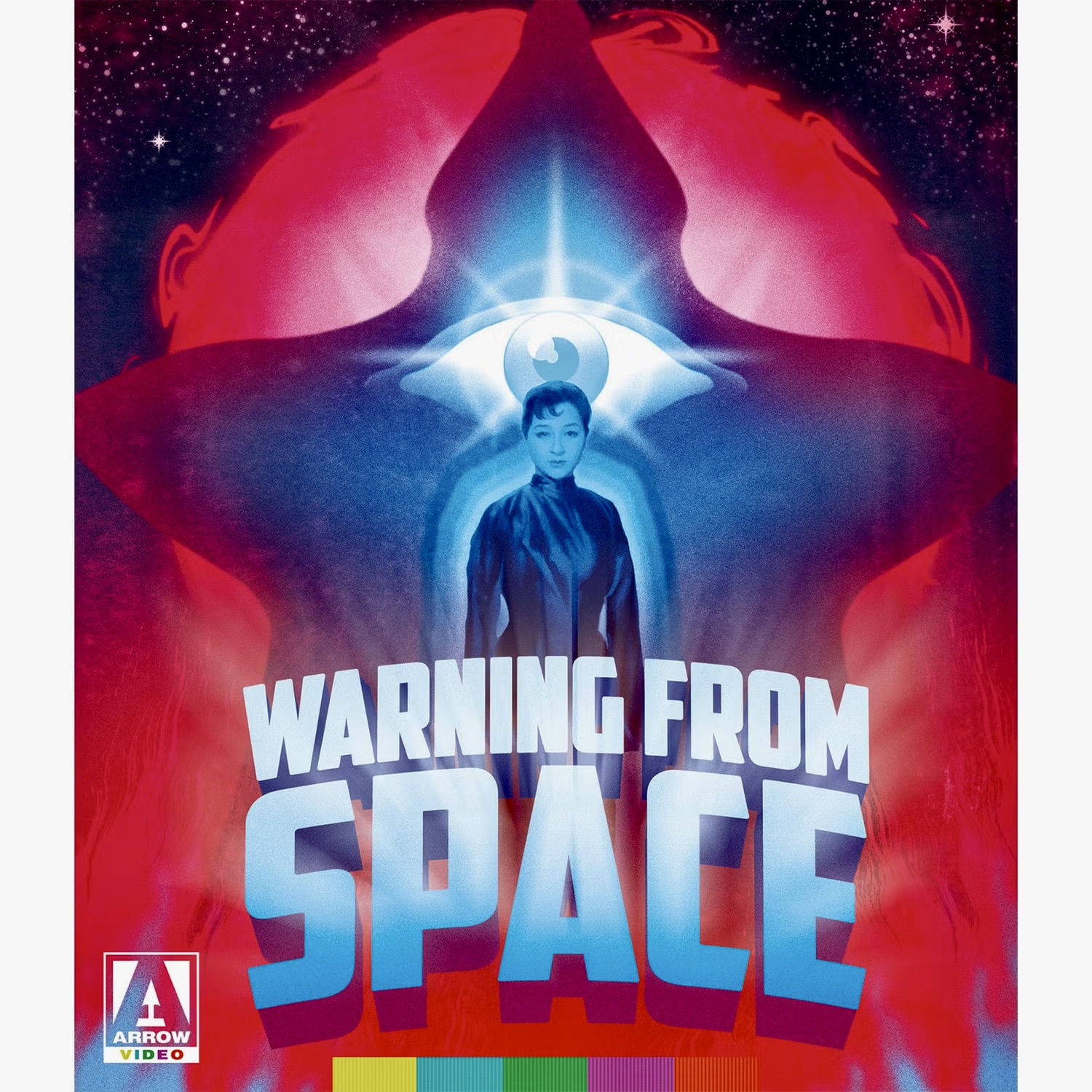
In recent years Warning from Space has been rediscovered by genre fans thanks to a beautiful restoration by Arrow Films, which was released on Blu-ray in October 2020, and also includes the English-dubbed U.S. release version. It runs about a minute longer than the original 87 minute Japanese version with some scenes arranged in a different order and English-dubbed dialogue that subtly changes the meaning of certain scenes. The disc also features an illuminating commentary by Stuart Galbraith IV, an authority on science fiction films, and the insert booklet includes essays by Nick West on the artist Taro Okamoto and David Cairns on the differences between the Japanese and English versions.
Other links of interest:
https://vocal.media/futurism/top-japanese-sci-fi-films
 Cinema Sojourns
Great write-up! And thanks for the shout-out!
Thanks but you are the one who has written the definitive article on the film. You covered all the bases and then some.
❤