
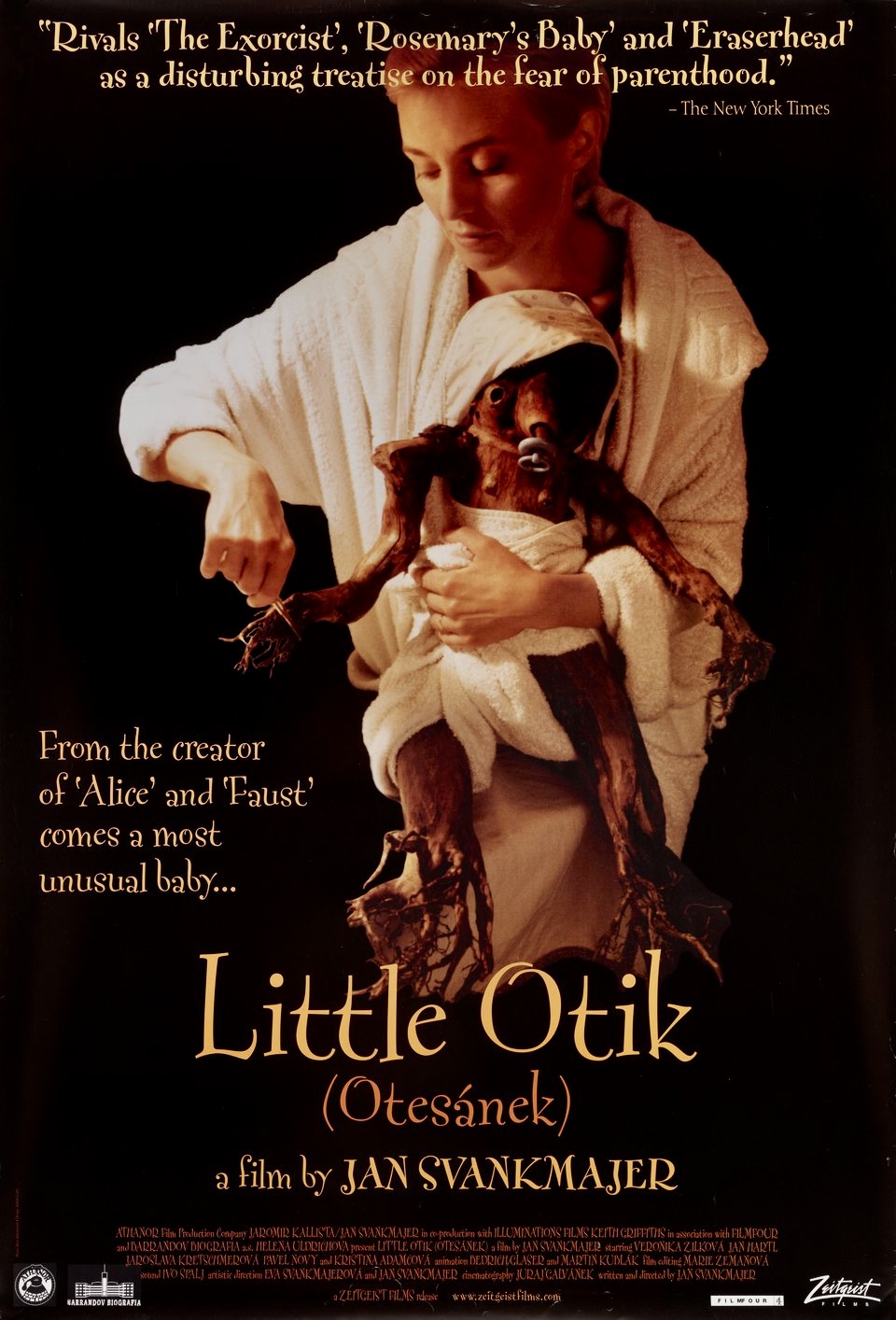
“Be careful what you wish for” is one of those popular expressions that offers cautionary advice for those who want something too desperately. And it has been illustrated repeatedly in literature and movies from timeless folk tales like Faust and The Golem to more recent efforts like Little Otik (2000), Czech filmmaker Jan Svankmajer’s take on Otesanek, a 19th century fairy tale by Karel Jaromir Erben. Svankmajer updates the tale about a childless couple and their substitute baby to contemporary times but also manages to weave in some of his favorite obsessions and thematic concerns (food, cannibalism, human fears) into a darkly funny but nightmarish portrait of parenthood and child rearing. Despite its stature as a fable, Little Otik is certainly not for children and probably not the best viewing option for expectant mothers either.
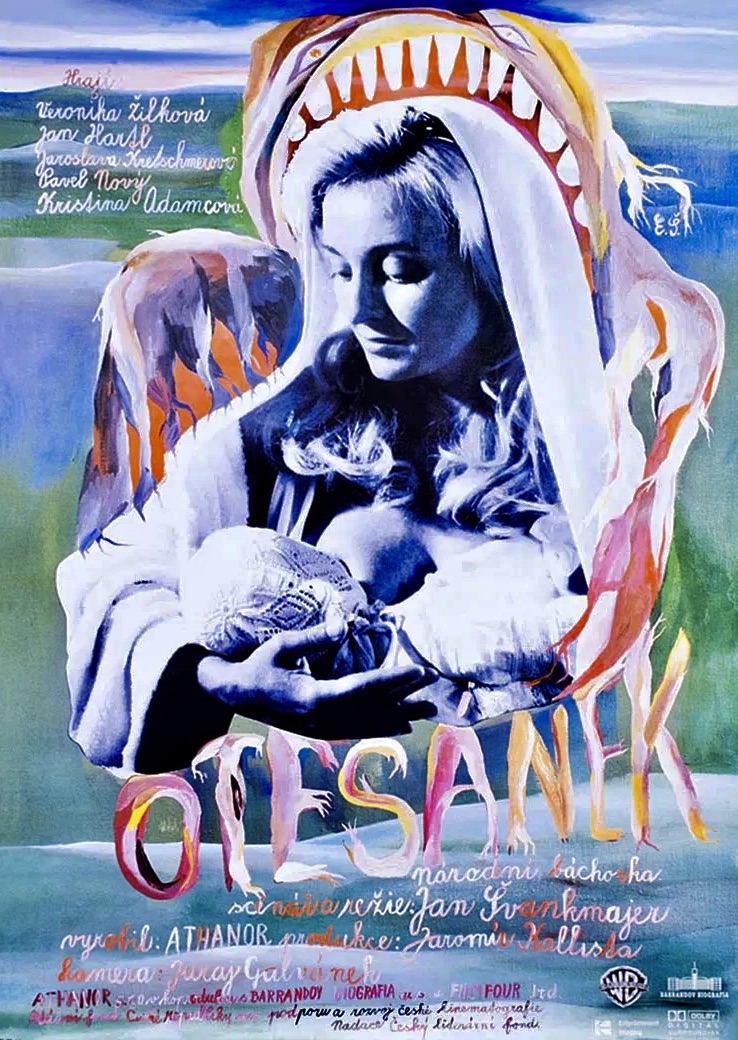
In the original story, a couple unable to have children of their own discover a tree stump that resembles a human infant and raise it as their child. It comes to life under their care but also develops an enormous appetite, eating everything in sight including people. Svankmajer grounds this bizarre premise in a recognizable reality from his opening scene, set in the waiting room of a pediatrician. Karel Horak (Jan Hartl) is waiting for his wife Bozena (Veronika Zilkova) to emerge from her check-up with good news. Instead, the couple learn that they are both infertile but their desire to have a child is so intense it completely absorbs and distorts their lives. In fact, while Karel is in the doctor’s waiting room, he imagines – or does he? – that the street vendor outside is scooping newborn babies out of a water basin and wrapping them up for customers in newspaper as if they were fresh mackerel fillets to go.
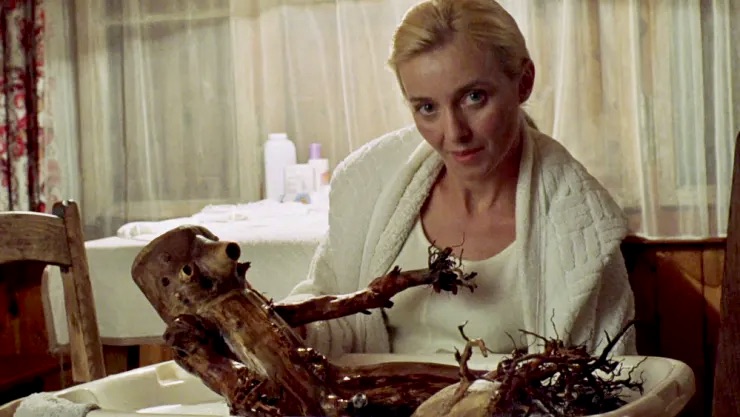
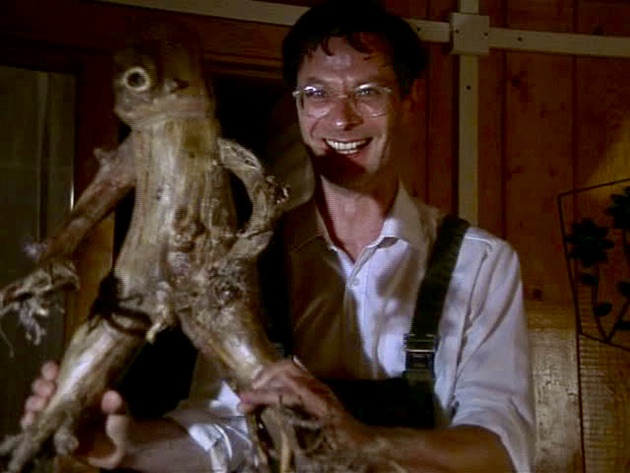
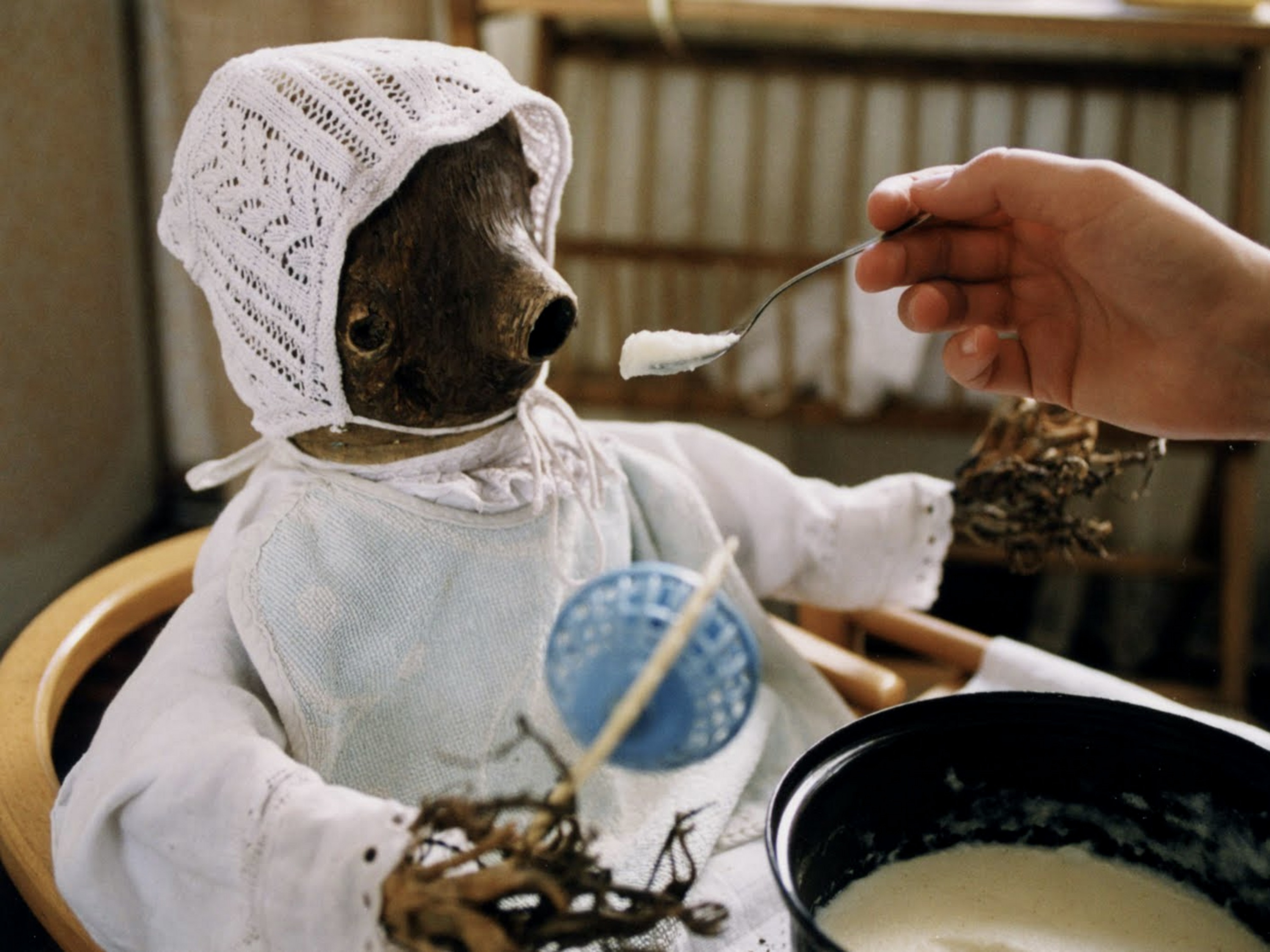
Bozena is so distraught over the doctor’s news that she lapses into a deep depression but Karel comes up with a solution to brighten her mood. While clearing land at their rustic weekend retreat, he digs up a tree stump and carves it into a life-like figure of a baby. The ploy works too well and soon Bozena is treating the wooden baby as if it is real, giving it baths and dressing it in baby clothes. Before you know it, the inert piece of wood known as Little Otik comes to life and becomes a voracious eating machine, requiring the Horaks to spend all their time and money on feeding him. His appetite for countless bottles of baby formula soon graduates to sacks of raw meat and Karel begins to regret ever gifting his wife with the tree stump. “It’s madness,” he mutters, “It can’t end well.”
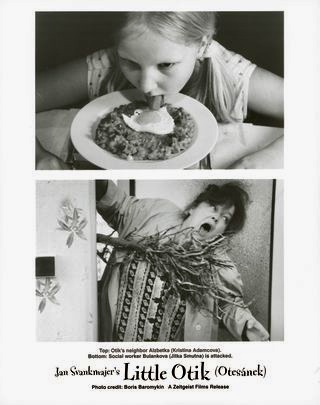
Indeed, Otik’s oversized appetite demands fresher options like Mikes, the family cat, or the postman on his daily rounds and even a social worker who comes to check on Bozena after hearing strange reports about her behavior. The whole dynamic between the Horaks and their “child” becomes a parody of child-rearing as do the couple’s attempts to pass Otik off as their own while refusing to let anyone actually see him (When Bozena is out in public with the baby carriage, she hides a plastic doll under the blanket while Otik remains hidden at home).
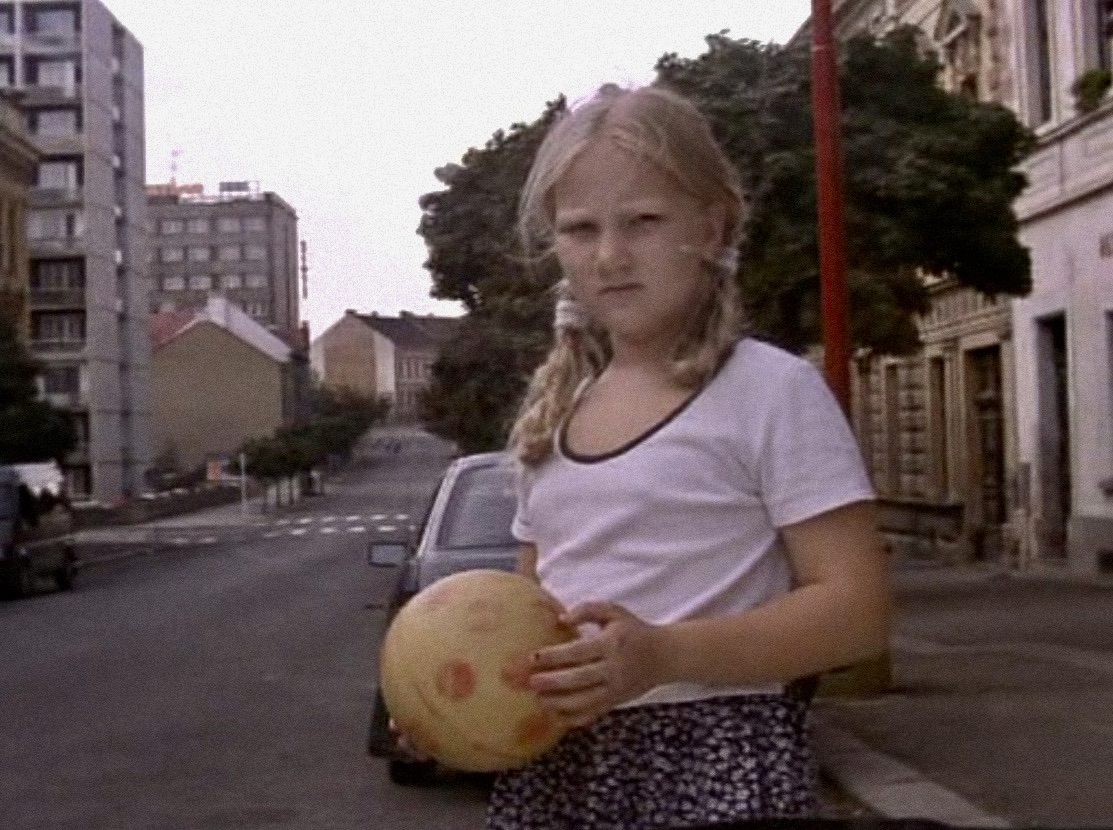
It is at this point that Svankmajer begins to switch the focus from the Horaks and their dilemma to their neighbor Alzbetka (Kristina Adamcova), the sexually precocious ten-year-old daughter of Mr. and Mrs. Stadler (Pavel Novy and Dagmar Stribrna), who has a driving need of her own. An only child with no close friends, she longs to have a close companion of her own and when she learns the Horaks’ secret, she embarks on a mission to protect Little Otik from his increasingly fearful “parents.” In essence, Alzbetka becomes the chief protagonist of the film albeit a misguided one – but even she faces the challenge of keeping Otik in line (When she comes to visit him in his basement prison, he attempts to devour her but is stopped by her rational response, “I want to help you but I’m not food.”)
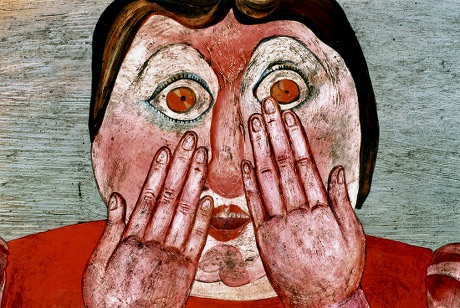
Other characters who figure prominently in the story arc are Mr. Zlabek (Zdenek Kozak), an elderly resident in the apartment building who is an obvious pedophile, and Mrs. Stadlerova (Jaroslave Kretschmerova), a suspicious neighbor who grows cabbages in the backyard and eventually battles the baby-turned-monster.
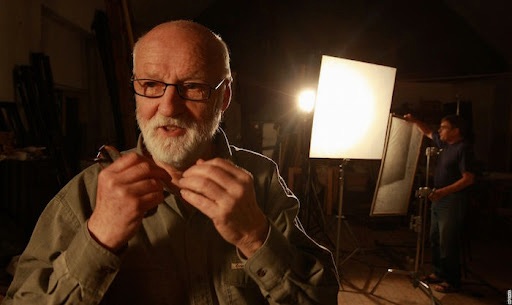
Little Otik originally began as an animation project in the late 1970s for Eva Svankmajerova, the wife of the director. After revisiting the story of Otesanek, Svankmajer also became interested in adapting it for the screen and the two collaborated on the project with Eva providing the animation and Jan directing the live action and stop motion scenes in parallel storylines. The film is even more ambitious in design with a greater focus on the live action aspects than Svankmajerova’s previous feature films such as Conspirators of Pleasure (1996) and Faust (1994). It also clocks in at a running time of two hours and twelve minutes, which is a surprising length for a filmmaker who first gained attention for his subversive and experimental film shorts.
Oral fixations such as eating have always figured prominently in other Svankmajer films like the shorts Jidlo (aka Food, 1992) but, in Little Otik, scenes of food and its consumption become grotesque and nauseating, all of it made more impactful by the exaggerated sound effects and the variety of unappetizing meals on display (watery soups, lumpy stews, messy whipped cream pastries). In an interview with Daniel Steinhart of Indiewire, Svankmajer admitted that “food is another theme that comes from my childhood. I was a boy who suffered from a lack of appetite. I was forced to drink wine containing iron in order to increase my appetite and was also sent to camps for fattening people up. The ways people deal with food and eating can be quite good at reflecting our civilization.”
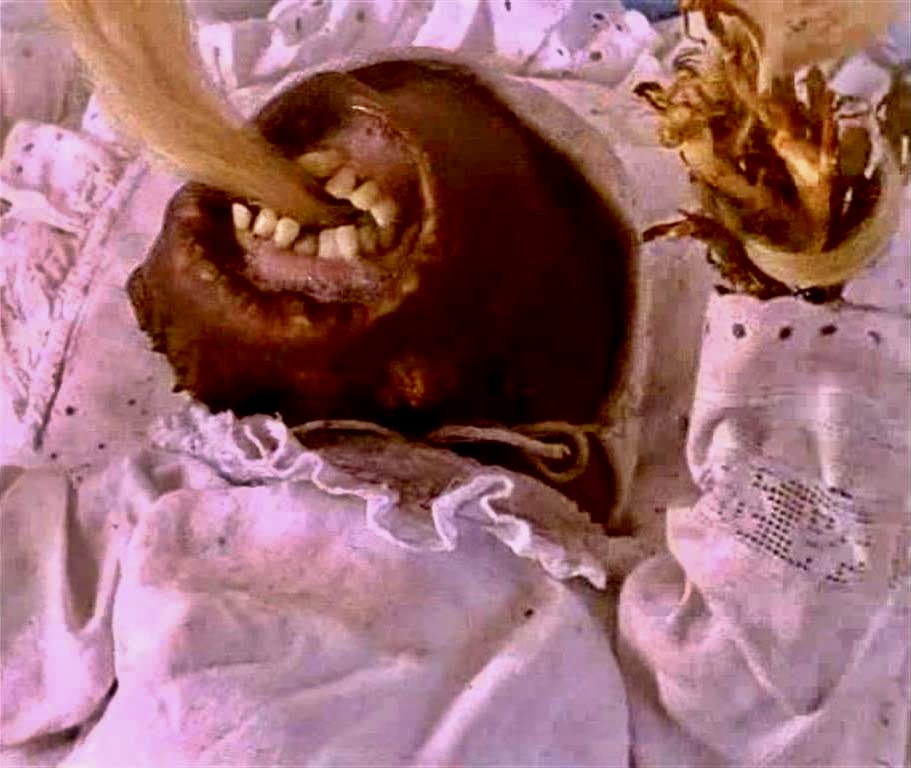
Zoe Gross in an essay on Little Otik for Senses of Cinema effectively sums up the film’s thematic preoccupations, stating the movie “frames these superabundant desires and appetites through a surfeit of ritualised meals and acts of ingestion in which babies themselves become both relentless consumers and objects of consumption. This perpetual confusion or interchange between the consumer and the consumed, and between a series of otherwise oppositional or divergent states between subject and object, interior and exterior, food and the eater, food and waste, food and the body itself, animated and inert matter, infants and monsters, and even ingestion and pregnancy engenders a constant blurring of boundaries.”
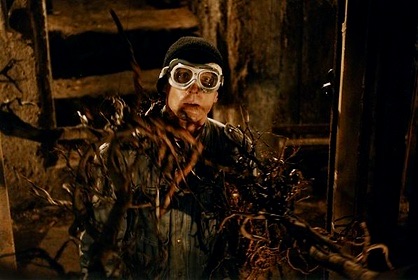
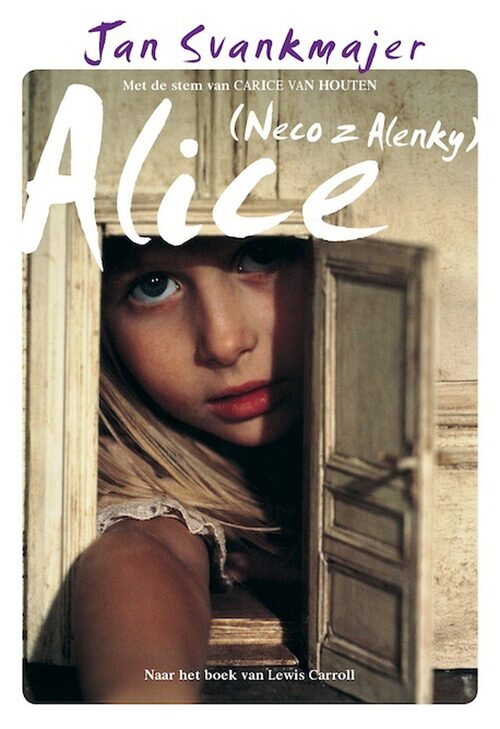
Svankmajer, who is now considered a major figure in Czech cinema, got his start specializing in set design and puppet theatre at the Academy of Performing Arts in Prague in the 1950s. He made his film debut in 1964 with the puppet animation short The Last Trick and first attracted international attention at the Cannes Film Festival in 1965 when his short J.S. Bach – Fantasy in G Minor won the Jury Prize for Best Short Film. Although Svankmajer struggled with Communist party censorship over his work in the late sixties/early seventies, especially regarding subversive shorts like Zahrada (aka The Garden, 1968) and Byt (aka The Flat, 1968), he finally was able to break free of most creative restraints in the early 1980s as witnessed by the award-winning short Dimensions of Dialogue (1983) and his first feature length film, Neco z Alenky (aka Alice, 1988), a surreal re-imaging of Lewis Carroll’s Alice in Wonderland. The director has gone on to achieve other career milestones such as his cinematic interruption of Faust (1994) but Little Otik remains a key work in his filmography.
When it was first released, most critics praised the film such as Elvis Mitchell of The New York Times, who called it, “…a handmade dream, cobbled together from dirt, wood and more imagination than most of us can muster in our most fevered states.” Philip French of The Guardian wrote, “Part horror story, part fairy tale, part social fable in the manner of Rosemary’s Baby, The Bad Seed, The Omen, Eraserhead and Doris Lessing’s The Fifth Child, the movie poses the question: ‘What do you do when you find you’ve bred a monster?’ It’s designed to disturb anyone who has had or contemplates having children…The combination of stylised live action and animation is skilfully contrived and as always with Svankmajer, as with his fellow countryman, Kafka, there is a sense of a real world surrounding the most fantastic events.” And Ed Gonzalez of Slant magazine, remarked, “However potent Little Otik may be at testing the limits of parental love, its the most deadpan piece of pop art this side of The Simpsons.”
There were a few dissenters in the lot such as Mick Lasalle of the San Francisco Chronicle, who pointed out “127 minutes is a lot of time for a simple movie with one satirical point to make and one animated character to show. At 80 minutes, this might have been a delight. At more than two hours, it’s so much of a good thing that it starts to become a bad thing.” And I have to agree that Little Otik becomes overly repetitive in its final act but it is still rare to see a movie that can be interpreted on so many different levels. It can be seen as a critique on the baby industry and people who place too much importance on procreation. It works as a horror movie about eating disorders but also succeeds as a morality play on how society can adversely affect humans and their expectations of happiness. The film is also fascinating for the way it makes the prepubescence schoolgirl Alzbetka more perceptive than the adults and instead of becoming victimized by a pedophile, she completely controls and manipulates the situation to her advantage.
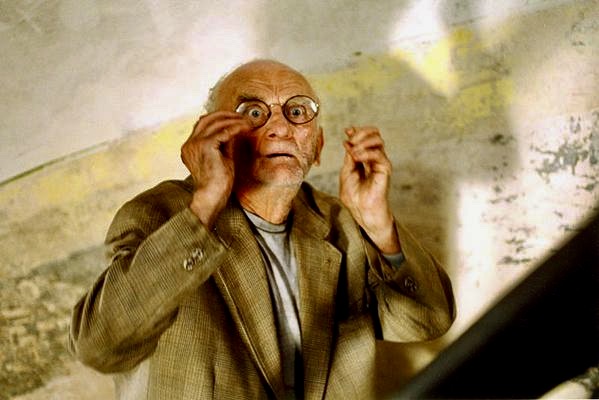
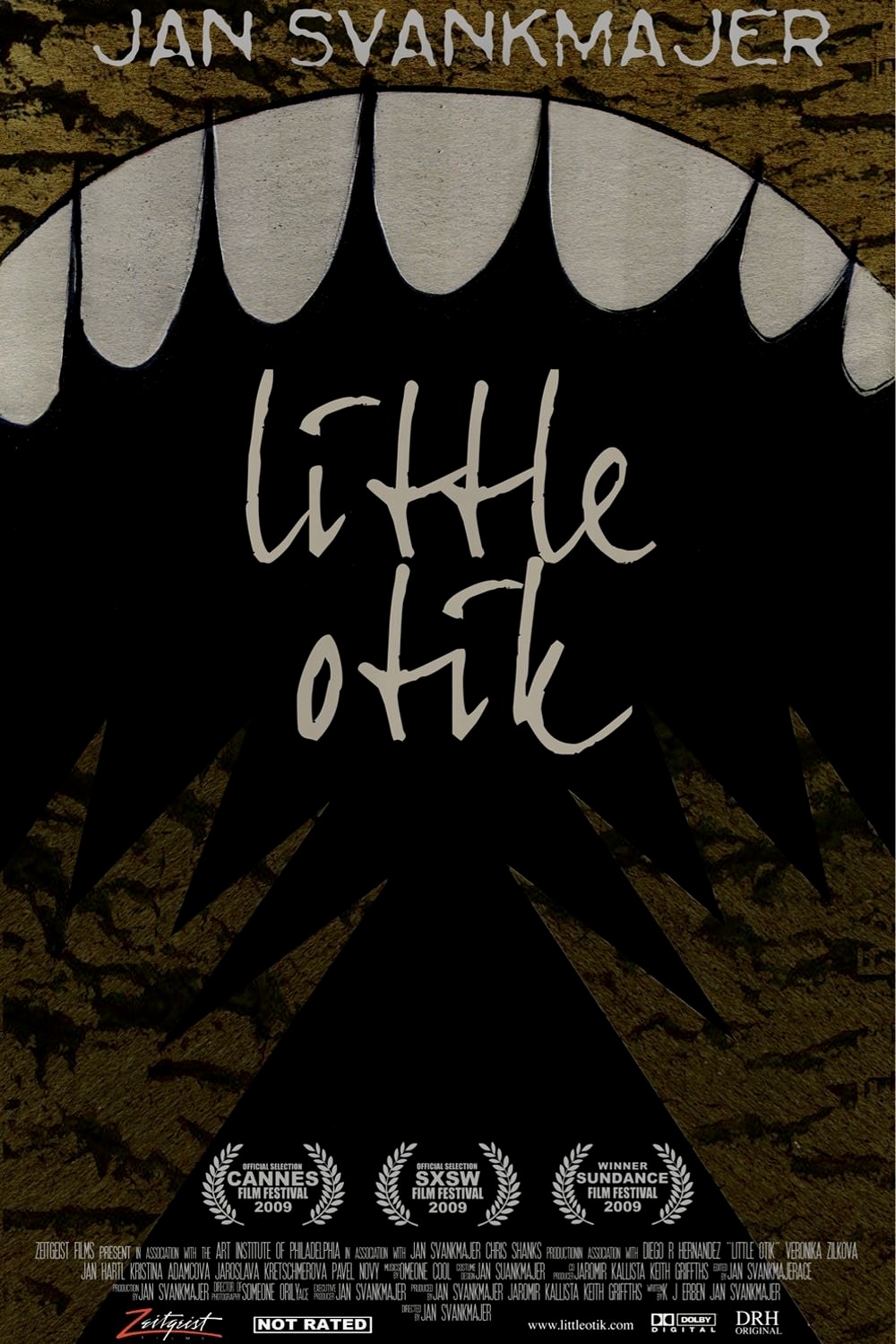
Little Otik was originally released in the U.S. on VHS and DVD by Zeitgeist Films and included the film short The Flat. It is now out of print although you might be able to still find a DVD from online sellers at ridiculously inflated prices. It is probably better to wait until the film is remastered and released on Blu-ray by some enterprising distributor like Deaf Crocodile Films.
Other links of interest:
https://www.kinoeye.org/~kinoeyeo/02/01/hames01.php
https://www.kinoeye.org/02/01/svankmajer01.php
https://www.slantmagazine.com/film/little-otik/
 Cinema Sojourns