

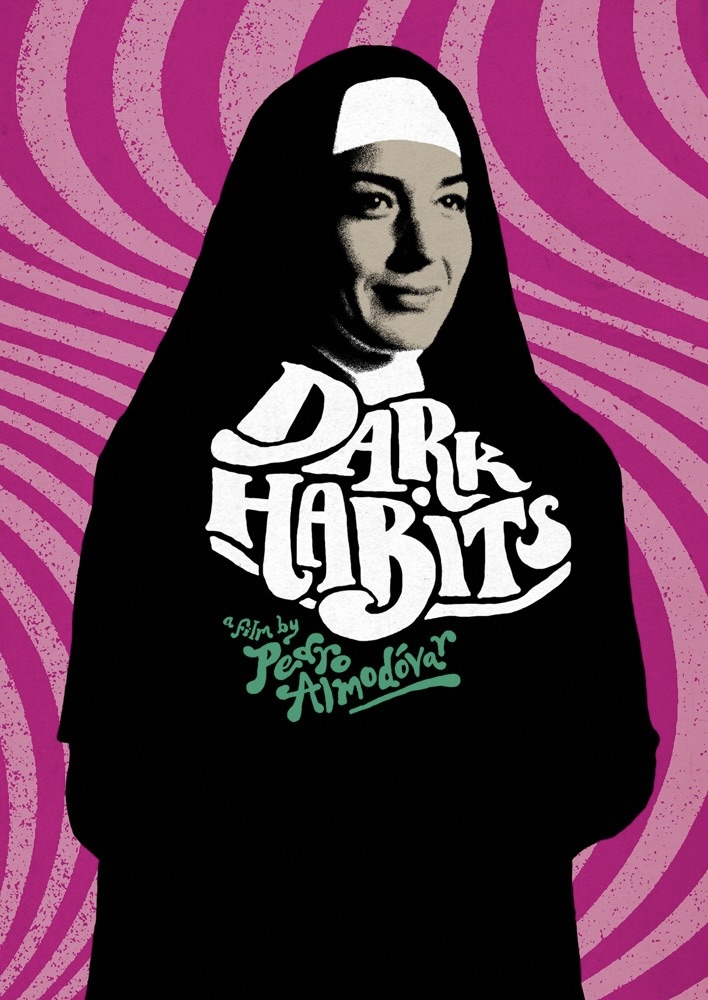
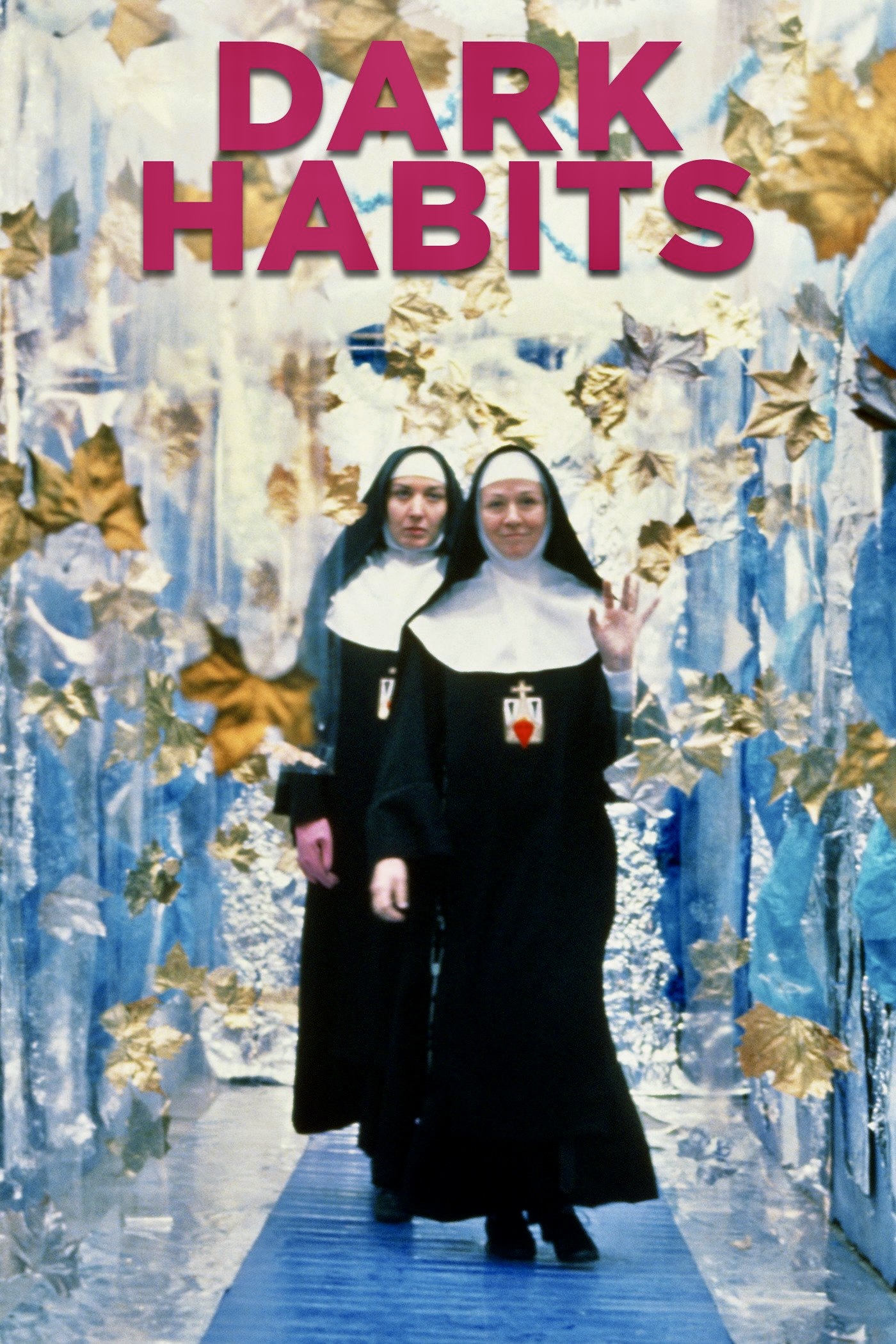
Do you have a favorite nun movie? It seems that the most popular and commercially successful of the lot are either serious dramas like The Nun’s Story (1959) or comedy/musicals such as The Sound of Music (1965) and Sister Act (1992). There is also the more polarizing subgenre known as nunsploitation which caters to grindhouse audiences with abundant scenes of sex and violence (Jess Franco’s Love Letters of a Portuguese Nun [1977], Killer Nun [1079]) but can also embrace art house fare like Ken Russell’s The Devils (1971) and Walerian Borowczyk’s Behind Convent Walls (1978). Entre Tinieblas (English title: Dark Habits, 1983), directed by Pedro Almodovar, doesn’t fit easily into any of the above categories but, like any nunsploitation flick, it is likely to offend conservative and religious viewers. Still, Almodovar’s film is much closer to a Hollywood soap opera crossed with screwball comedy but its subversive and controversial nature isn’t the result of explicit sex or violence but its wicked satire of Catholicism and those who practice it. In this case, it’s a quintet of nuns who call themselves the Community of Humble Redeemers.
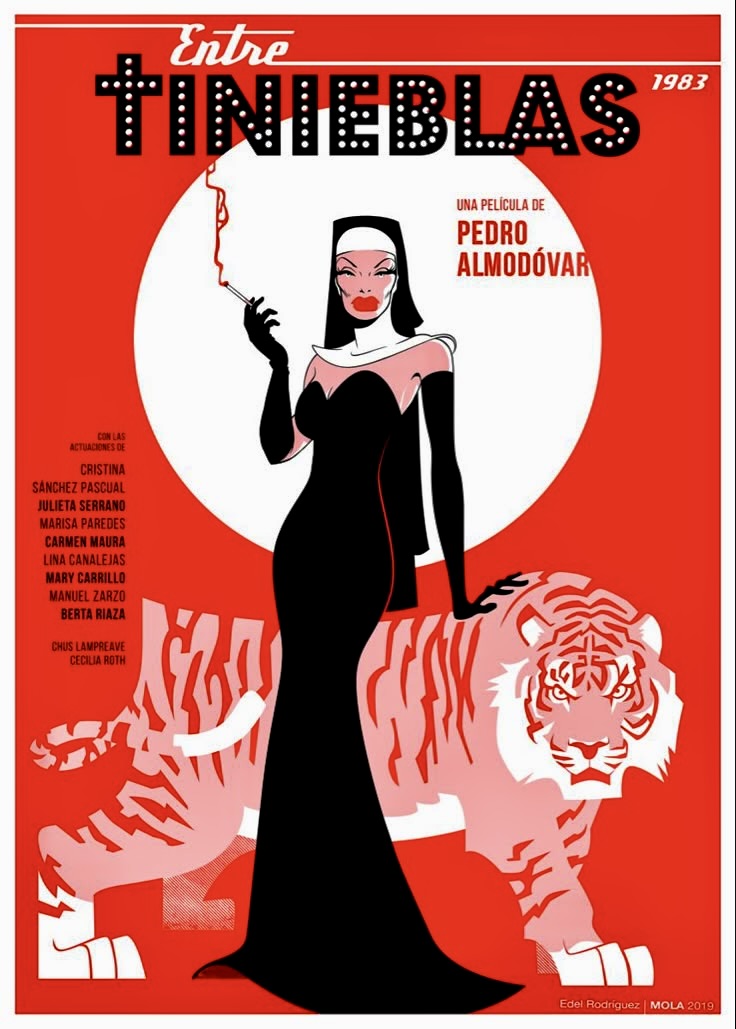
This is no traditional convent and the nuns practice their own quirky and highly personal interpretation of Catholicism under the guidance of Mother Superior (Julieta Serrano). The order is currently experiencing a financial crisis and may lose its crumbling house of worship unless a wealthy sponsor can be secured. Arriving in the midst of such upheaval is Yolanda (Cristina Sanchez Pascual), a nightclub singer and heroin addict, who seeks refuge after her young, deadbeat boyfriend overdoses and dies in her apartment.
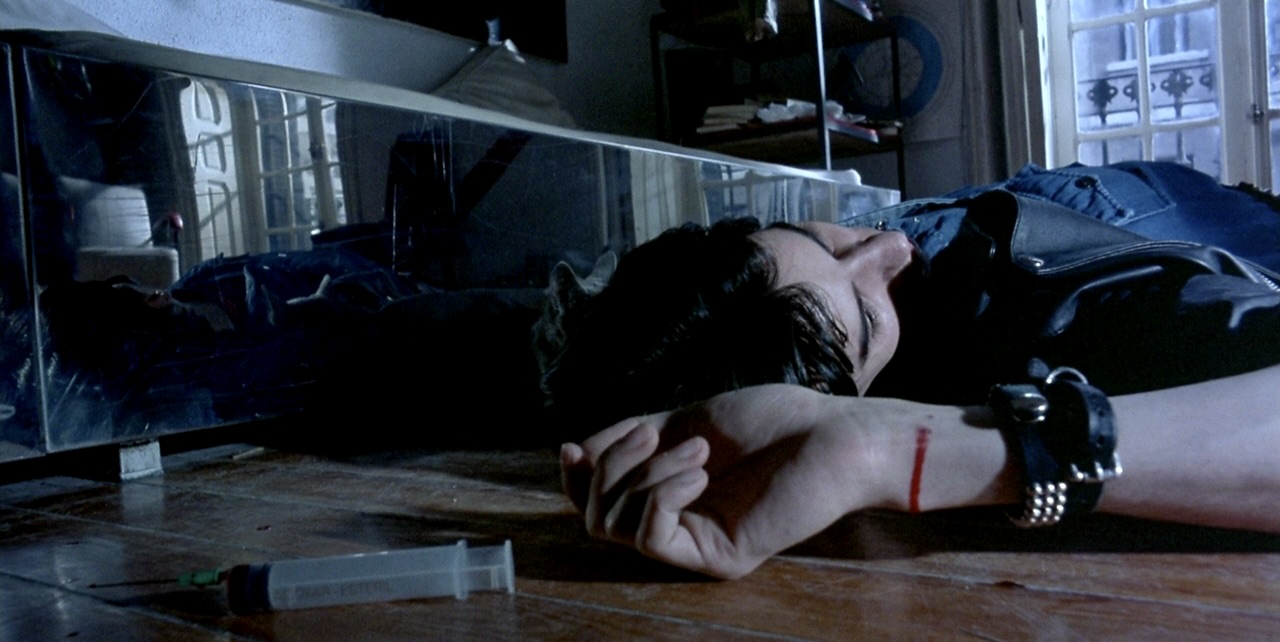
Yolanda desperately needs a place to hide from both the cops and drug dealers trying to collect the money she owes them but she has mixed feelings about her new situation. The nuns, on the other day, are delighted to have a new houseguest, especially one who is a local celebrity. Mother Superior, in fact, is a fan of Yolanda’s nightclub act but her generous offer of free room and board has ulterior motives. It turns out that the abbess is a repressed lesbian who has a history of taking in fallen women. She also has her share of secret vices which includes snorting heroin and cocaine and resorting to blackmail in order to raise the funds she needs to save her convent.
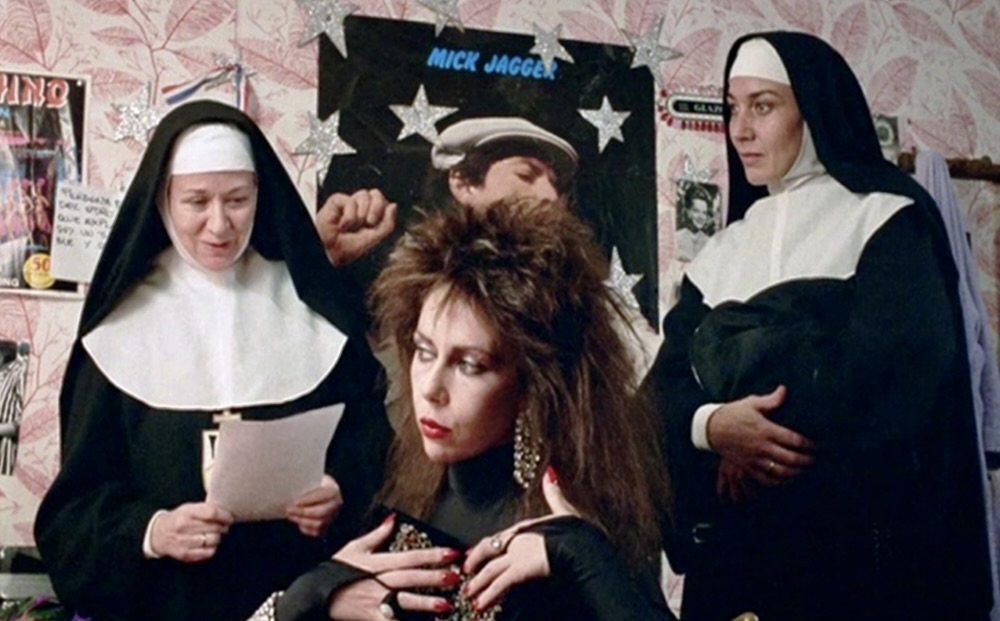
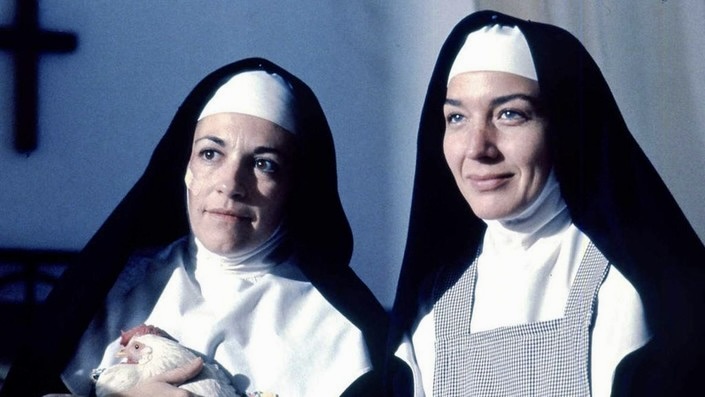
The other nuns are no less peculiar and their eccentricity is obvious from their unique nicknames, which are meant to keep them humble and from becoming overly pious. Sister Manure (Marisa Paredes) is a former murderess who enjoys taking LSD while she does the cooking. Sister Rat (Chus Lampreave) has a secret life as the author of such best-selling erotic novels as “The Call of the Flesh” and “Lost in the Big City,” all published under the pen name of Cocha Torres. Sister Damned (Carmen Maura) has a Joan Crawford-like cleaning obsession and keeps a pet tiger in the garden which occasionally mauls her (hence the scar on her cheek). And Sister Snake (Lina Canalejas) devotes her energies to designing elaborate robes for every holiday occasion alongside her secret admirer/sewing partner, the mission’s chaplain (Manuel Zarzo).
Admittedly the central premise of Dark Habits is a one-joke idea but Almodovar keeps the proceedings lively and freewheeling through an accomplished ensemble of actresses who are armed with some hilarious dialogue and wacko set pieces like a celebration party for Mother Superior where the nuns provide musical backup with Sister Damned on the bongo drums. What is particularly impressive is how the director takes these one-dimensional cartoon characters and has them evolve over the course of the film, eventually emerging as likable, empathic individuals who go their own way in the end. We want to know about them and where they will end up (This would make a fun TV series). And despite the fact that most of Dark Habits unfolds as a satire, the fadeout is both bittersweet and melancholy, especially in regards to the fate of Mother Superior.
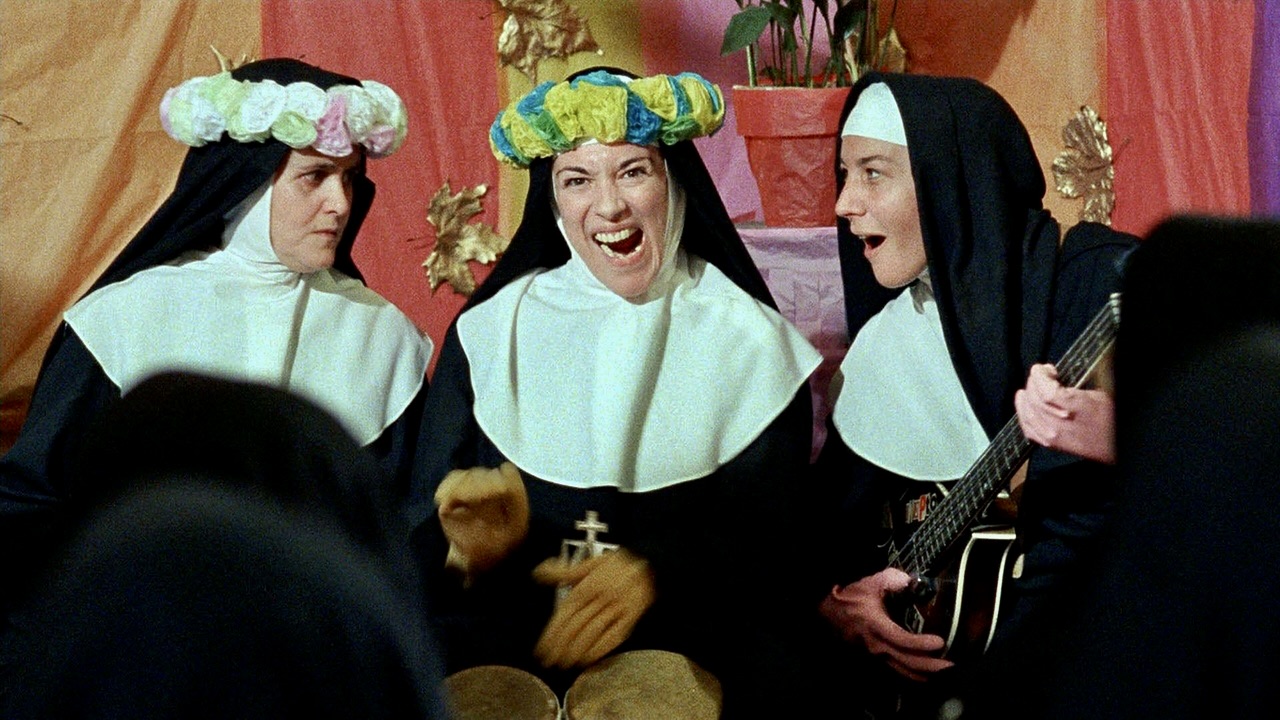
Dark Habits is the third theatrical feature for writer-director Pedro Almodovar (His first film, Folle…Folle…Folleme Tim! (1978), which was shot on super-8, doesn’t really count and is more of a glorified home movie). All of the familiar Almodovar tropes are already on display here – an irreverent, sacrilegious sense of humor, bold colors, unusual camera angles, a fondness for kitsch and high camp, a preoccupation with sex, gender and role-playing and a tendency to focus on women’s issues and female heroines.
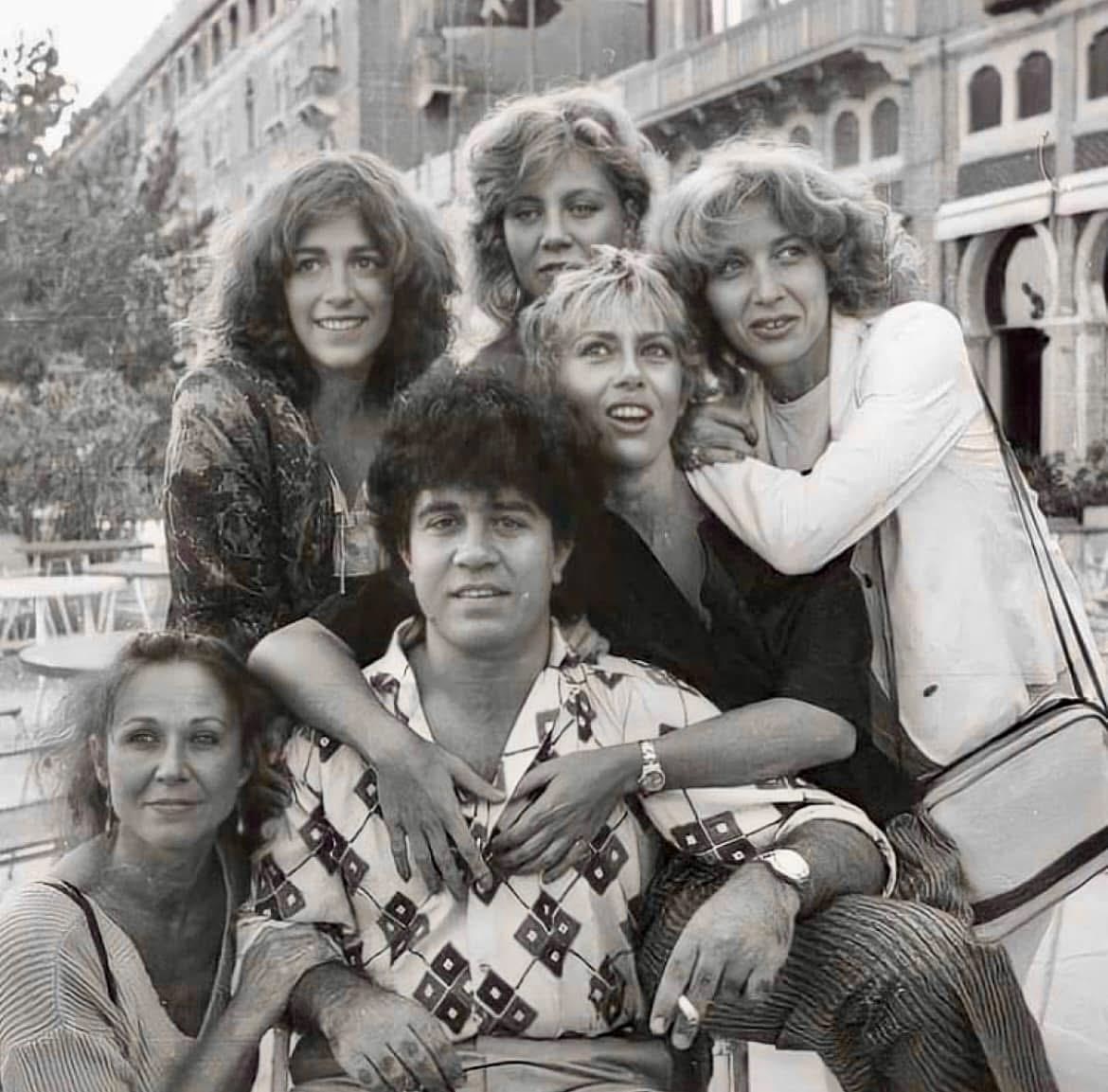
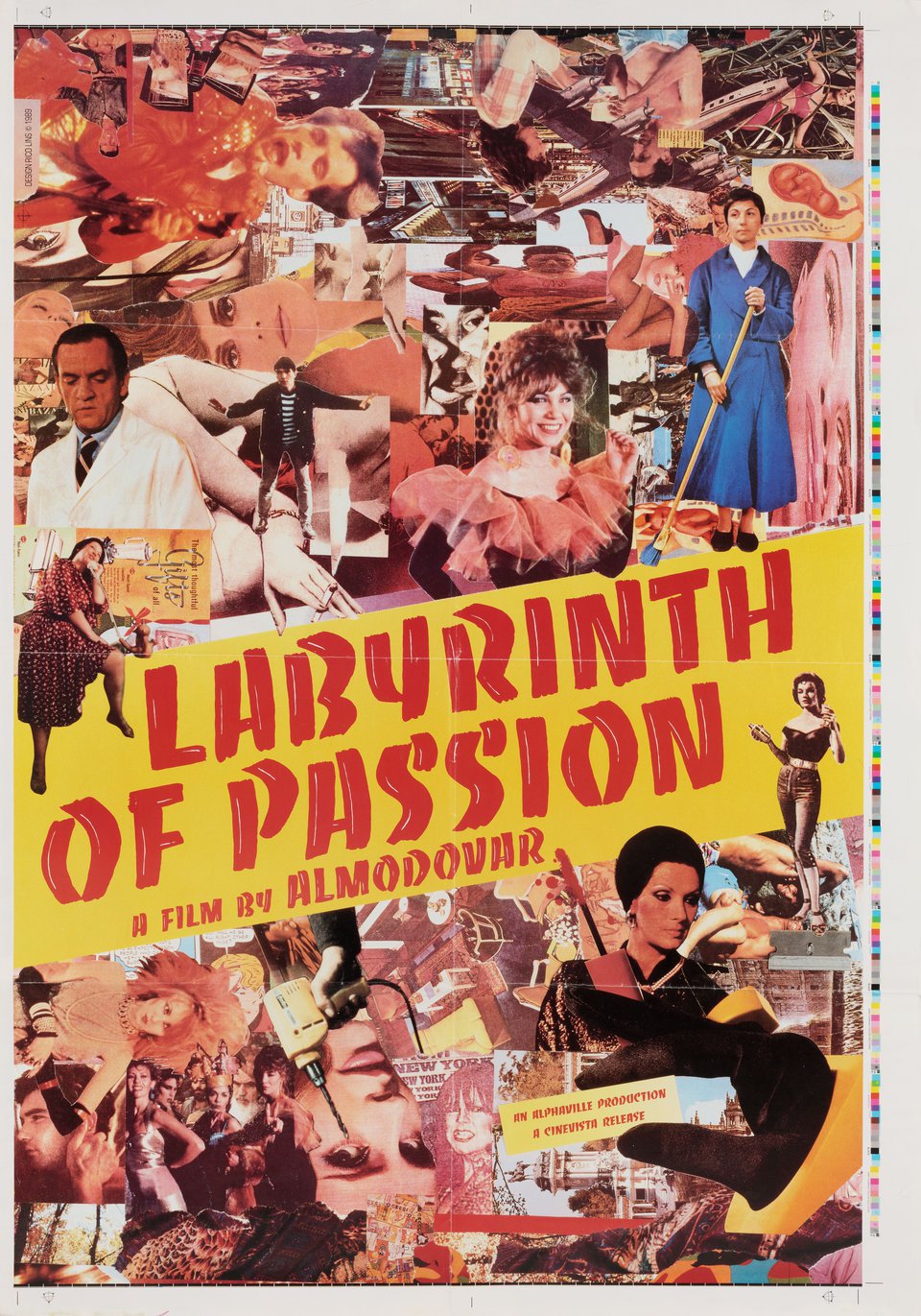
The director’s first two official features, Pepi, Luci, Bom and Other Girls Like Mom (1980) and Labyrinth of Passion (1982), are actually closer in spirit and tone to the early films of John Waters with their low production values and abundant scatological humor which also wasn’t afraid to make fun of drug use, rape, prostitution or religion. Dark Habits seems more sophisticated and self-assured in comparison and it was the first Almodovar film to receive a legitimate theatrical release and international distribution.
The project was actually instigated by Herve Hachuel, a wealthy producer who wanted to get into the film business so he could make movies featuring his girlfriend, actress Cristina Sanchez Pascual. Almodovar was charged with building a story around the actress but his original concept was quite different from the finished film. In an interview, he said, “I came up with the story of a girl who drives both men and women wild, a girl who sings, drinks, takes drugs, occasionally goes through periods of abstinence and has the extraordinary experiences one would never have, were one to live a hundred years… while writing I had in mind Marlene Dietrich’s work with Josef von Sternberg, especially Blonde Venus (1932), where she plays a house wife who becomes a singer, spy and prostitute, who travels the world living a life of never ending adventure.”
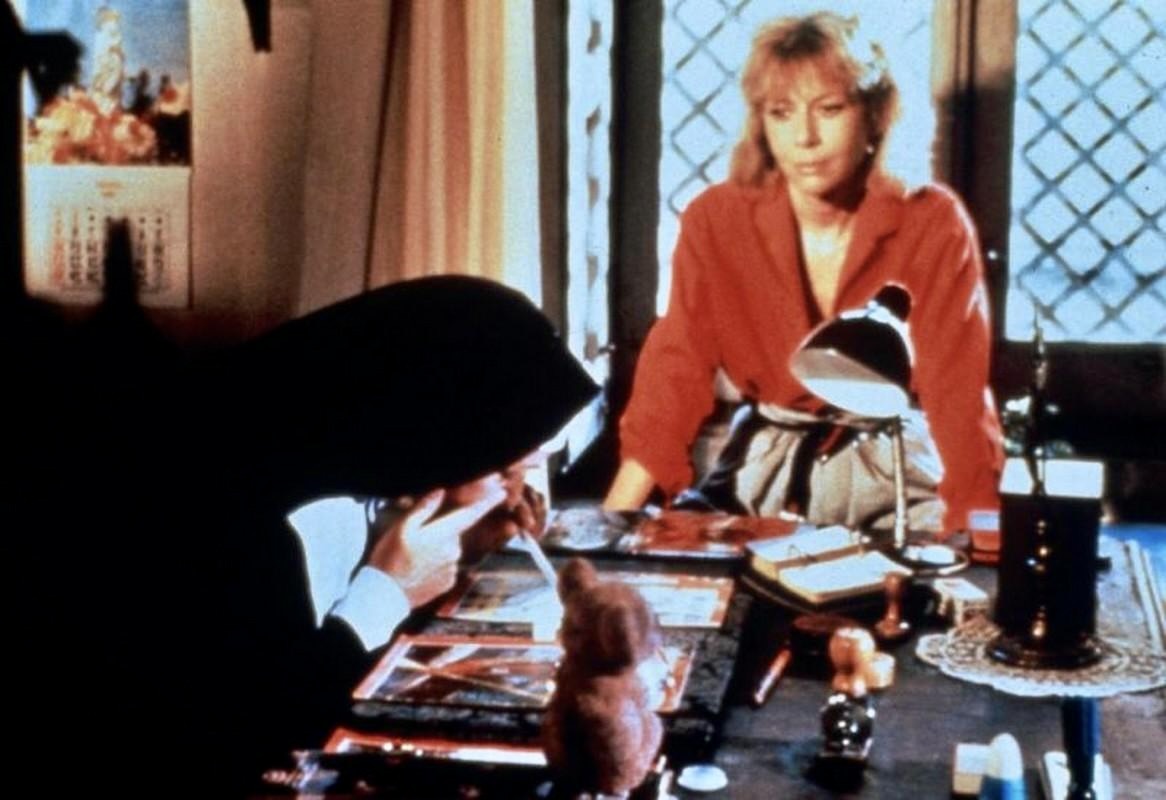
Dark Habits ends up being as much about Yolanda as it is about Mother Superior and her desperate attempts to keep the abbey from being shut down. Ms. Pascual is fine as the self-centered, opportunistic nightclub singer but a stronger actress could have made her character more sympathetic and complicated. Still, this is a minor quibble since the other performances are delightfully kooky but performed in a deadpan comic style which is the ideal way to handle such outrageous material. Even the minor supporting roles are distinctive such as Manuel Zarzo as a priest with a passion for sewing as well as an obsession with Cecil Beaton’s costumes for the film version of My Fair Lady (1964).
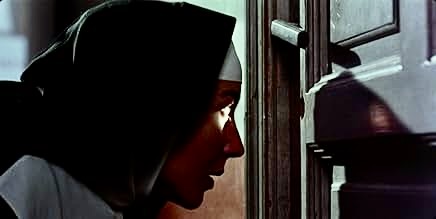
Some sources have stated that Dark Habits was Almodovar’s reaction to such classic religious dramas from the Franco era (1939-1975) as La Hermana San Sulpicio (1952) and The Miracle of Marcelino (1955), both sentimental crowd pleasers for Spanish moviegoers. Also, the music performed in Dark Habits celebrates the tradition of the bolero, a highly emotional approach to ballads as represented here by J. Curiel Alonso’s “Sali Porque Sali,” Louis Gaste’s “Pour Toi (Feelings),” and Carlos Arturo Bris’s “Encadenados (Chained Together).”
Most of the actresses in Dark Habits would enjoy numerous collaborations with Almodovar but this proved to be the last film Cristina Sanchez Pascual made for the director (she had previously appeared in his first two features). Carmen Maura and Chus Lampreave would end up working for Almodovar eight times each. And so would Cecilia Roth, who appears here briefly as Mercedes, a former lover of Mother Superior, who tries to reclaim her old room at the convent.
When Dark Habits went into release in Spain the critics were decidedly mixed. Younger, more progressive film reviewers celebrated Almodovar as the voice of a new Spain, freed from the censorship of the Franco era, but more conservative writers were offended by the film’s blasphemous, anti-Catholic satire. Outside of Spain, the film was much more favorably received. Michael Wilmington of The Los Angeles Times stated, “What gives [Dark Habits] its real intensity is Serrano’s performance. Her character is so twisted and tormented–and the actress plays it with such a seraphic face and such incongruous serenity–that she supplies the comic-melodramatic battle between flesh and soul almost single-handed.”
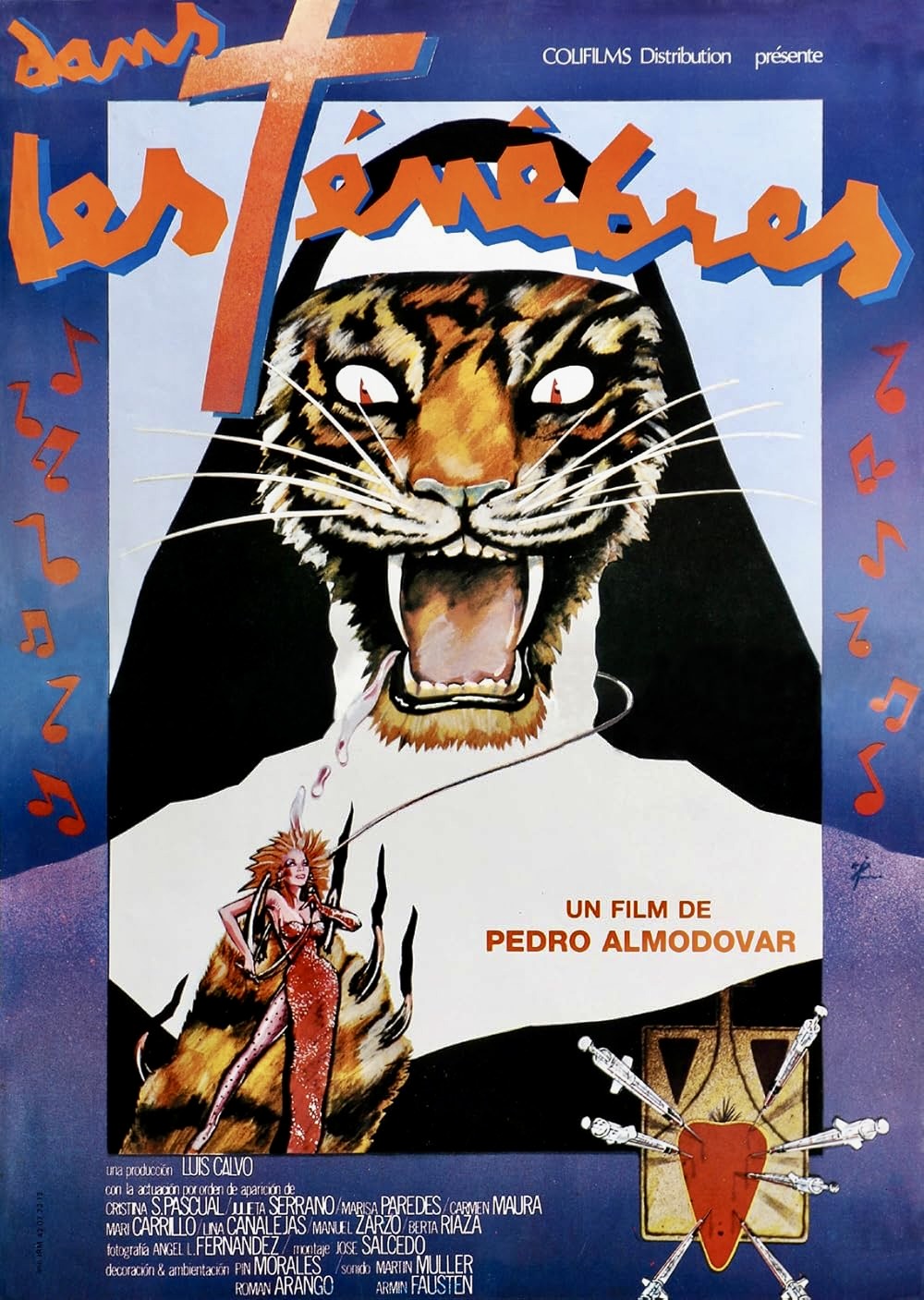
Ursula Munoz S. of Bright Wall/Dark Room wrote, “The nunsploitation genre was one that the openly gay and atheist [Almodovar] was destined to adopt at least once, and he did so through a surprisingly mature melodrama that pays tribute to the form in more ways than one… Dark Habits remains a jewel in its singular filmmaker’s body of work—one that tends to go unrecognized only because of the volume of hits it’s buried amongst.” And Suzi Feay of TimeOut noted: Almodóvar’s third feature is slapdash, occasionally slow-moving, haphazardly plotted. That it’s also wildly funny, bitchy, affecting and surreal is a tribute to his perennial warmth and wit….The whole thing winds up with the inevitable scandal and is almost completely silly; but as ever, Almodóvar’s adoration of his female stars is heart-warming, and his visual style a delight.”
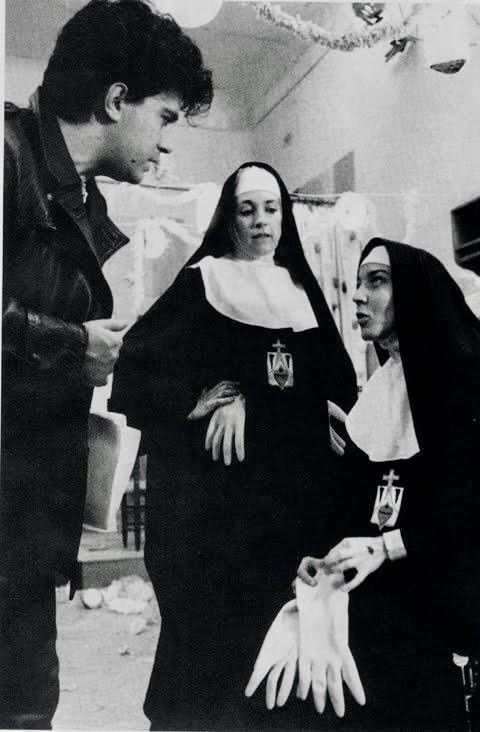
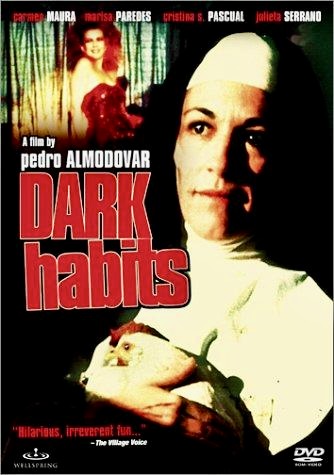
Dark Habits was the first of Almodovar’s films to receive a home video release in the U.S. and Wellspring released it on DVD in 2003. Considering Almodovar’s popularity, you’d think some distributor would have upgraded and remastered the film on Blu-ray or 4K but the Wellspring release is still the only option and the disc quality is mediocre at best.
Other links of interest:
http://shadows.wall.net/features/volver1.htm
https://www.theguardian.com/film/2016/aug/07/pedro-almodovar-observer-interview
 Cinema Sojourns