
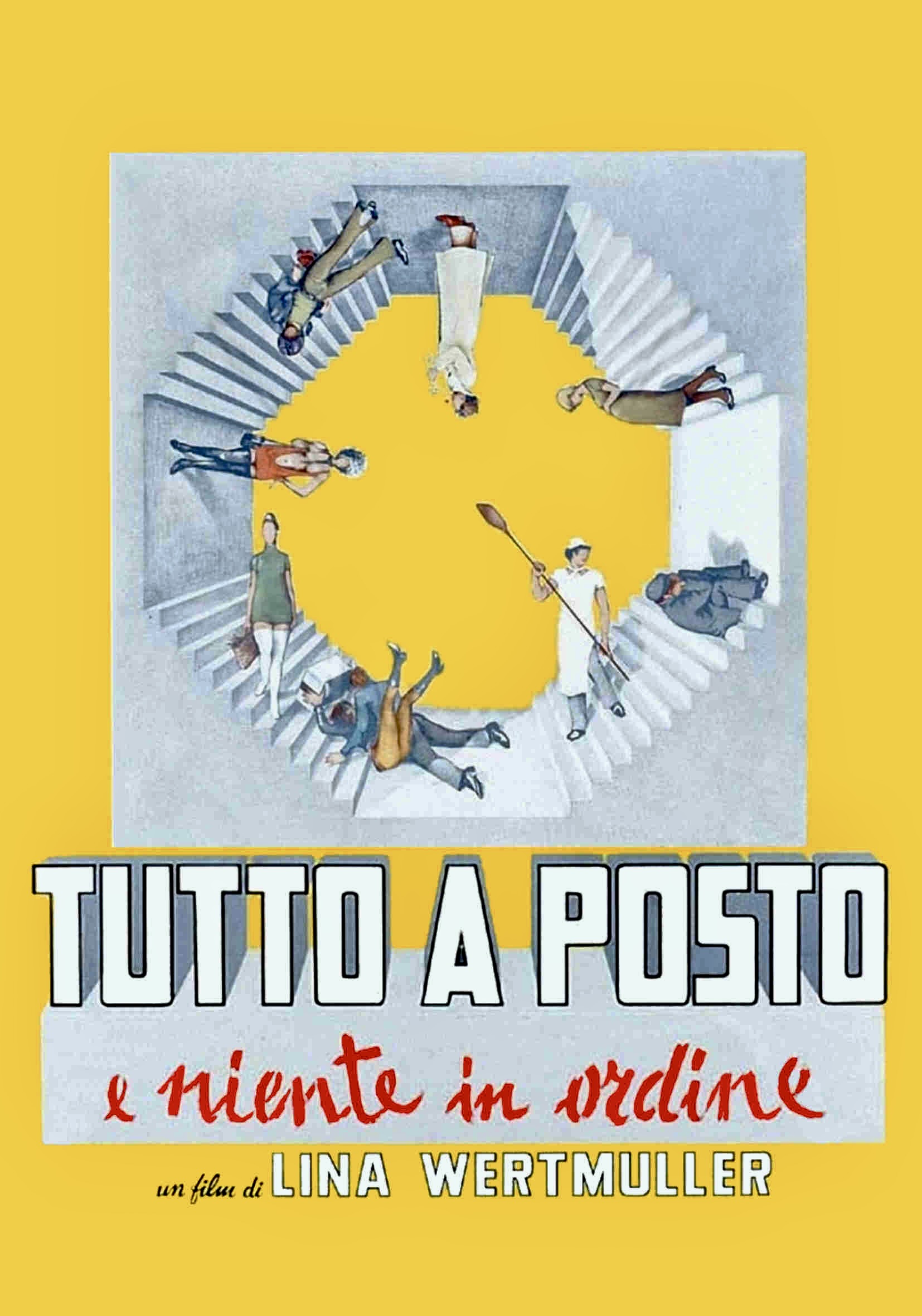
Gigi and Carletto are two naïve country bumpkins who, like many others from rural Italy and southern regions like Sicily, have come to the northern city of Milan to seek their fortunes. They soon fall in with other recent arrivals to the city seeking work and eventually set up a communal living situation in an abandoned apartment with others. Both men have big dreams and expectations but the reality is quite different from what they imagined and they fall prey to the city’s corrupting influences. It is a familiar scenario that you have probably seen in numerous other movies but director Lina Wertmuller gives it her own unique spin in Tutto a posto e niente in ordine (English title: All Screwed Up, 1974), an exuberant, gleefully crude satire that uses broad comedy and eccentric characters to magnify the myriad problems of Italy during the early 70s. This is her idiosyncratic contribution to Commedia all’italiana, a genre of comedic social commentary first created by Mario Monicelli and Pietro Germi in the late fifties/early sixties with such films as Big Deal on Madonna Street (1958) and Divorce Italian Style (1961), satires where serious themes like poverty, unemployment, marital woes and economic hardships are treated in a lighthearted style.
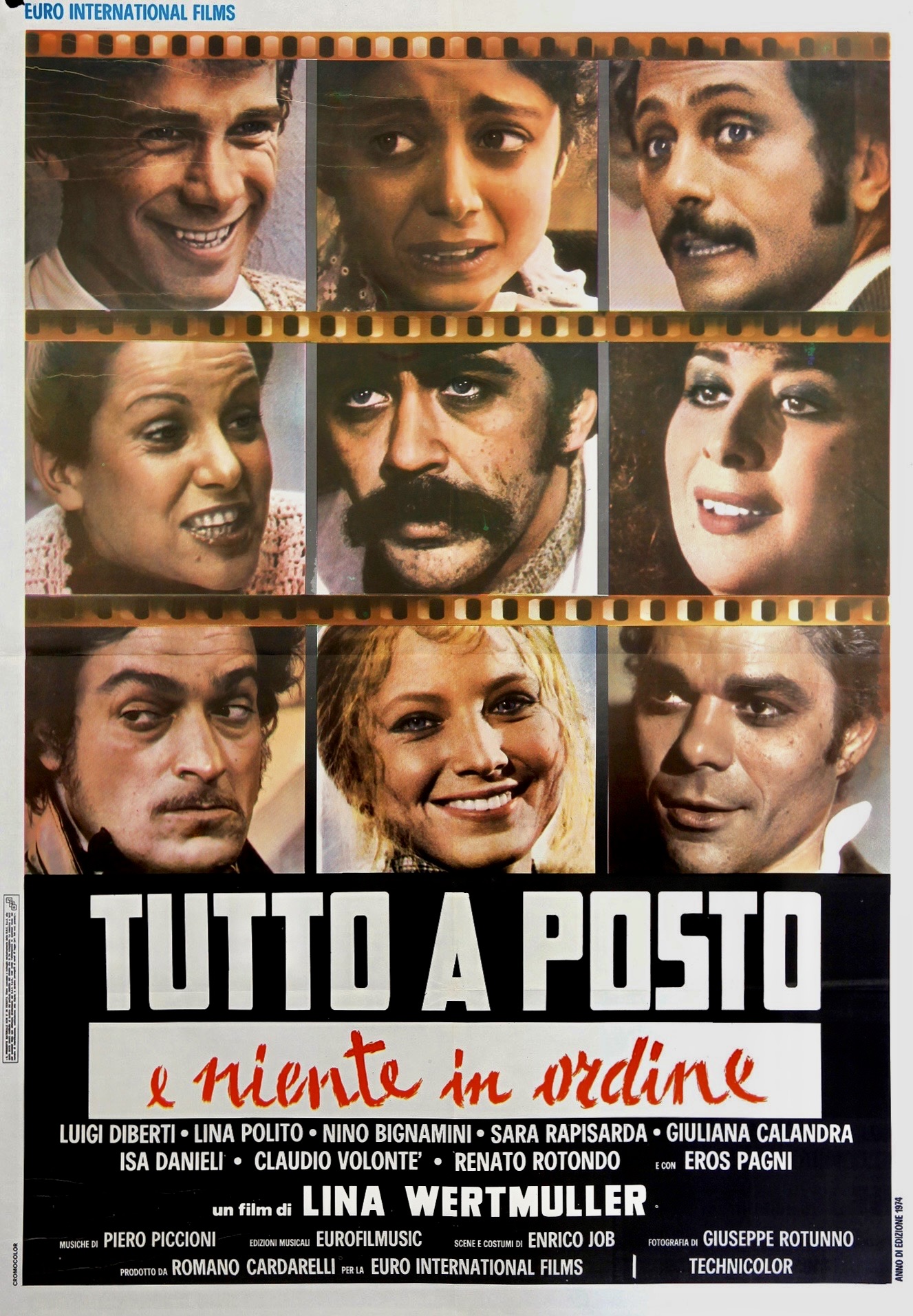
All Screwed Up was made after Wertmuller had already achieved international acclaim for The Seduction of Mimi (1972) and Love and Anarchy (1973) – both were nominated for the Palm d’Or at the Cannes film festival – but this movie is often forgotten amid her other work. That is because the two films that followed – Swept Away (1974) and Seven Beauties (1975) – completely overshadowed it and are often considered her peak achievements as well as her biggest box office successes. The latter film also garnered the director two Oscar nominations – one for Best Director (she was the first woman director ever nominated by the Academy) and Best Original Screenplay. Yet All Screwed Up is a master class in Wertmuller’s approach to cinema, highlighting her virtues as well as her weaknesses. In this case, she juggles a large cast of characters which she utilizes to take potshots at everything from exploitative working conditions to prostitution to abortion and often the effect is polarizing and confrontational. As a self-proclaimed socialist with a fondness for anarchy, Wertmuller’s take-no-prisoners approach isn’t afraid to offend feminists, male chauvinists, capitalists, Catholics, married couples, radicals…you name it. And underneath the farcical madcap approach is a sense of despair and disillusionment at the state of things. No solutions are offered but there is plenty of food for thought.

Another reason All Screwed Up is less well remembered than Wertmuller’s other films of the seventies is due to the relatively unknown cast (some of the players were familiar to Italian viewers but not outside the country). Giancarlo Giannini and Mariangela Melato became international stars after co-starring in Love and Anarchy and Swept Away but no one emerges from the ensemble cast of All Screwed Up to truly stand out. It also doesn’t help that most of the actors are playing exaggerated variations on familiar Italian stereotypes. Both Gigi and Carletto are energetic but clueless bumpkins who never learn from their mistakes and continue to exercise bad judgment in their decision making. Gigi, played by Luigi Diberti, is a perpetually horny bozo on the make who ends up getting involved with a criminal gang that burglarize the homes of the rich.
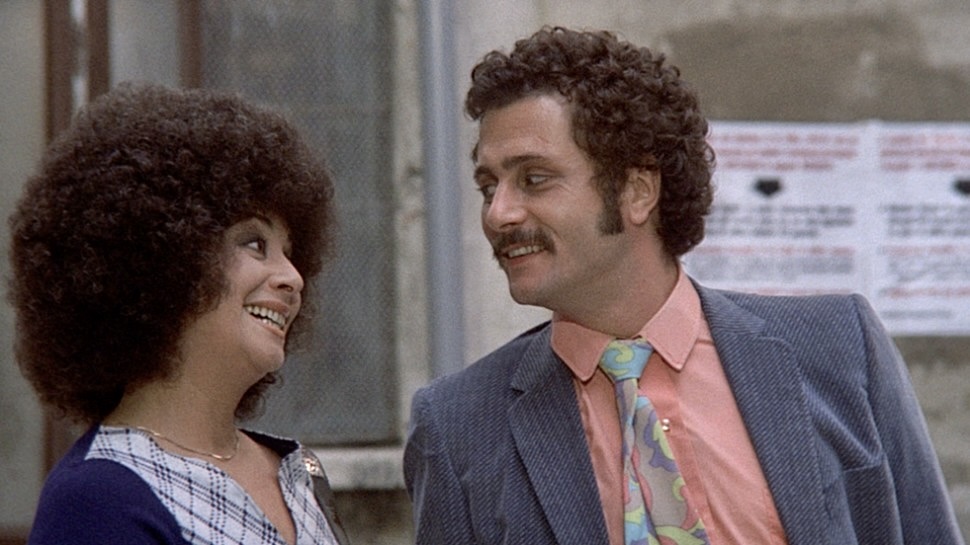
Carletto (Nino Bignamini) is also a would-be Lothario who falls for the virginal Adelina (Sara Rapisarda), a migrant from Sicily who lives in his commune. Like Gigio, Carletto has trouble holding a job, either from incompetence or disinterest, and he goes from slaughterhouse employee to market vendor to icehouse worker before winding up in the kitchen of a chaotic pizzeria. His frustration at being denied sex by his fiancé is resolved by some sage advice from fellow commune member Sante, who advises him to take her by force. “The impure act will fix everything,” he says and, after Carletto rapes Adelina, she appears to like it and melt in his arms. If that isn’t offensive enough, Bignamini makes Carletto even more unappealing with a face that resembles a leering ventriloquist’s dummy.

The other major male character, Sante (played by Renato Rotando, a poor man’s version of Giancarlo Giannini), is the most pitiful of them all. He works himself to exhaustion with numerous jobs just to support his wife and many children and yet refuses to use any kind of birth control. When his financial burden becomes too great, he tries to hire himself out as a male escort (a complete failure) and later accepts money from a group of terrorists who frame him for a fatal bombing.

The women in All Screwed Up don’t come off any more sympathetic or likable than their male counterparts. Biki (Giuliana Calandra) is a money-grubbing capitalist who runs the commune like a profit-making enterprise, charging the others (especially the men) for any amenities like coffee, soap, laundry needs. Adelina sees Biki as a role model and decides to avoid getting engaged to Carletto because “marriage is anti-economical.” Her refusal to have sex with him while expecting him to honor her virtue and abstain from relations with other women is not only depicted as a swipe at her Catholic faith but also justification for Carletto’s inevitable sexual assault
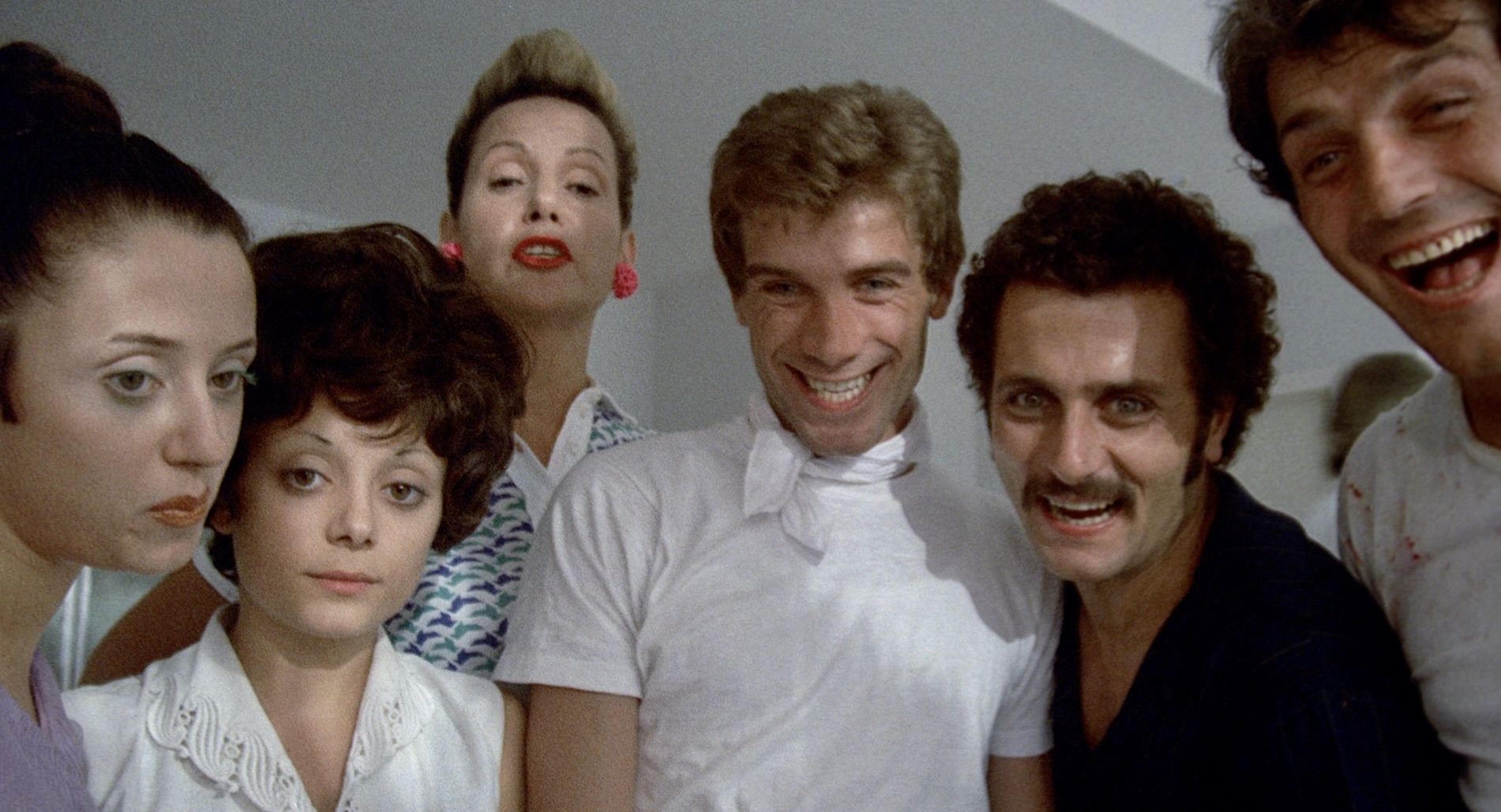
Isotta (Isa Danieli), another boarder, is also fixated on money and works as a prostitute but keeps it a secret from her family. There is also Mariuccia (Lina Polito), a window dresser who gets impregnated by Sante, loses her job and ends up having twins, then gets pregnant again and has quintuplets! Mariuccia’s inclusion in the storyline was probably Wertmuller’s excuse to address another social issue which figures prominently in a grim abortion clinic scene.
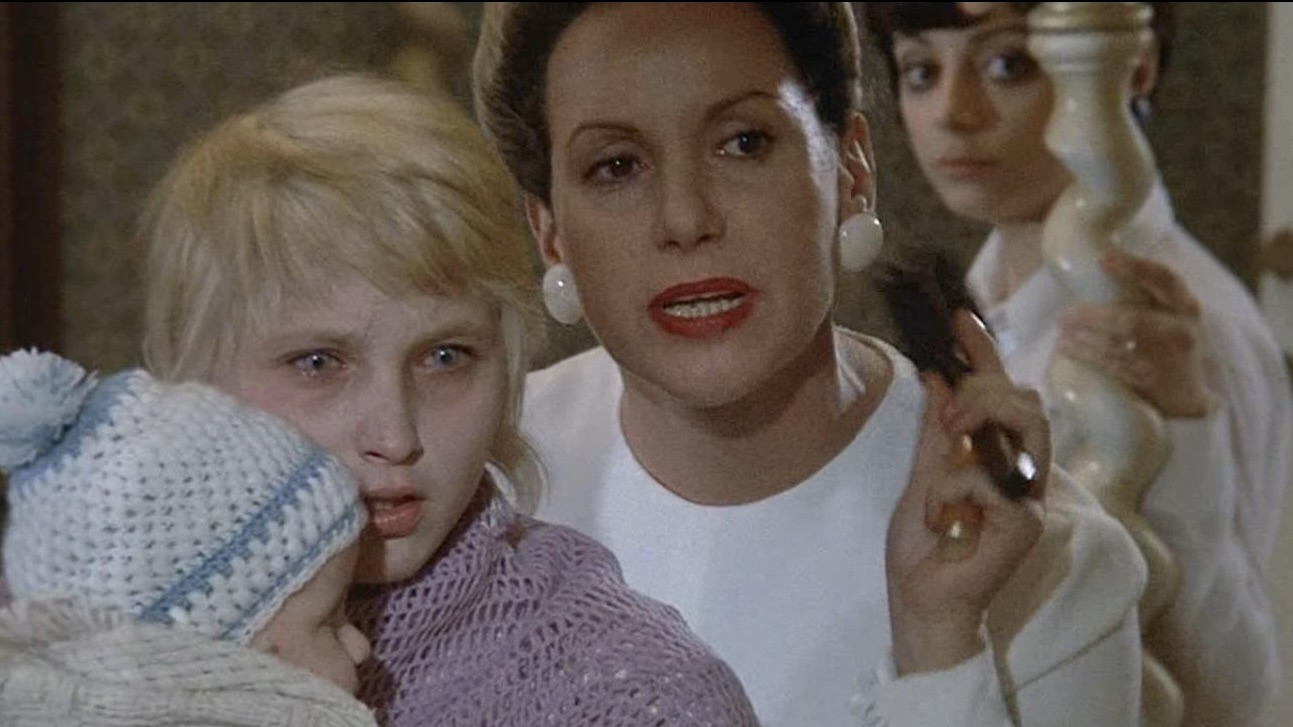
After recounting some of the film’s plots twists, you’re probably thinking, “This is supposed to be a satire?” Despite such hot button topics as male/female relationships, terrorism, urban renewal and homelessness, All Screwed Up is directed like a breakneck screwball comedy with moments of grotesque stylization. An early sequence in a slaughterhouse is designed to look like an elaborate choreographed dance routine – a ballet of meat carcasses. Another episode involves a former criminal taking revenge on a police chef by having his gang cover the man’s car in human feces. Scenes like this are clearly intended to provoke a response but Wertmuller’s intentions aren’t always clear. There are also subplots that don’t lead anywhere but provide insights into certain characters like the glamorous, high society beauty that Carletto sees around the city and stokes his fantasy life (she serves much the same purpose as Suzanne Somers, the mystery blonde who is pursued by Richard Dreyfuss in 1973’s American Graffiti.)

But regardless of whether you like or hate All Screwed Up, it’s never boring as it zips along from one over-the-top escapade to the next. Part of what keeps the viewer engaged is the pulsating, catchy music score by the great Piero Piccioni (Mafioso, Contempt, The Tenth Victim), the often stunning compositions by cinematographer Giuseppe Rotunno (Rocco and His Brothers, Amarcord, All That Jazz) and the frenetic editing of Franco Fraticelli (I Knew Her Well, The Bird with the Crystal Plumage).
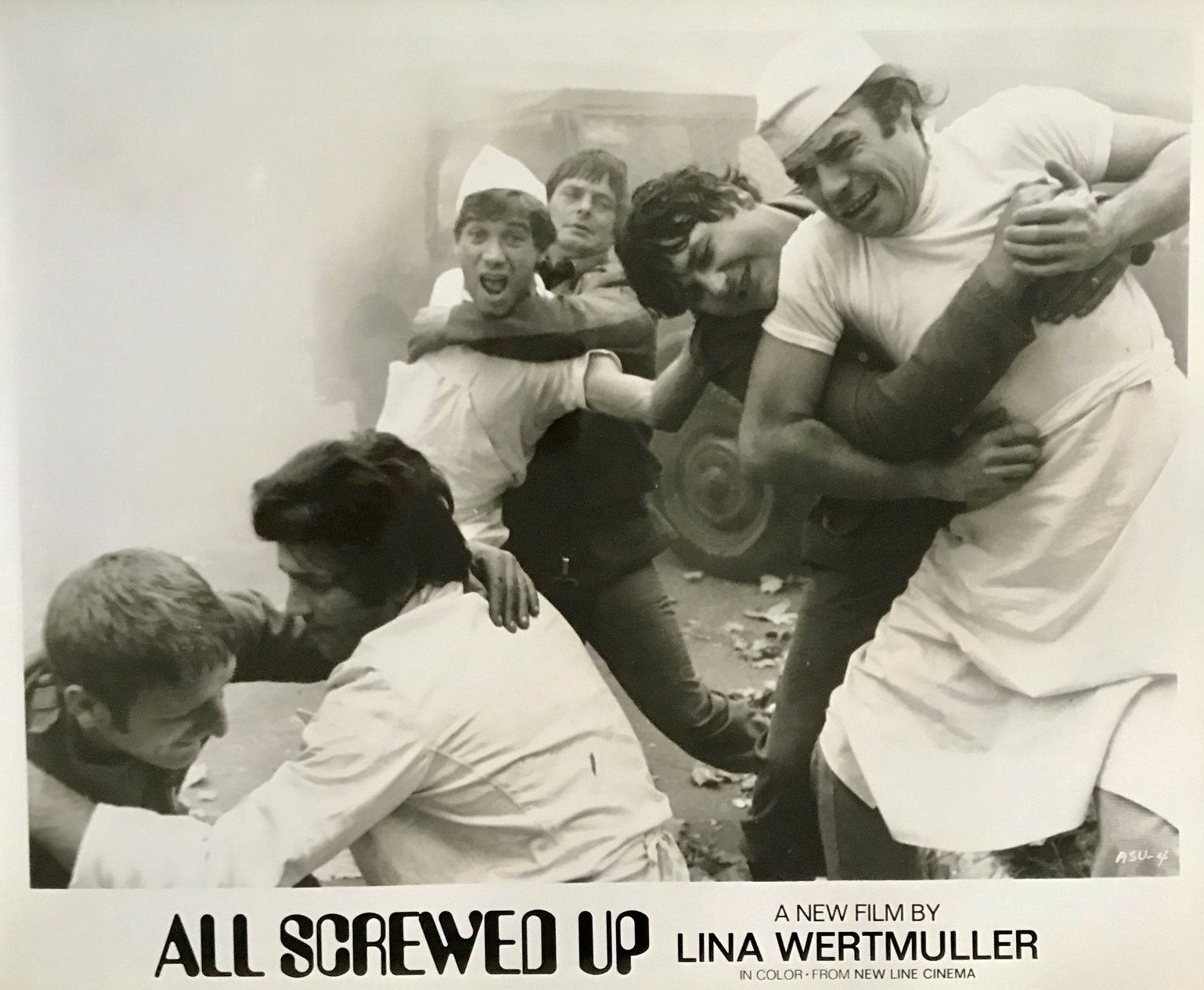
The American film reviews for All Screwed Up were mixed but as this was released during Wertmuller’s most fertile creative period, there were plenty of high profile critics to champion the work. John Simon, probably Wertmuller’s greatest admirer, wrote “Lina Wertmuller is the most important director since Ingmar Bergman” while Vincent Canby of The New York Times called the movie “Breathtaking…exuberantly funny. Watching ‘All Screwed Up’ is to be witness to a giant talent.” Stanley Kaufmann of The New Republic noted, “It’s strident, ecstatic, restless, perceptive, humane, despairing. It takes banal material and sizzles it electrically into new life.” And Rex Reed said it was “a brilliant movie that must be seen several times.”
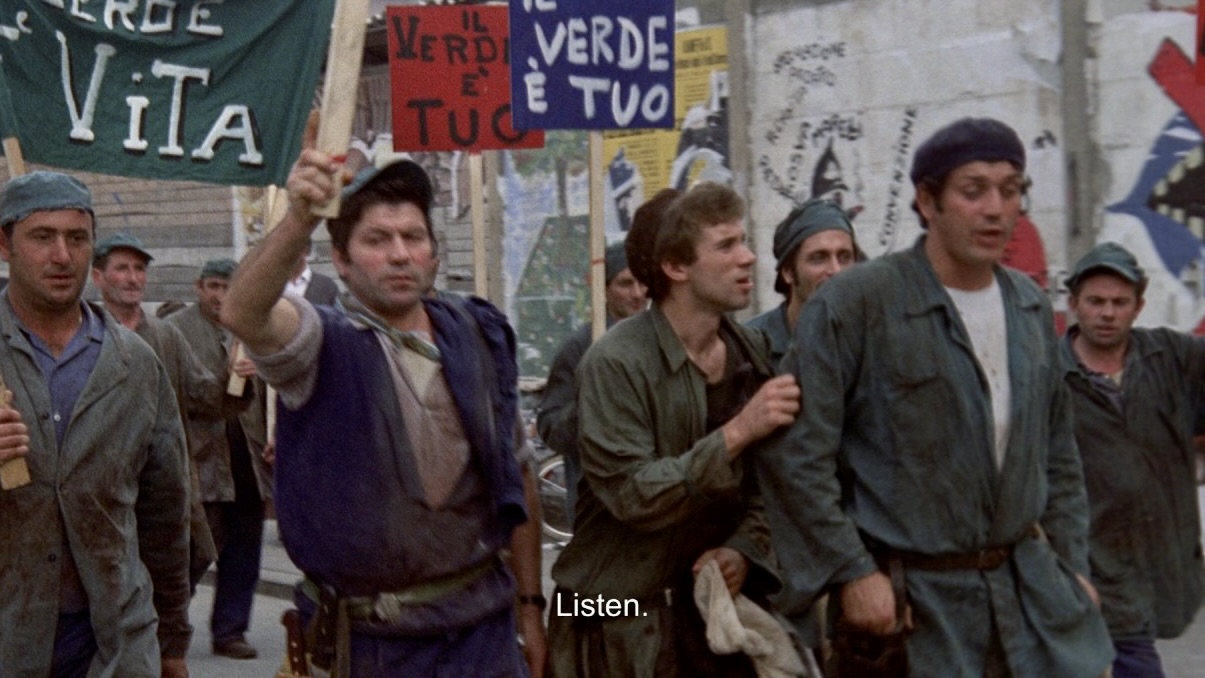
On the negative side were David Rosenbaum of The Boston Phoenix and Pauline Kael of The New Yorker. Rosenbaum wrote, “In All Screwed Up, Wertmuller’s attacks upon the economic, political and social mores of modern, capitalist Milan pale before her relentless assaults upon the audience’s sensibilities. Imagine an Italian Nashville, edited by a sadistic speed freak, and you get something of the flavor of All Screwed Up.”

Kael added that “Wertmuller’s point of view is chaotic. The women workers are shown as tightfisted petit-bourgeois schemers who manipulate and exploit their likable proletarian men, and there’s a ballet in a slaughterhouse, which has comic bravura but is so ambiguous that we seem to be asked to laugh at the dead animals.”
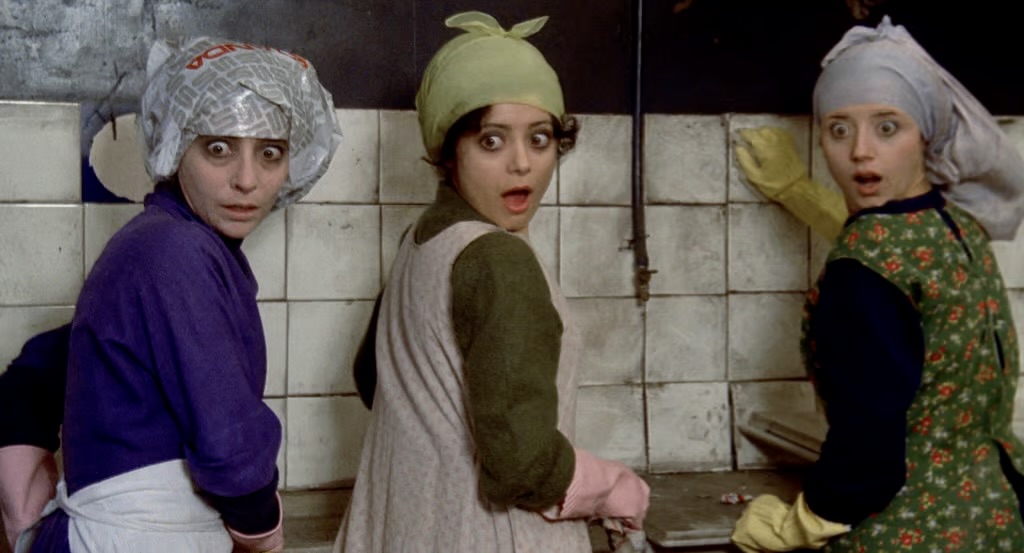
Probably the most damning criticism of the director’s work in general came from Ellen Willis in Rolling Stone who wrote, “Wertmuller’s basic appeal is a clever double-dealing that allows high-minded people to indulge their lowest-minded prejudices. She is…a woman hater who pretends to be a feminist. She pities the benighted masses and calls it radicalism, evades responsibility for what she says and calls it comedy.”
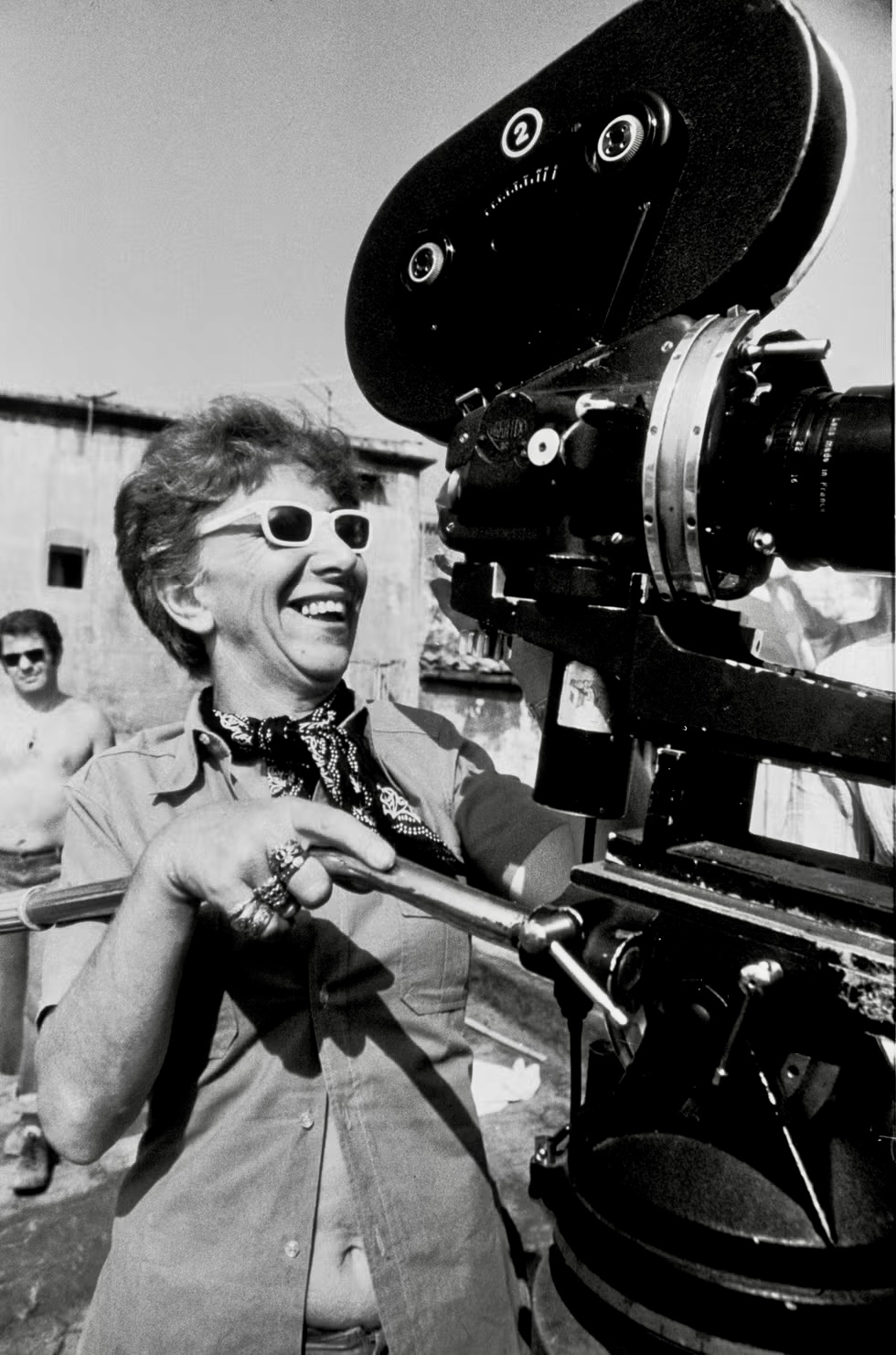
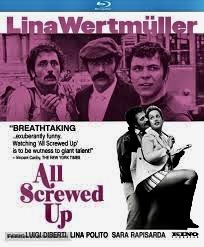
Certainly, Wertmuller’s reputation as a world class film director has been downgraded since her brief reign in the seventies (1972-1975), mostly due to the poor reception of later work such as A Night Full of Rain (1978), Blood Feud (1978) and A Joke of Destiny (1983), but her early work still stands out for its quirky, unorthodox approach to social and political satire and All Screwed Up is a good introduction. You can still purchase the Kino Lorber multidisc version (Blu-ray & DVD) from online sellers (it doesn’t include any extra features).
Other links of interest:
https://italysegreta.com/lina-wertmuller-the-seduction-of-lina/
https://www.interviewmagazine.com/film/lina-wertmuller-creative-chaos
https://www.criterion.com/current/posts/4498-grotesque-poetry-a-conversation-with-lina-wertmuller
 Cinema Sojourns