
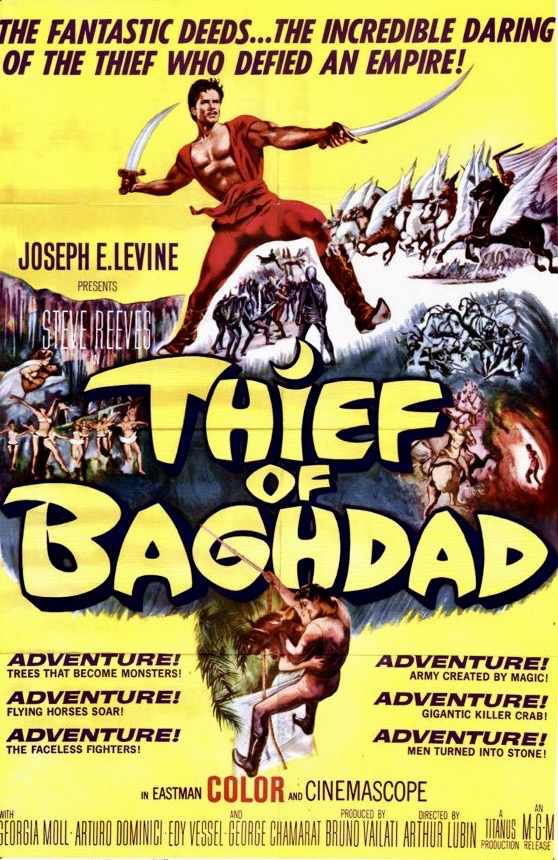
One Thousand and One Nights also known as the Arabian Nights is a collection of stories from the Middle East and India that can be traced back to the 9th century although the author or authors of the tales are anonymous. What is known is that the stories introduced such famous fictional characters as Sinbad, Aladdin, Ali Baba and others, all of whom have inspired numerous film versions of their exploits. One of my favorite Arabian Nights fables is The Thief of Bagdad but the first movie version I encountered was the 1961 Italian fantasy-adventure Il Ladro di Bagdad (released in an English dubbed version as The Thief of Baghdad in the U.S.) starring Steve Reeves. First seen at a kiddie matinee during its original release, it made a strong impression on me as a ten-year-old, even if it is not the best known, most lavish or critically respected of the many film versions.
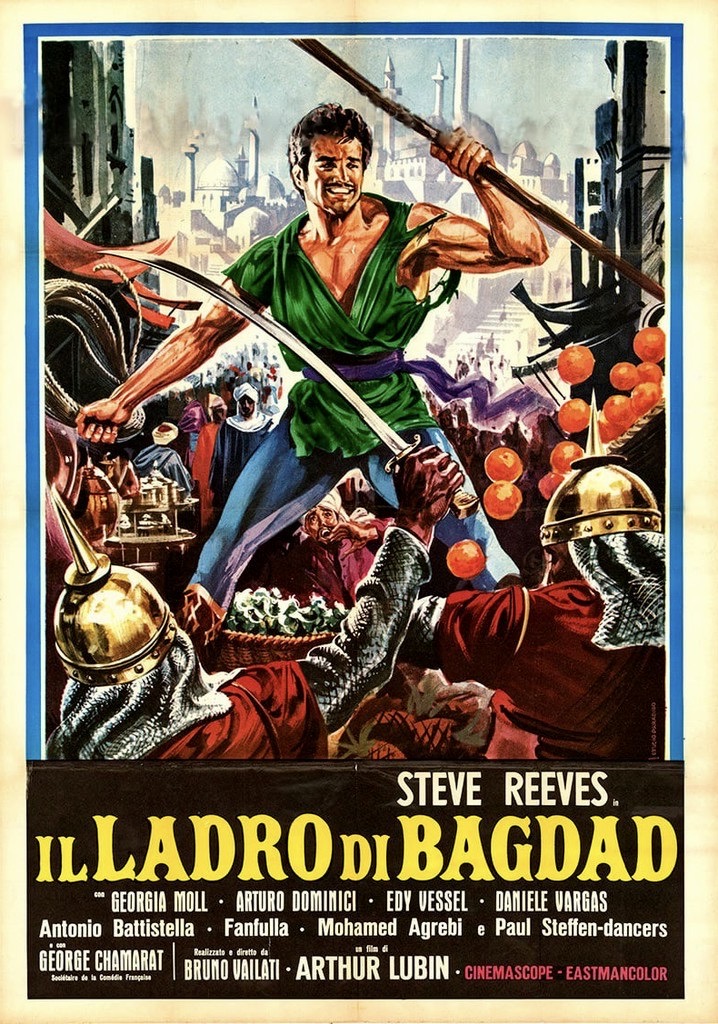
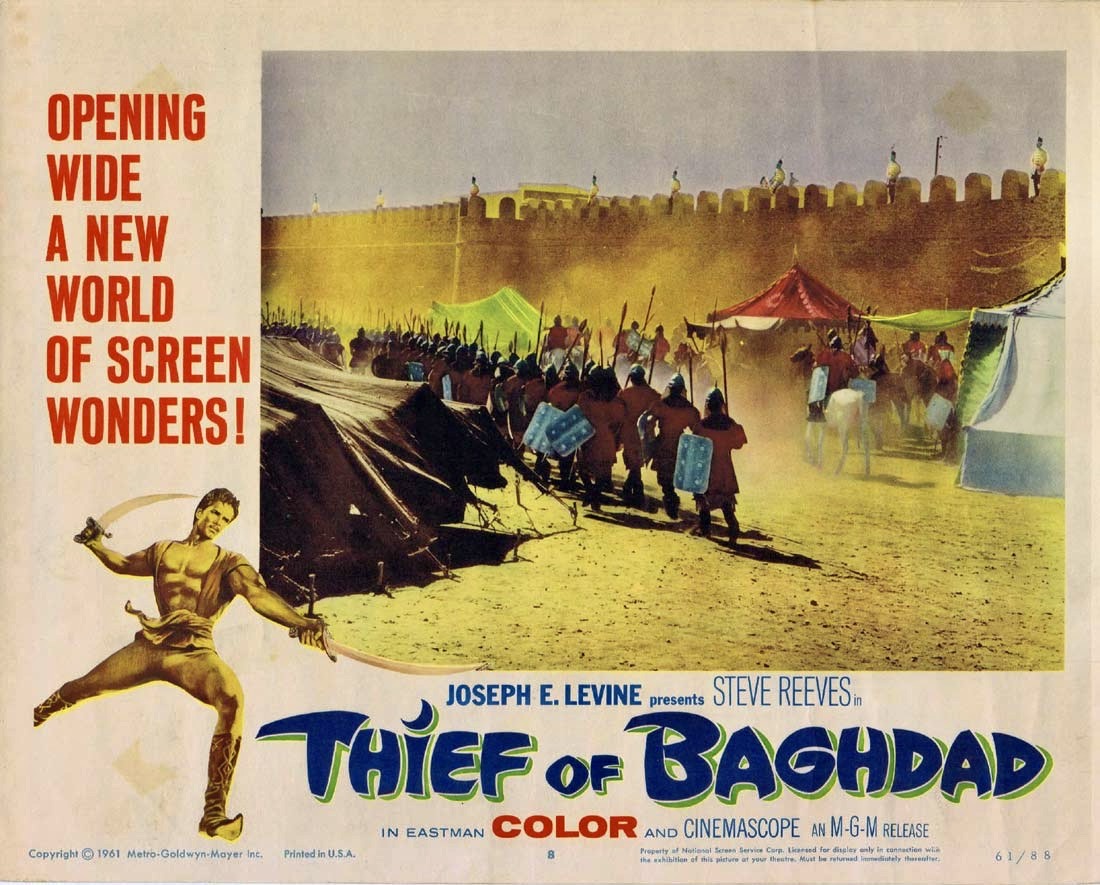
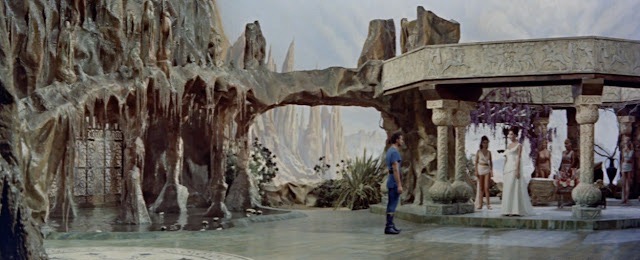
Certainly it can’t compare to the 1924 silent version directed by Raoul Walsh and starring Douglas Fairbanks or the equally spectacular 1940 version produced by Alexandra Korda and co-directed by Ludwig Berger, Michael Powell and Tim Whelan but – because I saw the Steve Reeves version first – it remains a personal favorite for nostalgic reasons. It also stood out from the typical Hollywood produced fantasy-adventures of that era due to the unusual look of it (the fake rococo architecture, imaginative matte paintings and miniatures and the landscapes of Tunisia, where much of it was filmed) and the low-budget special effects, which were often more bizarre than convincing.
Most critics and many moviegoers often ridiculed and disparaged these unsophisticated action-adventure imports but film scholar Jon Solomon nailed their basic appeal in his book The Ancient World in the Cinema, noting, that the films “have colorful costumes and imaginative sets and seductive mistresses and burly humor and Mediterranean scenery and bizarre tortures and nineteen-inch biceps and furious battles and likeable heroes and the triumph of good over evil. This is what movies are for, sometimes.”
In terms of the storyline, this Italian production shared more similarities with the 1924 version in that the title character was sent on a mission to prove his bravery and win the love of a beautiful princess. Directed by Bruno Vailati, 1961’s The Thief of Baghdad was shorn of ten minutes and released in an English-dubbed version in the U.S. under the supervision of Arthur Lubin, who had helmed Universal’s box office hit, Ali Baba and the Forty Thieves, in 1944.
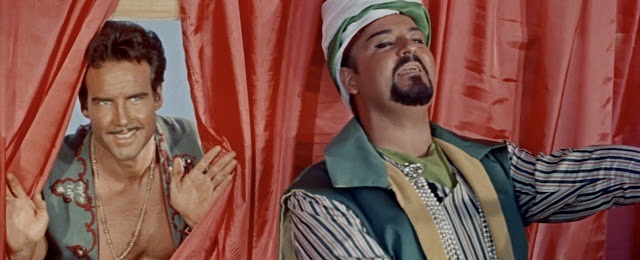
In this rendition of the story, Karim (Reeves) is a happy-go-lucky thief who smuggles himself into the sultan’s palace and impersonates Prince Osman (Arturo Dominici), a visiting dignitary who intends to marry Princess Amina (Giorgia Moll), the sultan’s daughter. Amina falls in love with Karim at first sight but Osman employs Gamal (Daniele Vargas), a treacherous aide to the sultan, to help him manipulate the situation to his advantage.
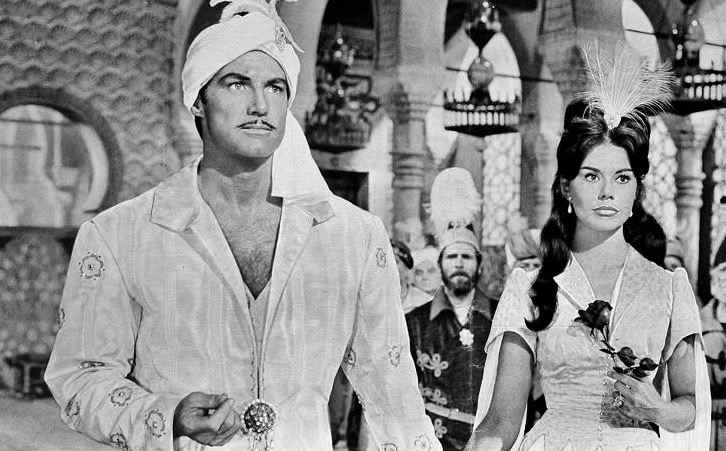
Events take a dramatic turn when the princess falls ill (after being slipped a love potion by Gamal) and the only cure resides in a rare blue rose which exists in a magical realm. Karim, Osman and various would-be suitors of the princess embark on a race against time to find the legendary object but must first pass through seven doorways representing different perils before reaching their goal. Only Karim succeeds in the quest but he still has to defeat Osman and his army, who have taken the princess hostage and surrounded the city of Bagdad.
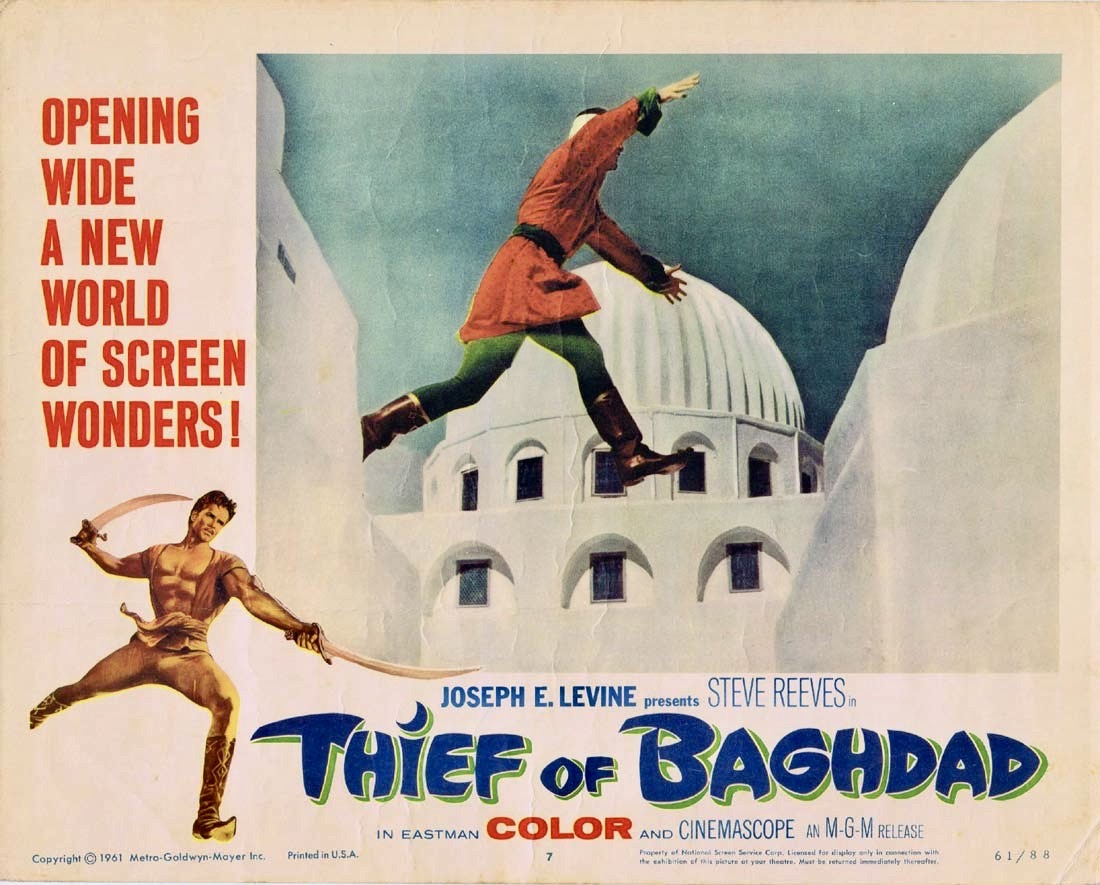
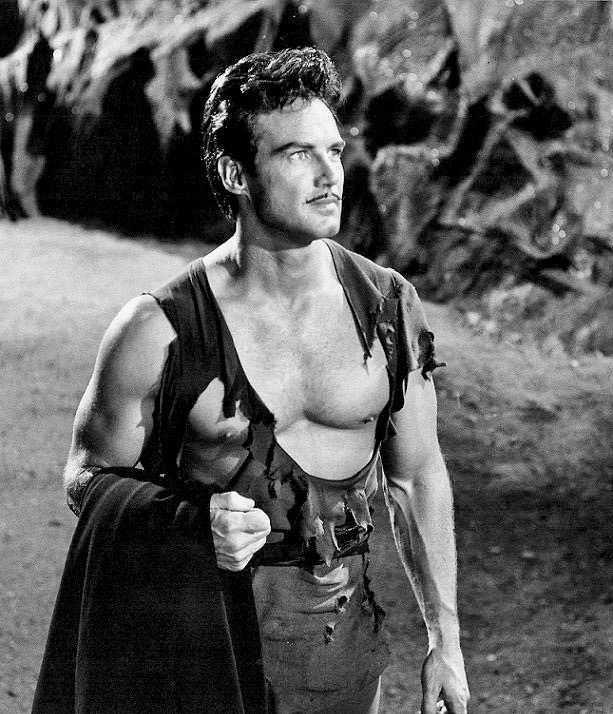
True, Reeves lacks the gravity-defying acrobatic skills of Douglas Fairbanks or the matinee idol handsomeness of John Justin from the 1940 version, but he does possess the awesomely sculpted physique of a Greek god that looks almost normal compared to later, more overdeveloped bodybuilder actors like Arnold Schwarzenegger or Lou Ferrigno. More surprising is his loose, playful performance which is a departure from previous outings like Goliath and the Barbarians (1959). Often disparaged by film critics and moviegoers for his wooden acting and self-conscious screen presence, Reeves actually seems to be having fun here and brings a comic, Errol Flynn vibe to the proceedings.
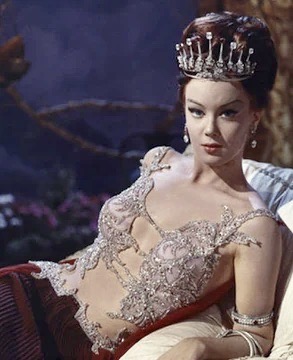
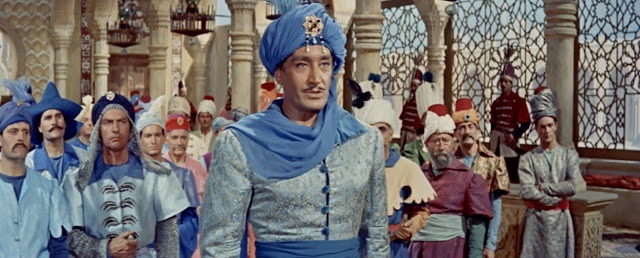
Giorgia Moll, in a mostly decorative role, is suitably gorgeous and exotic as Princess Amina but Arturo Dominici effectively ramps up the dramatic tension in the tale with his diabolical portrayal of Osman. Dominici, who divided his time between voice work and film acting, has appeared in numerous peplum adventures and horror films in Italy but is best known for his villainous roles in Hercules (Italian title: Le Fatiche di Ercole, 1958), the film that launched Steve Reeves’s European career, and Mario Bava’s gothic horror chiller Black Sunday (1960).
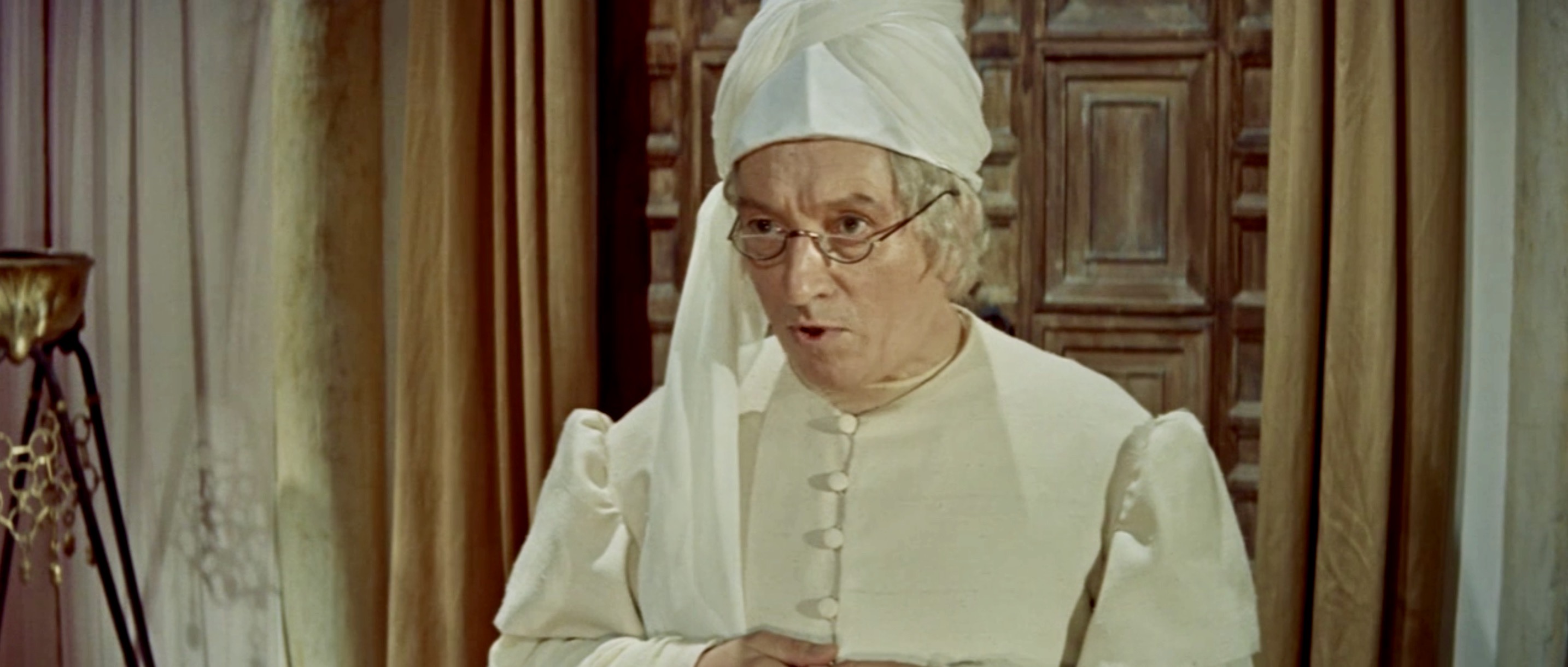
Other familiar faces in the cast include French actor Georges Chamarat as the mischievous magician who helps Karim in his quest and Antonio Battistella, who provides some lighthearted humor as the easily befuddled but benign sultan.
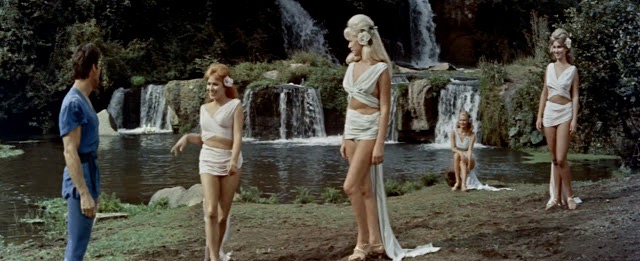
Although the first forty-five minutes of The Thief of Baghdad with its emphasis on palace intrigue and Karim’s romance with Amina is overly talky for young viewers addicted to video games, the movie becomes much more entertaining when Karim is suffering through the trials of the seven doors. These oddball fantasy sequences are achieved through the special photographic effects of Thomas Howard (a two-time Oscar winner for his work on Blithe Spirit [1945] and Tom Thumb [1958]) and miniatures designed by Joseph Nathanson. But the real talent behind the scenes is Mario Bava, who goes uncredited here, but was responsible for the matte paintings, optical effects and occasional bits of animation like the scene where a winged horse takes flight.
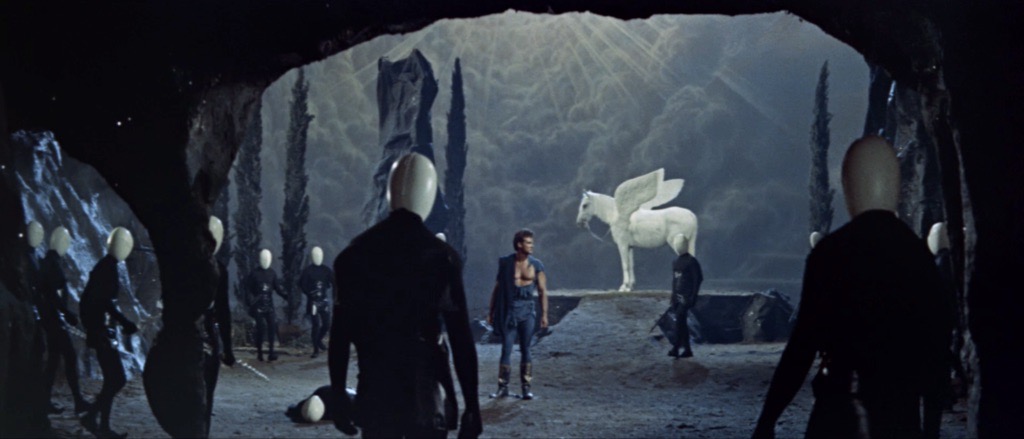
While there is nothing here to give kids nightmares, there are plenty of fantastical touches that conjure up a weird netherworld of monstrous trees that can walk and kill, an ogre wearing an invisible cloak, a burning desert with sinkholes, a seductive siren (Edy Vessel) who turns her lovers into stone statues, faceless entities who stalk Karim in a maze-like cavern, and a magic jewel that conjures up an army of blue-coded warriors. It might not rival the artistry of a Ray Harryhausen special effects extravaganza like The 7th Voyage of Sinbad (1958) but it is nonetheless funky and peculiar like some tacky carnival attraction that fascinates in spite of its phoniness.
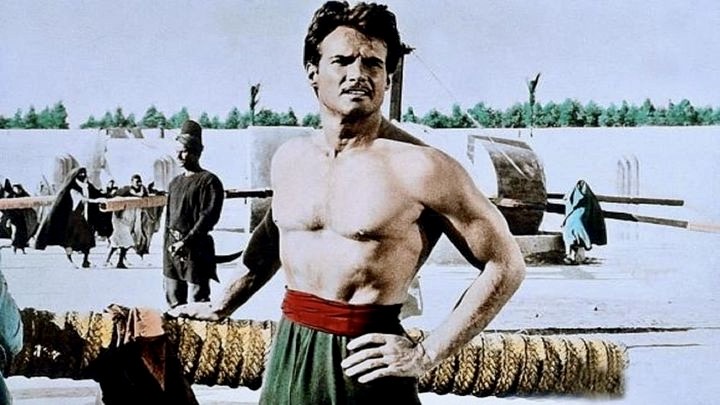
Other appealing aspects of the film include the colorful costume design by Georges K. Benda, the striking widescreen cinematography of Tonino Delli Colli (Once Upon a Time in the West, Seven Beauties) and an atmospheric music score by Carlo Rustichelli, which presents various reiterations of the haunting main theme throughout the movie.
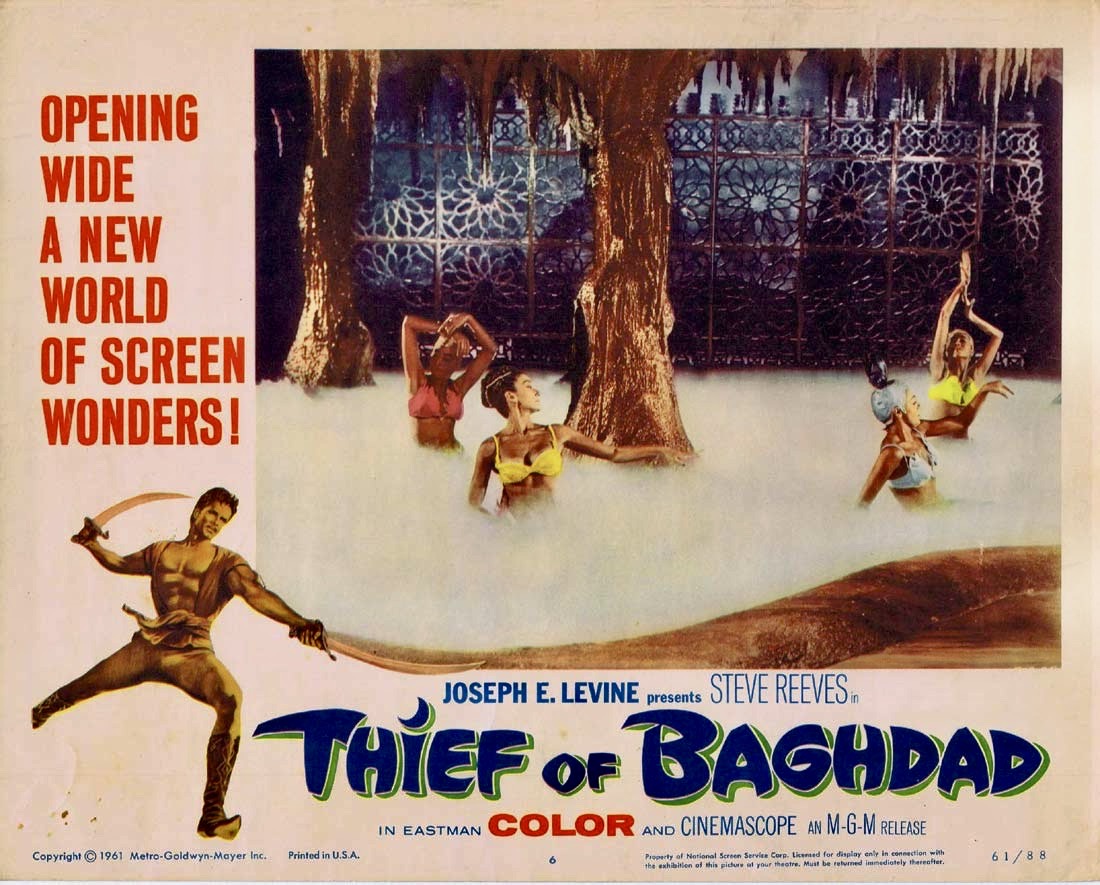
In an early promotional poster for the U.S. release of The Thief of Baghdad, a mention is made of a “gigantic killer crab’ but that scene does not appear in the movie nor is there any evidence that it was actually filmed or even existed in the Italian version. No matter. There are other things to command your attention like a ballet/modern dance number featuring scantily clad vixens who cavort like Las Vegas showgirls amid a mist-covered throne room (supplemented by dry ice machines).
As noted earlier, The Thief of Baghdad was filmed in Tunisia (near Kairouan on the edge of the Sahara Desert) with some interiors being shot at Titanus Studios in Rome and a scene featuring a waterfall in a lush oasis was lensed at the Monte Gelato Falls outside Rome.
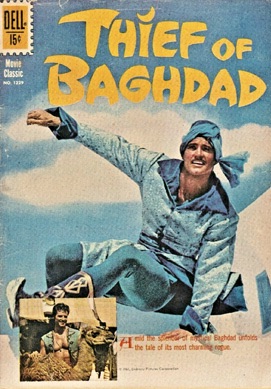
A comic book adaptation by Dell Publishing was released in advance of the film’s opening in the U.S. and so was a paperback novelization. The Thief of Baghdad also marked the eight peplum adventure made in Italy featuring Reeves and was one of his most successful ventures at the box office, thanks to the extensive marketing by MGM publicists of the film at children’s matinees in America.
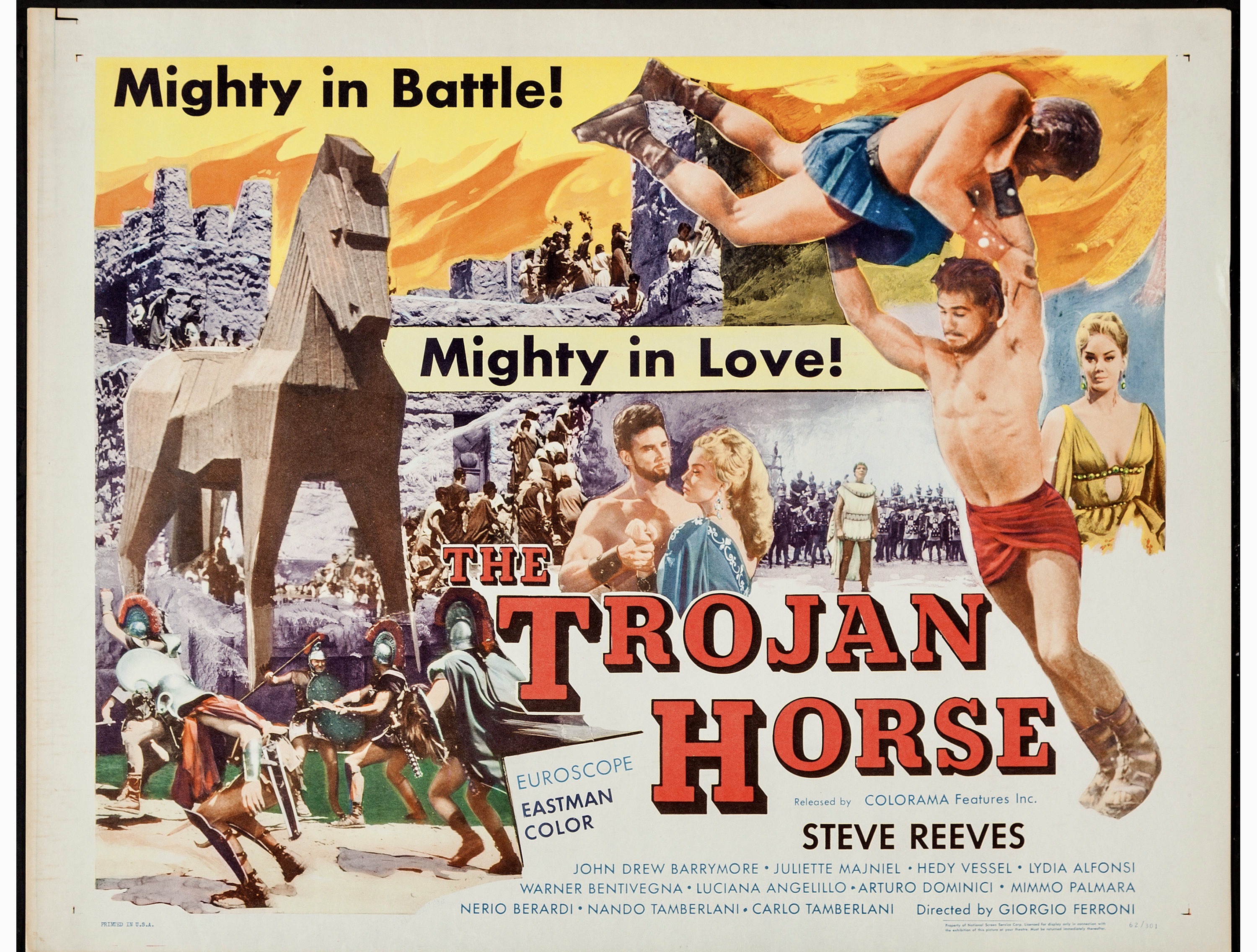
Reeves’s next project was the peplum epic The Trojan Horse (1961), directed by Giorgio Ferroni, while special effects master Mario Bava would move on to the Arabian Nights comedy, The Wonders of Aladdin (1961) starring Donald O’Connor.
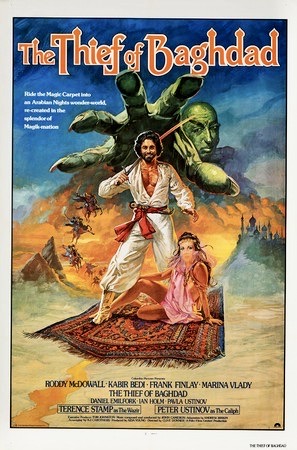
In addition to the 1924 silent version and Korda’s 1940 adaptation, there have been other movie versions of The Thief of Bagdad. There was a 1952 West Germany version directed by Karel Lamac – Die Diebin von Bagdad – and a 1978 made-for-TV version helmed by Clive Donner, which shares some plot similarities to the Korda version. For instance, Roddy McDowall plays Hassan, the thief hero modeled on Sabu, and other roles are filled by Terence Stamp. Ian Holm, Peter Ustinov, Frank Finlay and Marina Vlady.
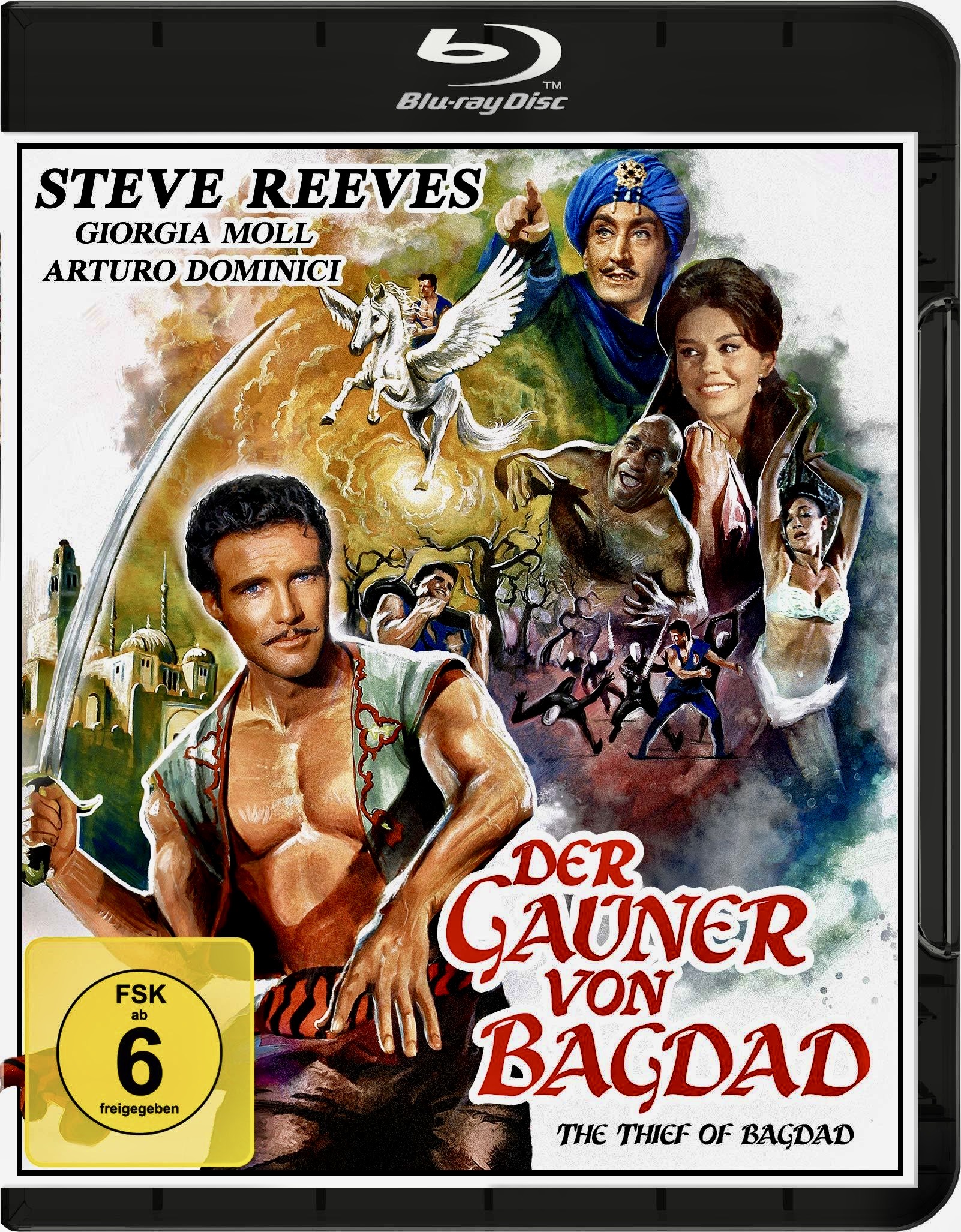
For years, The Thief of Baghdad was only available in poor transfers of the film featuring the wrong aspect ratio and other defects. Finally in 2020, a German company Colosseo Film released the film on Blu-ray in an all-region release with the correct aspect ratio (2.35:1) with English, German and Italian audio options. This is the longer European cut of the film and a few of the previously deleted scenes appear in Italian with English subtitles. The only additional features are a theatrical trailer and an interview (in Italian only) with Steve Reeves’ stunt double in the film, Giovanni Cianfriglia.
Other links of interest:
https://www.stevereeves.com/films
https://variety.com/2000/scene/people-news/steve-reeves-1117781293/
 Cinema Sojourns