
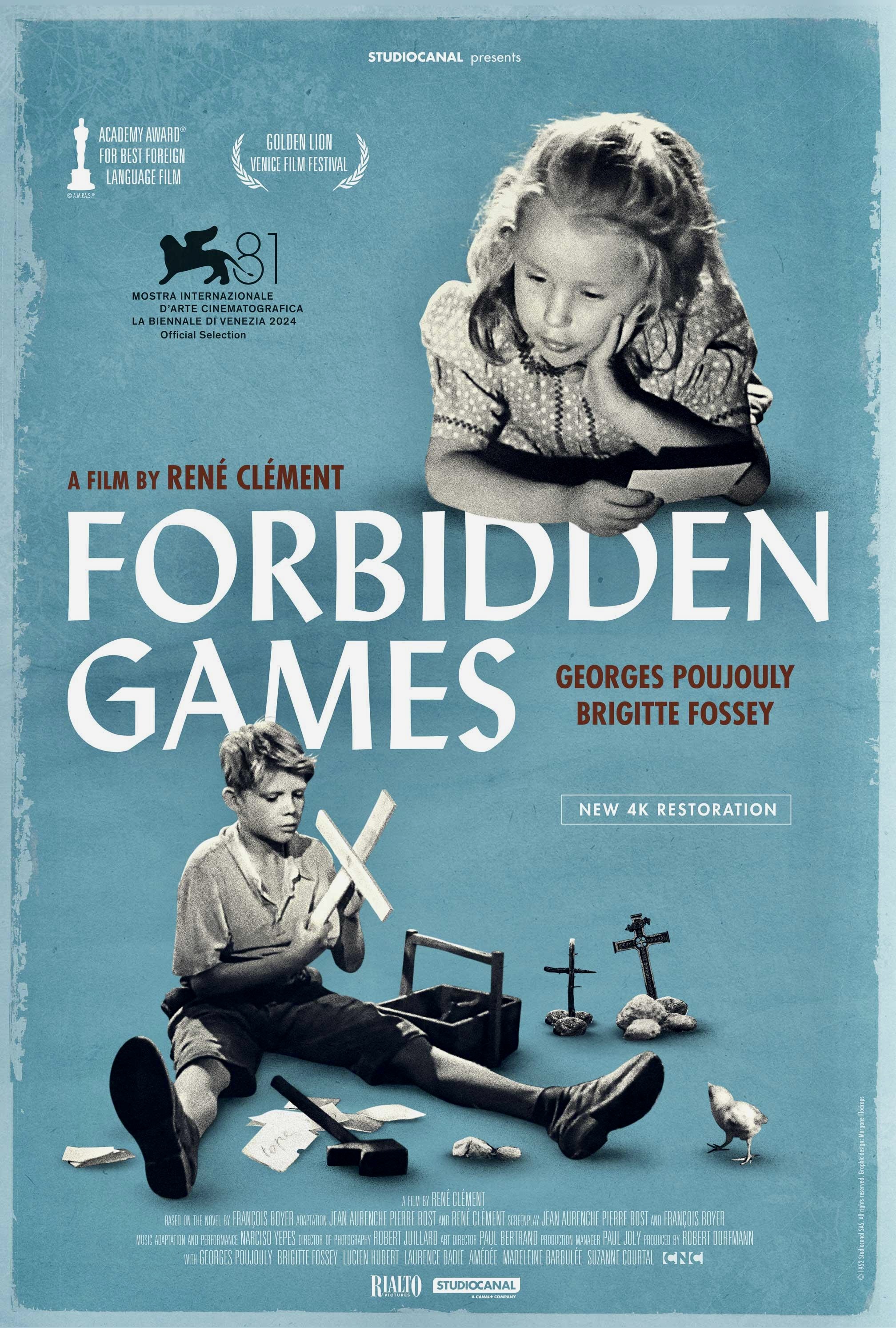
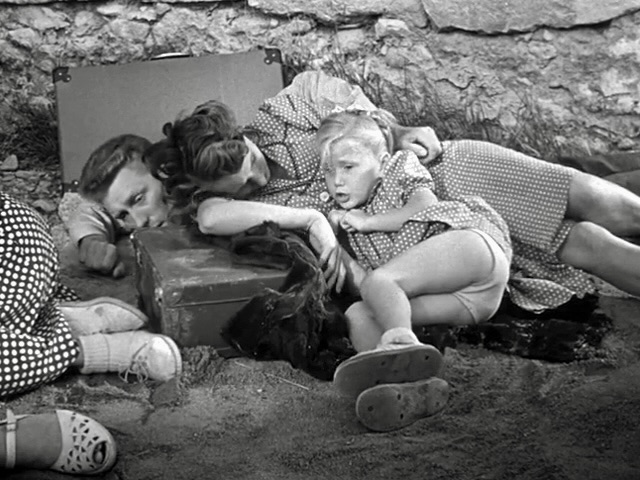
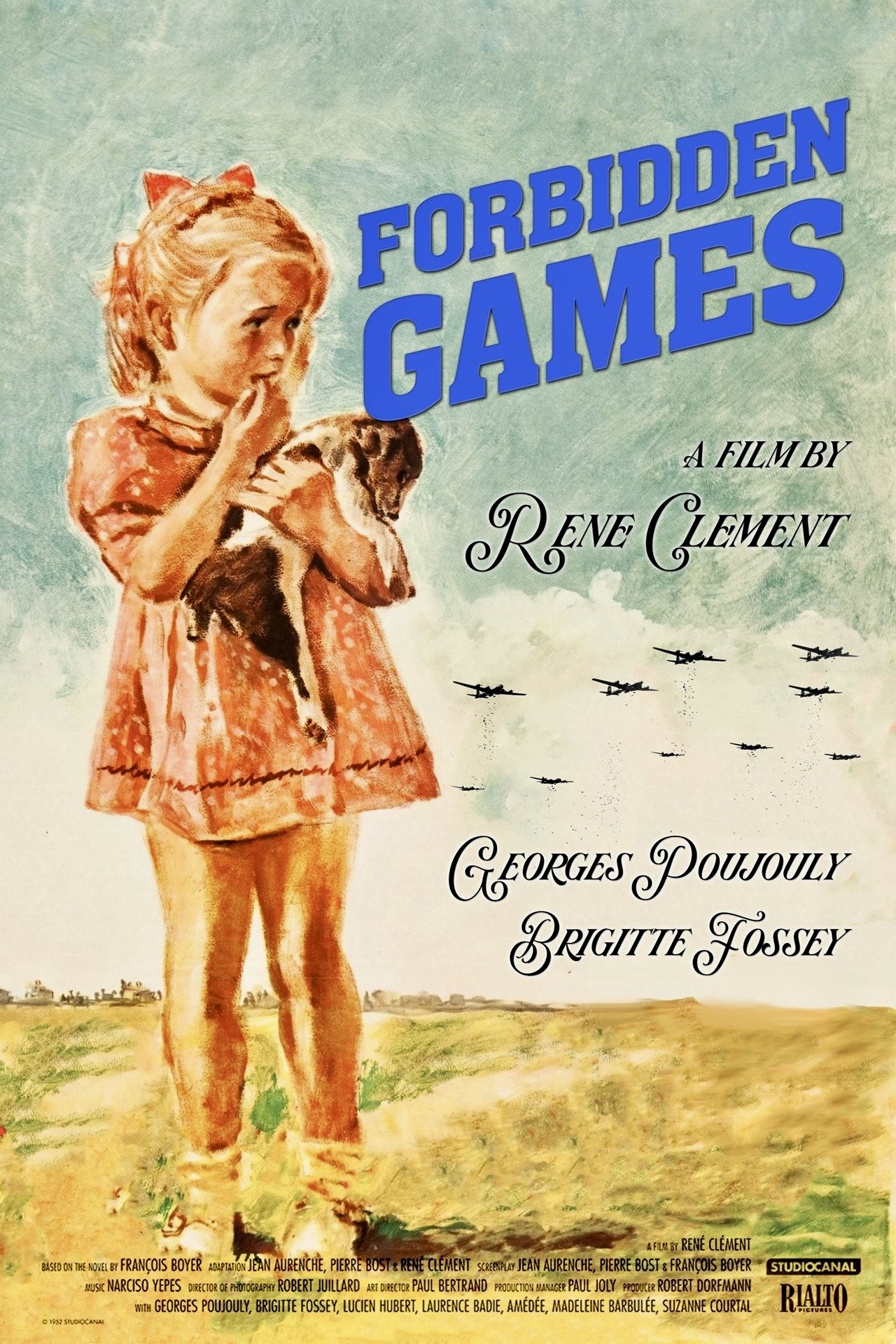
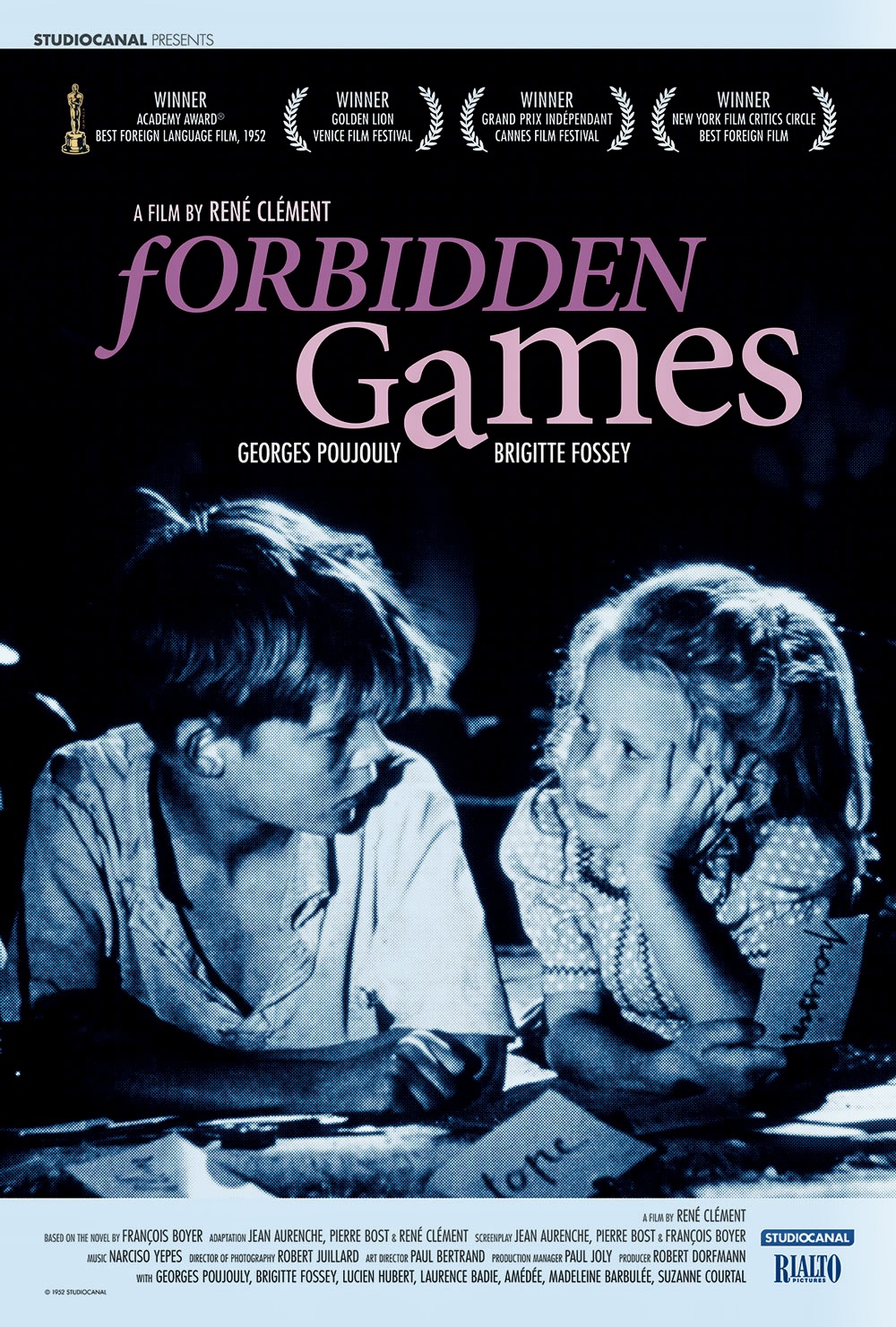
June 1940. A long line of French refugees flee Paris for the countryside during the German invasion of France in WW2. Among the evacuees are a young couple with their 5-year-old daughter Pauline and her pet dog Jock. When the couple’s car stalls on the road, angry refugees push it out of the way and down a hill. The family grab whatever they can carry from their stranded vehicle and return to the road as German aircraft start dropping bombs. In the confusion, Jock runs off and Pauline chases after him. Her parents follow in pursuit but the family is forced to take shelter again as aerial machine-gunners target the escaping Parisians. This time the parents and the dog are mortally wounded and Pauline is left abandoned. She wanders into the countryside clutching her dead pet, not really comprehending what has happened to her. All of this occurs in the few ten minutes of Jeux Interdits (English title: Forbidden Games), one of the most powerful war films of all time. Yet, it is unique within its specific genre because it does not focus on the war itself but the effects of the devastation on a young child. Directed by Rene Clement, the film became an international sensation and won a honorary Oscar as Best Foreign Film of 1952.
What is puzzling is why Forbidden Games appears to have faded in importance over the years. Despite its critical acclaim and inclusion in the Janus film collection, the film has been overshadowed by other war films focusing on children subjected to man-made calamities. On one side there are such harrowing and horrific glimpses into the abyss as Roberto Rossellini’s Germany, Year Zero (1948), Andrey Tarkovsky’s Ivan’s Childhood (1962) and Elem Klimov’s Come and See (1985). But an entirely different approach is offered in such audience pleasing favorites as Hope and Glory (1987), John Boorman’s rich, autobiographical memoir, and Roberto Benigni’s Life is Beautiful (1997), which combines humor and sentimentality in equal measure. Falling somewhere between these two extremes is Forbidden Games, a somber and melancholy meditation on death and grief as experienced by children in wartime. The plaintive guitar music of Narcisco Yepes and the lyrical cinematography of Robert Juillard help enhance the film’s mixture of the realistic with the poetic. The movie also showcases two remarkable performances by child actors while avoiding the temptation to become a tearjerker. Still, Clement’s film didn’t even make the BFI list of the top 200 films of all time conducted in 2023. But the time seems right to revisit this cinematic gem.
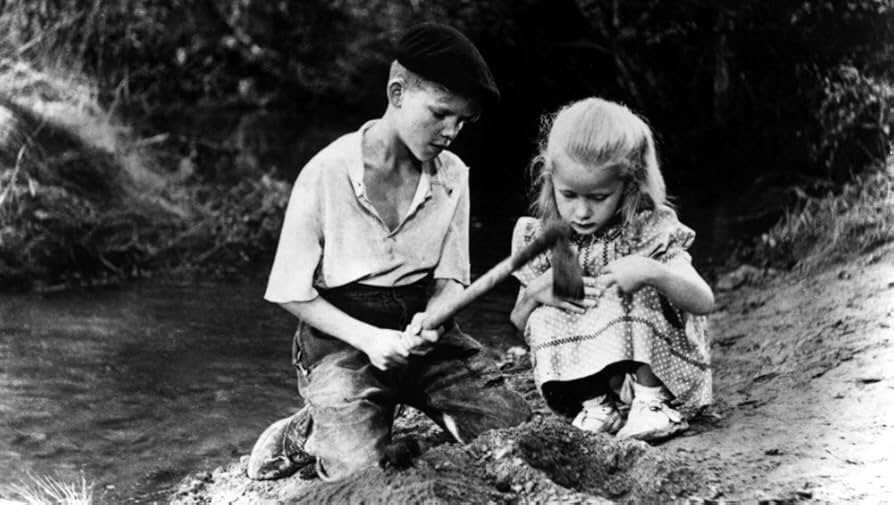
After the shocking opening sequence, Forbidden Games follows Paulette (Brigitte Fossey) as she is befriended by Michel Dolle (Georges Poujouly), a country boy of ten or eleven, who insists that his family offer her refuge. Although the little girl’s adjustment to her new situation is difficult at first, her friendship with Michel helps her process her grief in a unique way. Starting with the burial of her dead dog in the basement of an abandoned mill, the two children become obsessed with creating a secret cemetery where even the bodies of chickens, crickets and worms are honored with a grave and a homemade cross.
Expanding the pet cemetery becomes a game for Paulette and Michel and soon they are stealing materials for more graves and eventually pillaging crosses from the local church. Their secret activities, however, inadvertently stir up animosities between the Dolle family and their neighbors, the Gouards. When Michel removes the ornamental crosses on his family’s hearse, Michel’s father (Lucien Hubert) suspects Mr. Gouard (Andre Wasley) of the deed and, in retaliation, goes to the church graveyard and trashes the burial site of Mr. Gouard’s deceased son.
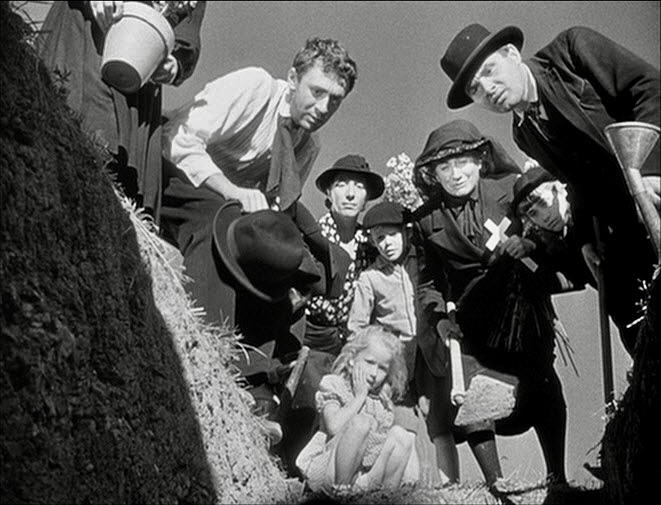
Creating further tension between the two families is the fact that Berthe (Laurence Badie), the Dolle’s daughter, is having a secret affair with Francis Gouad (Amedee), a deserter from the French army who has recently returned home. Only the village priest (Louis Sainteve) knows through his confession booth the secrets of his congregation and he is eventually forced to share that knowledge to keep the peace in his village.
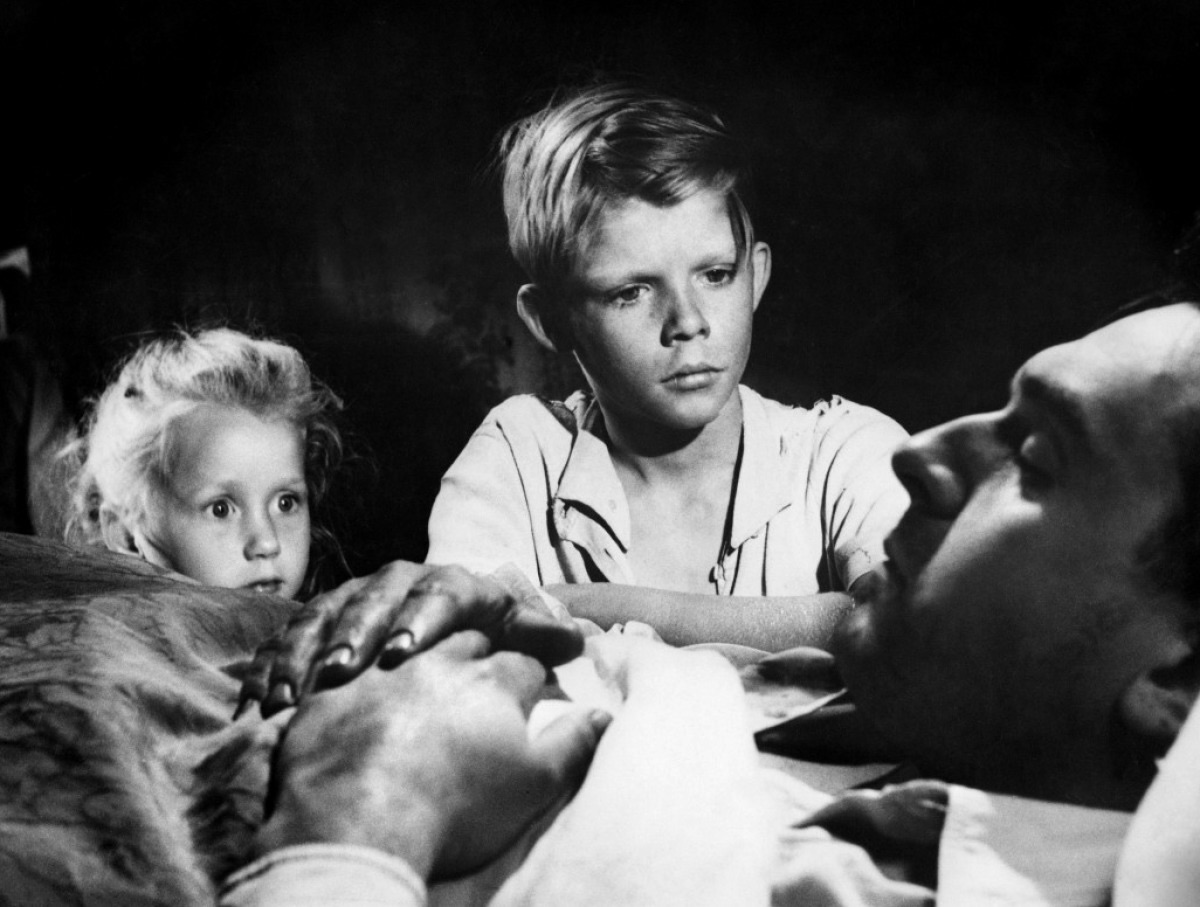
The specter of death hangs over everything that happens in Forbidden Games but it isn’t morbid or tragic. As seen through the eyes of Paulette and Michel, it becomes something mysterious and sacred that they can celebrate in their private cemetery in the mill. Even the death of Michel’s older brother Georges (Jacques Marin) from injuries caused by a horse and his burial becomes a source of fascination to the children. Brigitte Fossey would later state in interviews that she was too young to understand what the story was really about when she was making Forbidden Games but her natural, unself-conscious performance helps us believe in the conspiratorial bond she forms with Michel over their “hobby.”
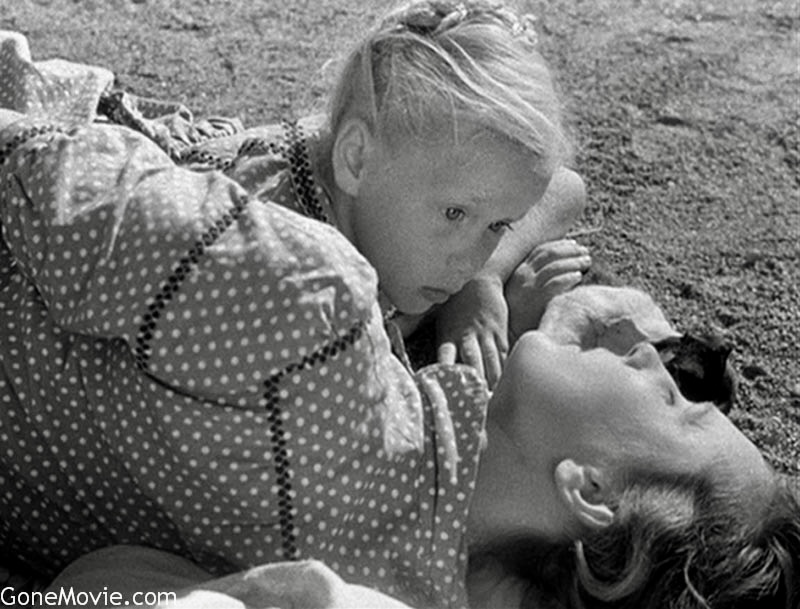
Clement’s film is filled with scenes that linger in the memory for days or longer. One is the scene where Paulette touches her dead mother’s face with her hand and then touches her own face in an attempt to understand why her mother now lies cold and still. Another powerful moment occurs when Michel looks proudly over the cemetery he and Paulette have created before destroying it so the adults can’t see it in its original state, much less understand it. Forbidden Games is also bookended by two devastating scenes – Brigitte’s transformation into an orphan through the violence of war and her abandonment again in a Red Cross hospital after she has been taken from the Dolle family.
Forbidden Games is particularly good at contrasting the strong bond between the two children with the often insensitive and combative behavior of the adults toward each other. Some also saw the film as a harsh critique of provincial French peasants and rural life depicted in the film. Roger Ebert noted this in an essay on the movie, writing “Clement was accused simultaneously of trivializing the war and inflicting its horrors too mercilessly on his actors. Leftist critics accused him of an attack on the working class, although his poor peasant farmers are the most warm and generous of characters.” But none of that mattered once the film was released outside of France and became an international success. Bosley Crowther of The New York Times wrote that Forbidden Games had “the irony of a Grand Illusion, the authenticity of a Harvest and the finesse of French films at their best.” And film critic Pauline Kael voiced a similar opinion, describing the movie as “Rene Clement’s beautiful, lacerating film on the themes of innocence, Christianity, war and death. It is perhaps the greatest war film since La Grand Illusion. (Neither deals with actual warfare).”
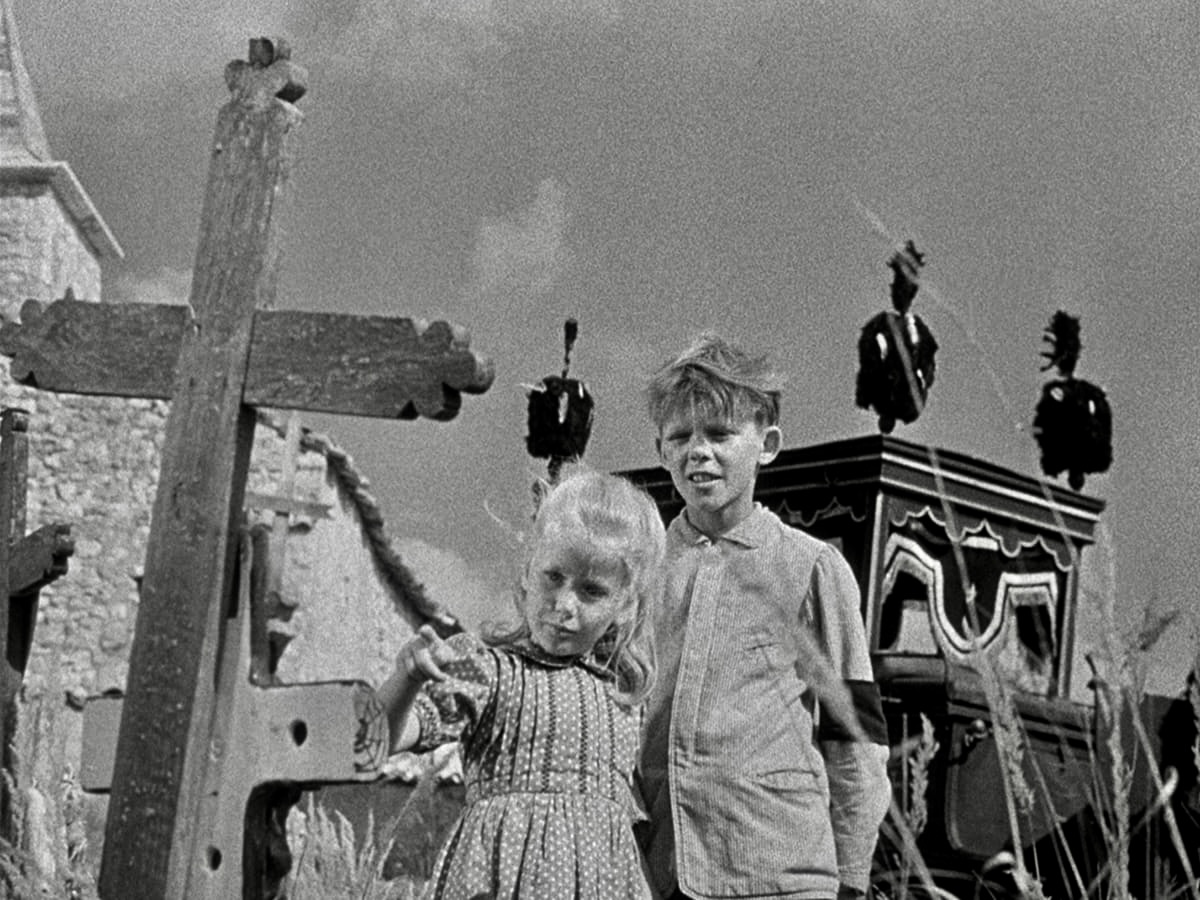
Initially, Clement adapted the screenplay with Jean Aurenche and Pierre Bost from a 1947 novel by Francois Boyer entitled The Secret Game. At first the director planned to film it as a vignette for a three-part movie and shot his segment but the project ended up being shelved. However, it was producer Robert Dorfmann, who looked at Clement’s footage and convinced the director to expand the episode to feature length. Allegedly Clement also shot a prologue and epilogue for Forbidden Games featuring Michel and Paulette in a storybook setting which was later discarded for being at odds with the realistic nature of the main narrative.
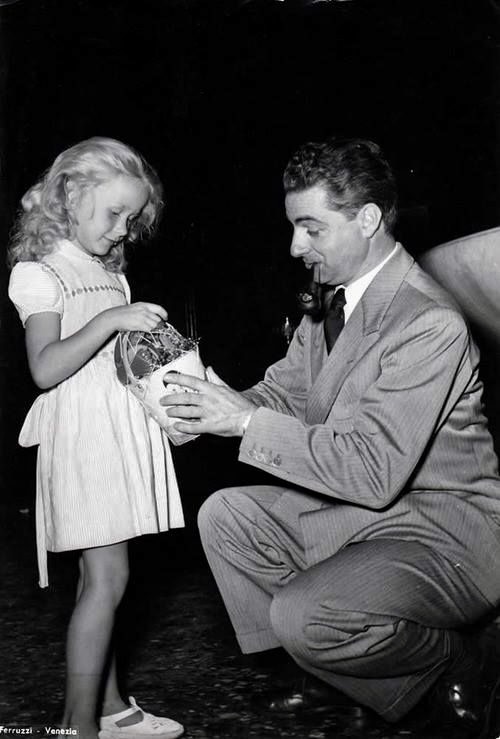
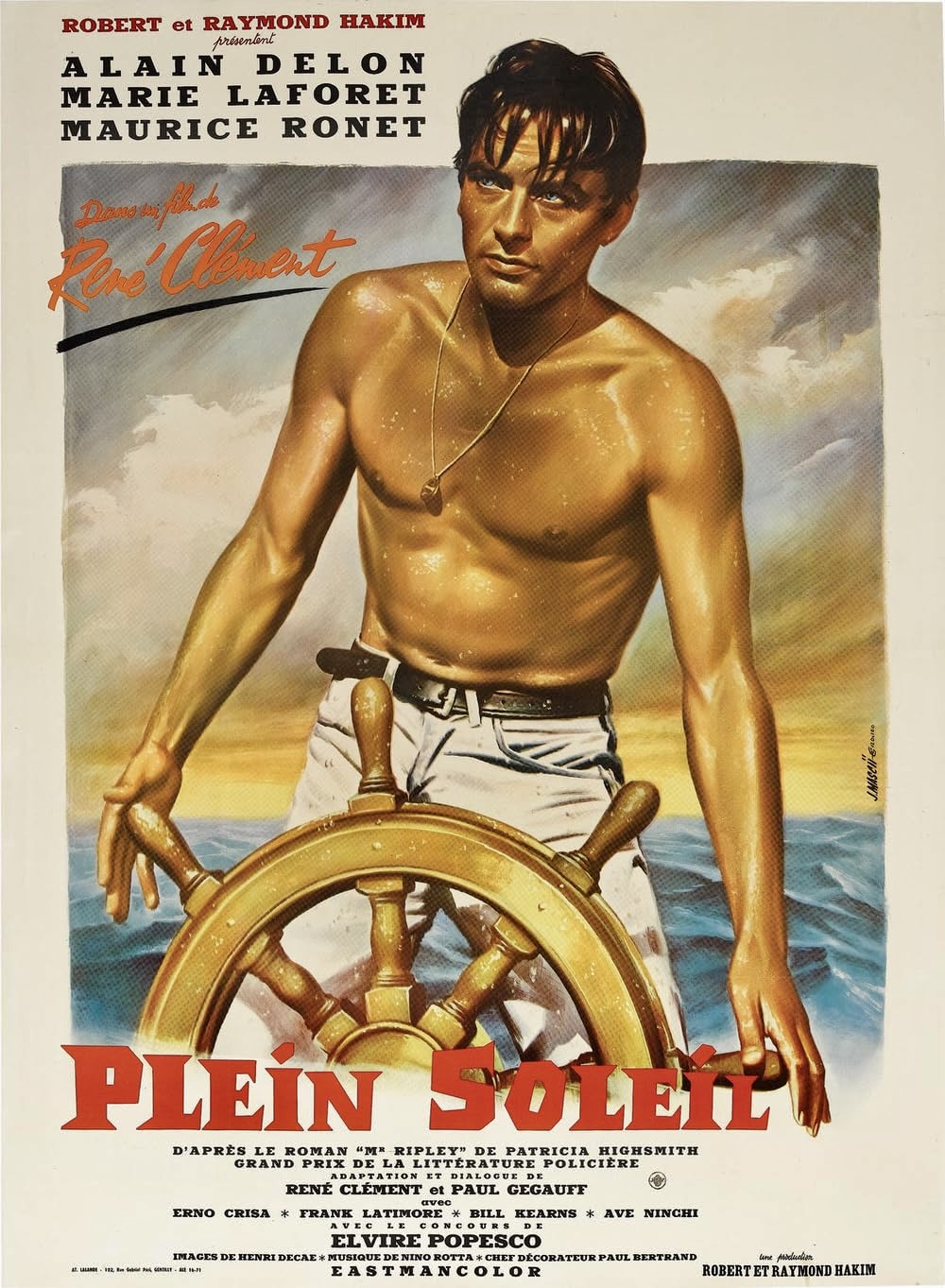
Forbidden Games was made during Clement’s peak years as a filmmaker – 1946-1960. He established himself as a talent to watch with his feature film debut, The Battle of the Rails aka Bataille du Rail (1946), a drama about the French Resistance during WW2. The Damned aka Les Maudits (1947), a war drama that takes place on a German submarine headed toward South America, and The Walls of Malapaga (1949), a tragic love story which won the Best Director and Best Actress Award (for Isa Miranda) at Cannes, established Clement as one of France’s most important directors. Forbidden Games might represent the pinnacle of his career but some critics prefer his 1956 adaptation of Emile Zola’s 1877 novel Gervaise starring Maria Schell or Purple Noon (1960), a stunning psychological thriller based on Patricia Highsmith’s The Talented Mr. Ripley with Alain Delon in the lead.
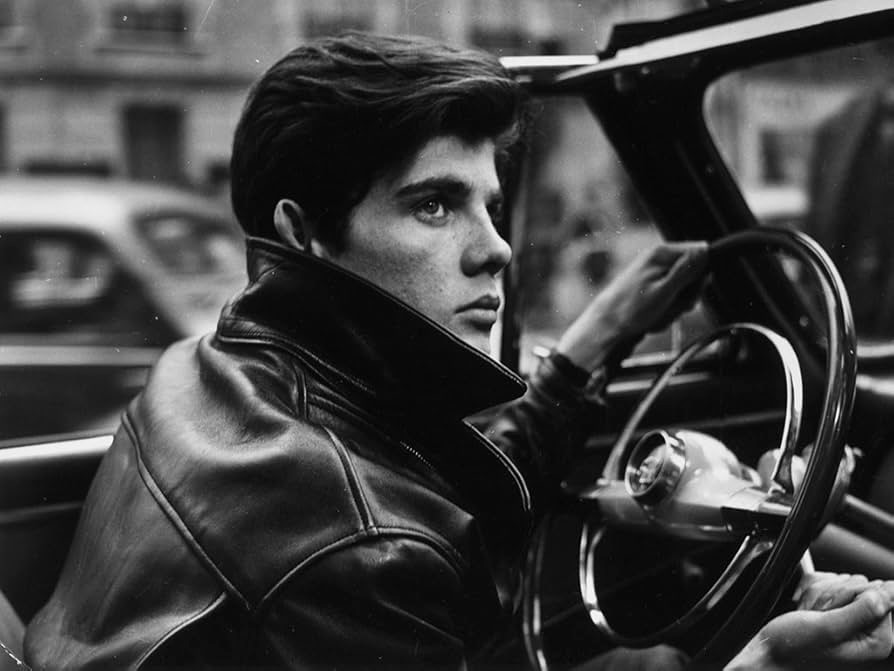
As for the two child actors in Forbidden Games, Brigitte Fossey would go on to make a successful transition to adult starring roles in French cinema. She appeared in such diverse roles as Bertrand Blier’s controversial sex comedy Going Places (1974), Francois Truffaut’s The Man Who Loved Women (1977), the 1981 biopic Chanel Solitaire, and Giuseppe Tornatore’s Cinema Paradiso (1988), an Oscar winner for Best Foreign Film. Georges Poujouly would also continue working as an actor in film and television after this but mostly in minor or supporting parts. One of the few exceptions was his third billed role as a car thief/killer in Louis Malle’s Elevator to the Gallows.
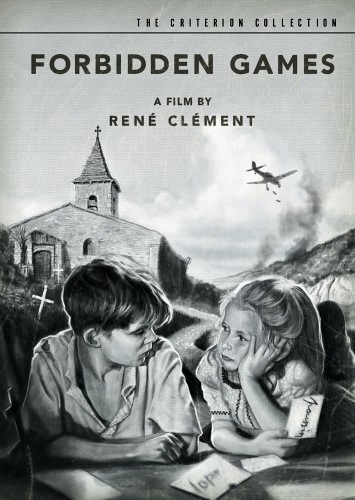
Forbidden Games has been released on various formats over the years but fans of the movie will probably want the DVD release from The Criterion Collection released in January 2013. The extras include archival interviews with Rene Clement and Brigitte Fossey, an alternate opening and closing to the film, and other supplements. A remastered upgrade to Blu-ray or 4K UHD would be most welcome.
Other links of interest:
https://www.rogerebert.com/reviews/great-movie-forbidden-games-1952
https://www.criterion.com/current/posts/952-forbidden-games
https://www.criterion.com/current/posts/408-forbidden-games-death-and-the-maiden
https://filmstarpostcards.blogspot.com/2015/09/brigitte-fossey.html
 Cinema Sojourns