
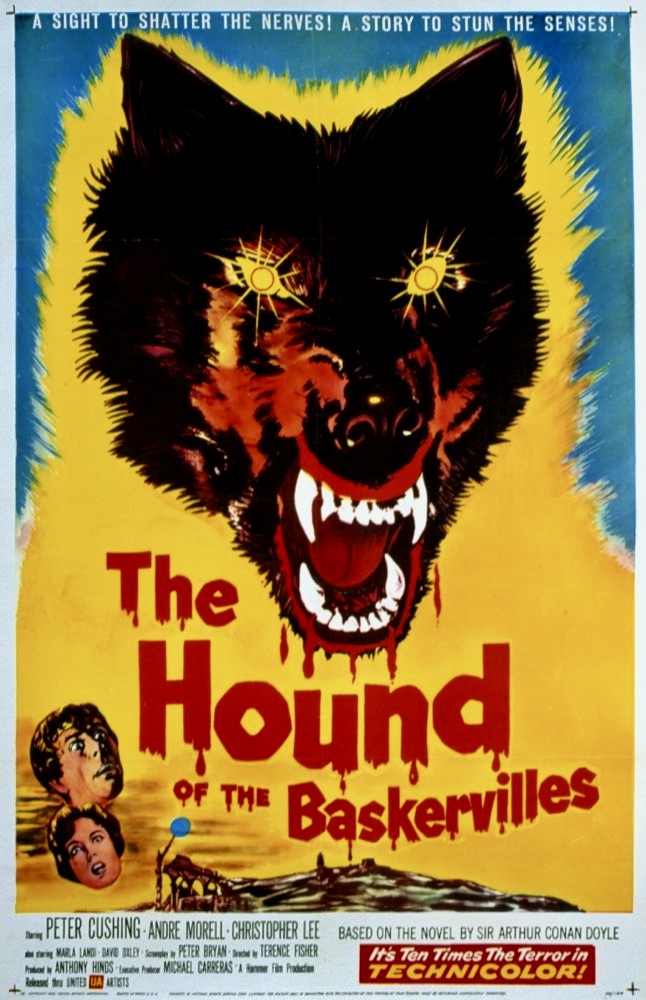
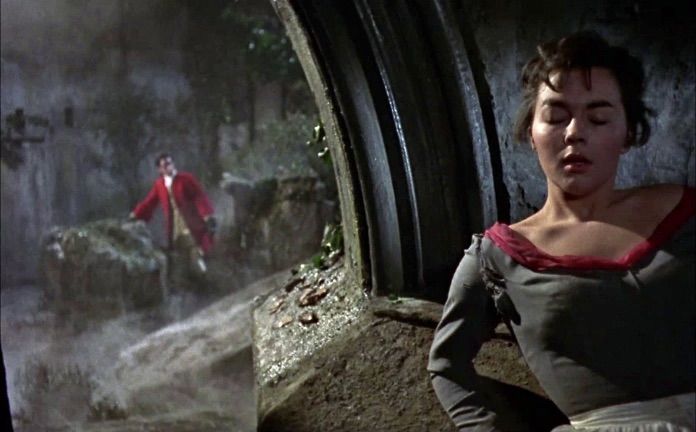
Almost thirteen years after Basil Rathbone had filmed his final screen appearance as Sherlock Holmes, Hammer Studios decided to resurrect Sir Arthur Conan Doyle’s internationally famous detective in a Technicolor remake of The Hound of the Baskervilles (1959) which had been previously filmed with Rathbone in 1939. The eerie tale, which opens in a flashback sequence to an earlier time, depicts the origins of the Baskerville curse: the decadent Sir Hugo Baskerville brutally murders a servant girl who flees a group orgy at his mansion. Immediately following her death, however, Baskerville hears a strange braying on the moors before encountering an immense spectral hound which avenges the girl’s death. We then flash forward to the present, where Sherlock Holmes and his partner, Dr. Watson, are investigating the mysterious recent death of Sir Charles Baskerville.
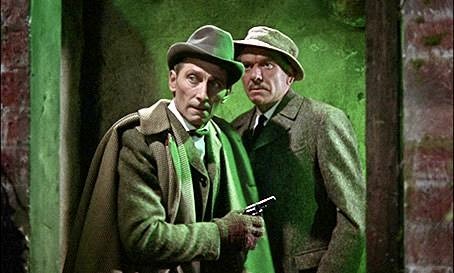
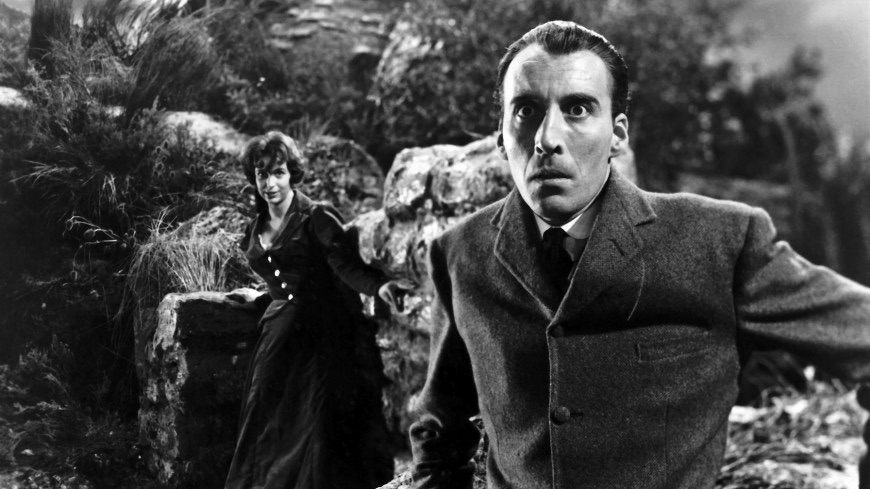
At the time of production, Hammer, a small British film studio, was at the height of its success, enjoying huge profits from two trend-setting horror films, The Curse of Frankenstein (1957) and Horror of Dracula (1958). Peter Cushing gave definitive performances in both of those period thrillers and producer Anthony Hinds and director Terence Fisher knew he would make a great Sherlock Holmes. The announcement of his casting generated a great deal of excitement about the project in the British press and Cushing was soon joined by Andre Morell as Dr. Watson and Christopher Lee as Sir Henry Baskerville, the unfortunate heir to a dreadful curse. Lee was anxious to escape his villainous typecasting (he played Frankenstein’s monster and Dracula in the previously mentioned Hammer horrors) and relished the opportunity to play the victim for a change.
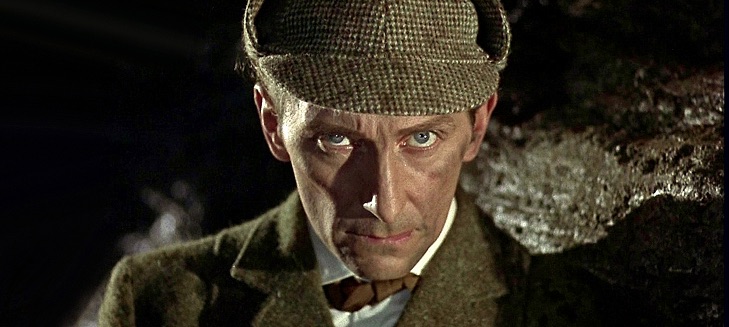
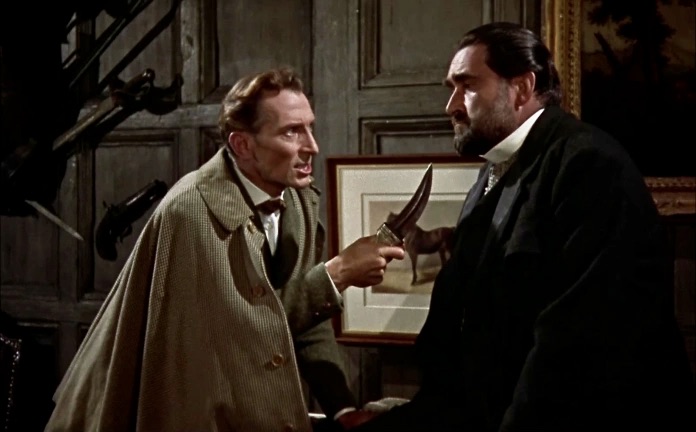
Cushing heavily researched his role prior to creating Holmes’ character and took care to incorporate the sleuth’s well-known addiction to morphine into his physical appearance and behavior. He even provided his own costumes which accurately matched the famous Paget illustrations from the Sherlock Holmes series published in the Strand magazine. Cushing added, in an interview for The Evening News, that “everything is accurate right down to the famous ‘mouse-colored’ dressing-gown which I charred with cigarettes to get the burns Holmes made during his experiments. The producer had some absurd idea that I should not wear a deerstalker. I told them you might as well play Nelson without a patch over his eye! But still I am avoiding the more obvious props – the things like the huge curved pipe and magnifying glass that make Holmes a music-hall joke. Quite a bit of time, I wear a homburg on the moors – which is absolutely right, I find.”
Several exterior sequences for The Hound of the Baskervilles were shot near Frensham Ponds, Surrey, which served as a reliable stand-in for the real Dartmoor, but the majority of the filming took place on the Bray studio set. Animation techniques were first considered for introducing the monstrous hound, but cost factors prevented it so the production crew was forced to use a real dog.
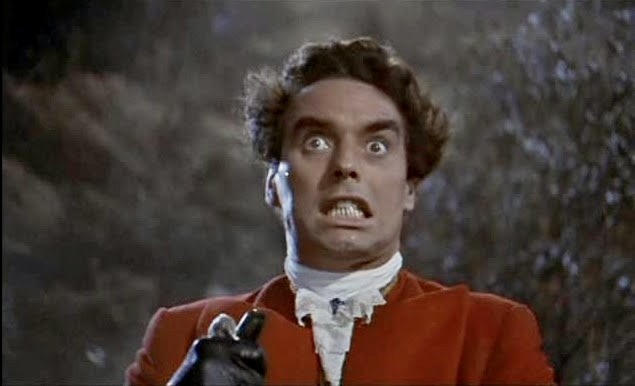
In Hammer Films: An Exhaustive Filmography by Tom Johnson and Deborah Del Vecchio, crew member Margaret Robinson said, “They had two dogs originally. One had been typecast because he once bit a barmaid! This was Colonel, who actually played the part. The other dog was owned by Barbara Wodehouse, and cost five times as much to hire. Also, Barbara wanted to double for Christopher Lee!” Robinson was charged with creating a frightening mask for the dog to wear and added, “I made the mask out of rabbit fur, and the dog wouldn’t allow anyone else to put the mask on him. He was a lovely dog – to me, at least!” As for the climactic scene between Sir Henry and the hound, Robinson revealed that “they duplicated the part of the set in miniature where the dog was to leap onto Sir Henry. A small boy named Robert was dressed to duplicate Christopher Lee. The dog couldn’t bear the sound of crumpled paper, and the idea was he would go straight for a prop man as he crumpled it. What we didn’t know is that Colonel hated small boys, too! The prop man caught the dog in mid-air before he got to Robert.” Otherwise, the rest of the filming went smoothly, even Christopher Lee’s hair-raising encounter with a deadly tarantula.
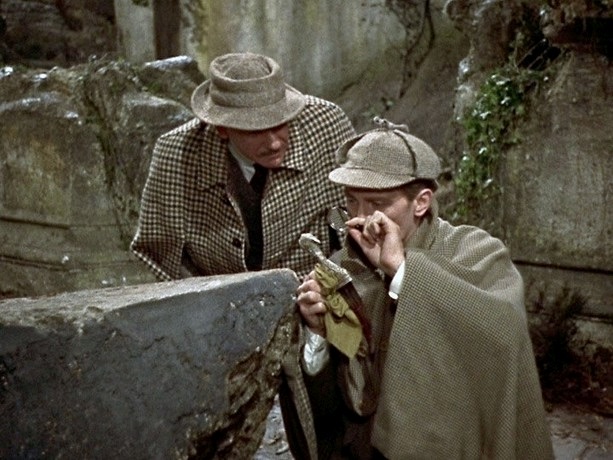
In the end, The Hound of the Baskervilles succeeds as a stylish and colorful period thriller which demonstrates Terence Fisher’s skills as a director (For one thing, he was able to compress the entire Baskerville legend into a ten minute opening sequence!). Unfortunately, it was not successful enough at the box office to justify Hammer’s plans to continue the series despite Peter Cushing’s fine portrayal of Holmes. And in the United States, the film was marketed as a creature feature and not a murder mystery since the Hammer name was more synonymous with horror here.
Film critics were quite favorable in their reviews of the movie with The Daily Express calling it “a merry little romp,” and The Standard, stating “Played effectively for a maximum of blood and thunder.” The New York Herald Tribune commented,”Sound version, nicely photographed and should be a pleasant introduction to the adventure,” while Variety stated, “It is difficult to fault the performance of Peter Cushing.” In fact, over time Cushing’s performance has become as beloved as Basil Rathbone’s in the role and might even be the favorite if it came down to a poll.
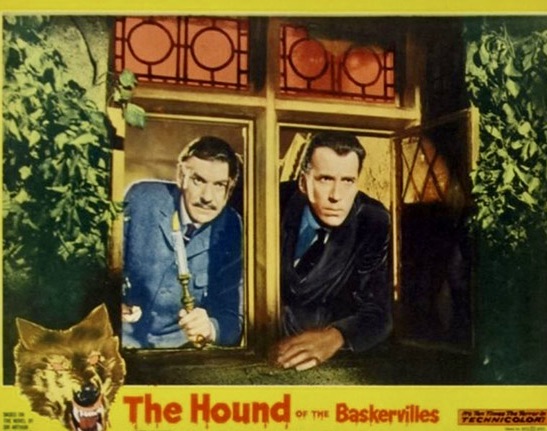
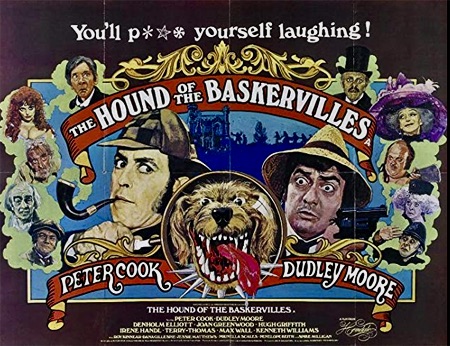
The Hound of the Baskervilles has been adapted for the screen numerous times since it was first serialized in The Strand Magazine in 1901-1902. The first film version was a British production directed by Maurice Elvey that was released in 1921. Gareth Gundrey directed another British version of it in 1931 but the most famous adaptation of it was the Hollywood production from 1939 starring Basil Rathbone and Nigel Bruce. Since then, it has been remade by Andy Warhol protege Paul Morrissey, who directed a parody of it in 1978 starring Dudley Moore and Peter Cook, and more recently, Tim Jackson and Lotte Wakeham helmed another comedic remake in 1922. The Sir Arthur Conan Doyle story has also been adapted for numerous TV versions including a 1983 production directed by Douglas Hickox (Theater of Blood) featuring Ian Richardson as Sherlock Holmes.
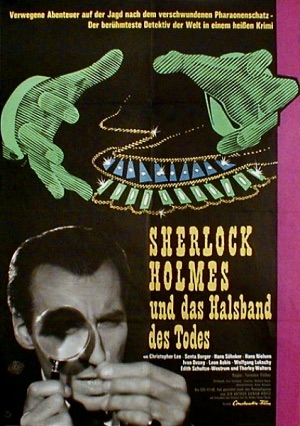
Fans of Peter Cushing and Christopher Lee also know that both actors have played Sherlock Holmes more than once. Besides his appearance in The Hound of the Baskervilles, Cushing also played the detective in a 1968 BBC series entitled Sherlock Holmes and again in the 1984 TV movie Sherlock Holmes and the Masks of Death with John Mills as Doctor Watson. Lee first stepped into the role of Holmes in 1962 in the West Germany film Sherlock Holmes and the Deadly Necklace, directed by Terence Fisher. He later returned to the role twice in the TV movies Sherlock Holmes and the Leading Lady (1991) and Sherlock Holmes: Incident at Victoria Falls (1992), with Patrick Macnee as Doctor Watson in both films. Lee also appeared as Mycroft Holmes, older brother of Sherlock, in Billy Wilder’s underrated The Private Life of Sherlock Holmes (1970).
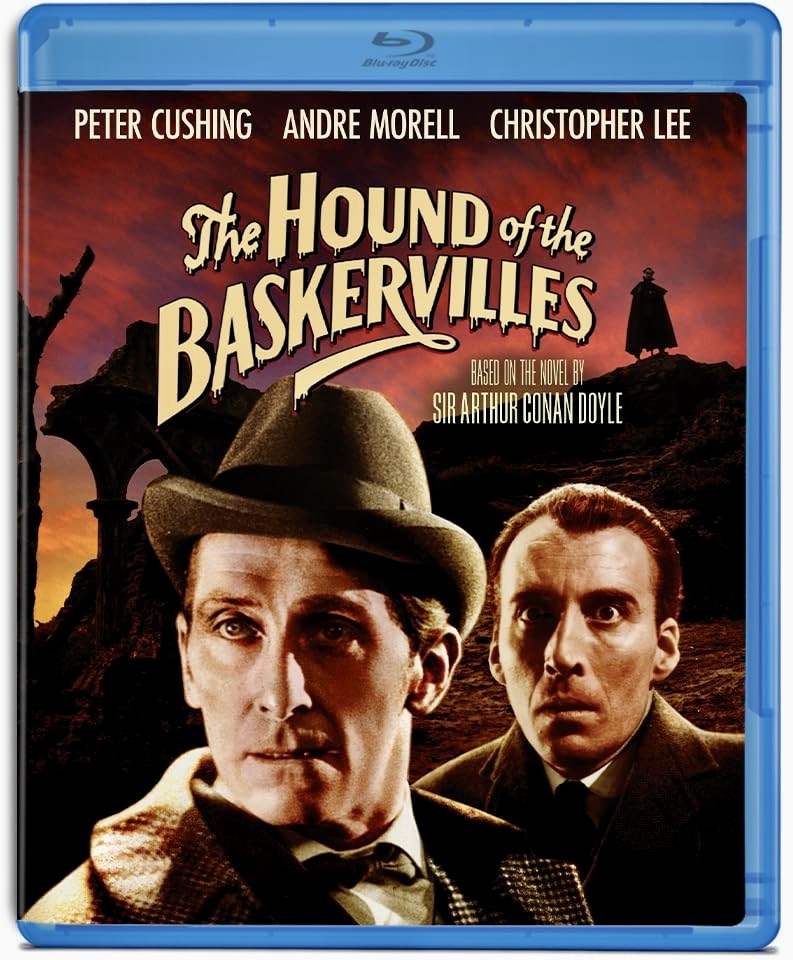
The Hammer film version of The Hound of the Baskervilles has been released on various formats over the years but the most recent release of it is a no-frills Blu-ray edition issued by Sandpiper Pictures in September 2024 (it has no extra features).
*This is a revised and expanded version of an article that originally appeared on the Turner Classic Movies website.
Other links of interest:
http://www.screenonline.org.uk/people/id/455344/index.html
https://classic-horror.com/masters/terence_fisher.html
http://www.bakerstreetdozen.com/lee.html
 Cinema Sojourns