
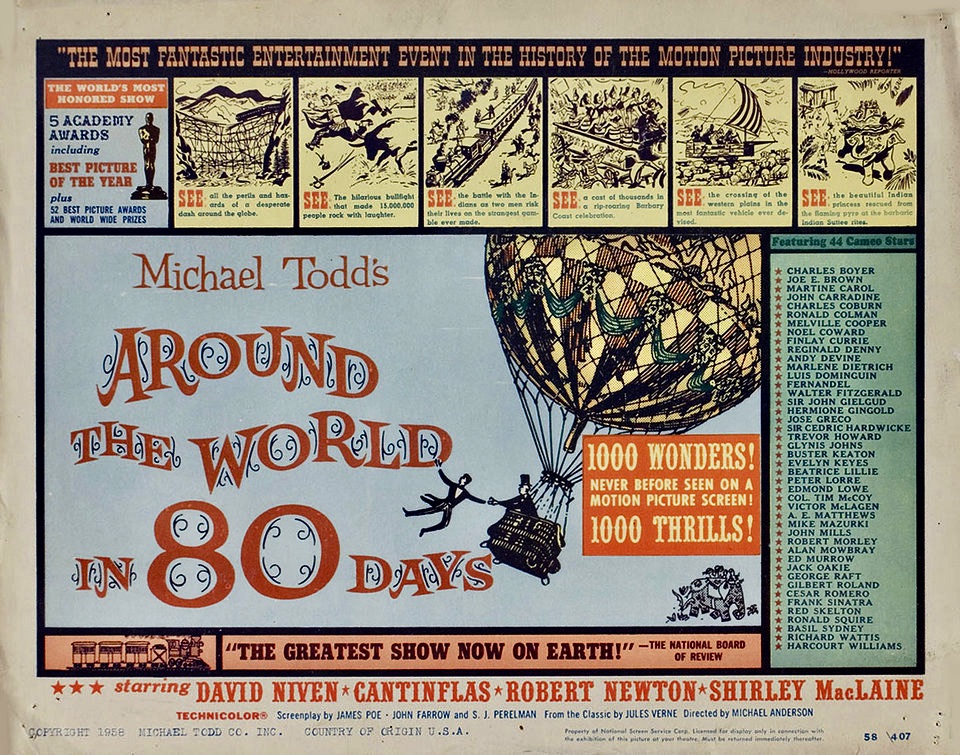
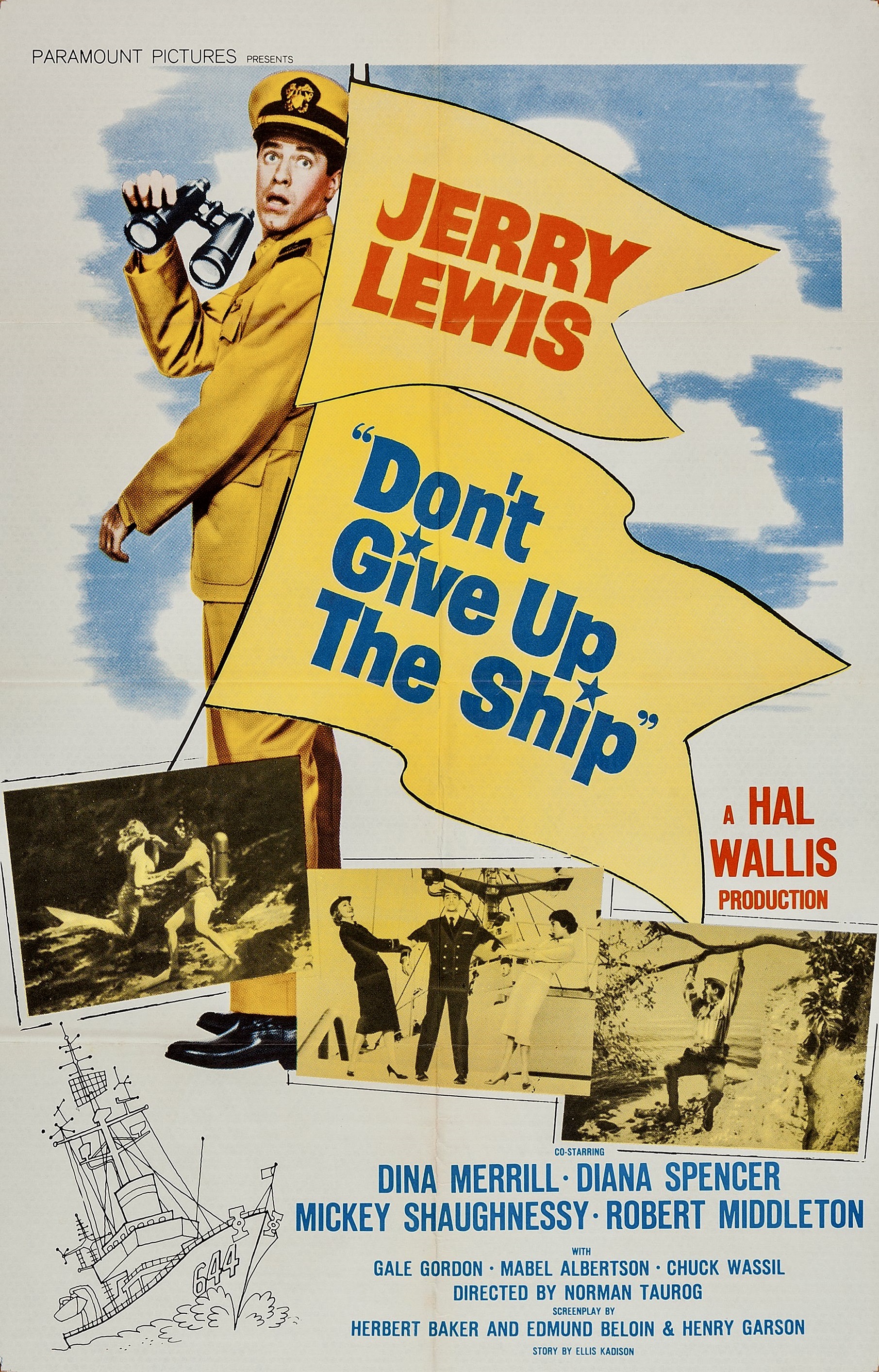
All of us have probably walked out on a movie at the theatre at some point in our lives but how often have you been forced to leave a film due to circumstances beyond your control? The few times this has happened to me are ingrained in my memory probably because it was such a rare occurrence…and because the interrupted scene and the movie itself never received the proper closure. In other words, a simple case of cinema interruptus (the Latin word for interrupted). The films in question are Around the World in 80 Days (1956), Cat on a Hot Tin Roof (1958), Don’t Give Up the Ship (1959) and Cat Ballou (1965).
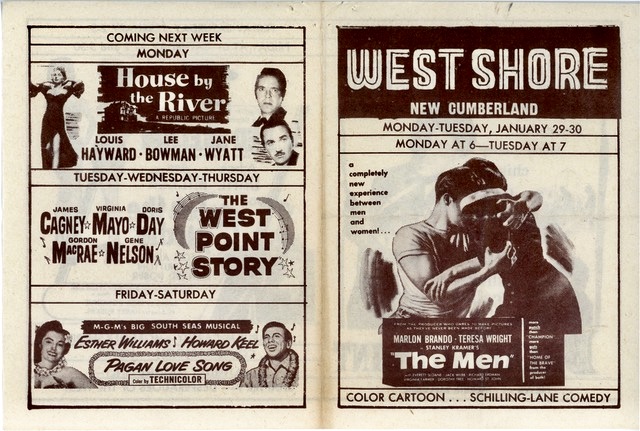
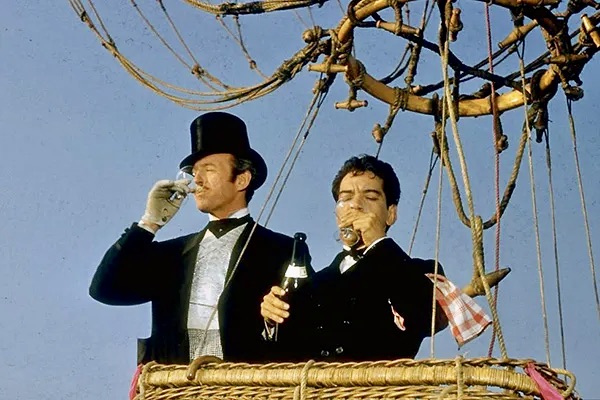
My first recollection of this was in West Cumberland, Pennsylvania (just outside Harrisburg) at the West Shore Theatre where my family and I went to see the re-release of Around the World in 80 Days in 1958. When we got to the scene where David Niven and Cantinflas are passing a snow-topped peak and Cantinflas grabs a handful of snow to ice the champagne they are carrying, my mother started having labor pains and we left for the hospital. It was a false alarm though.
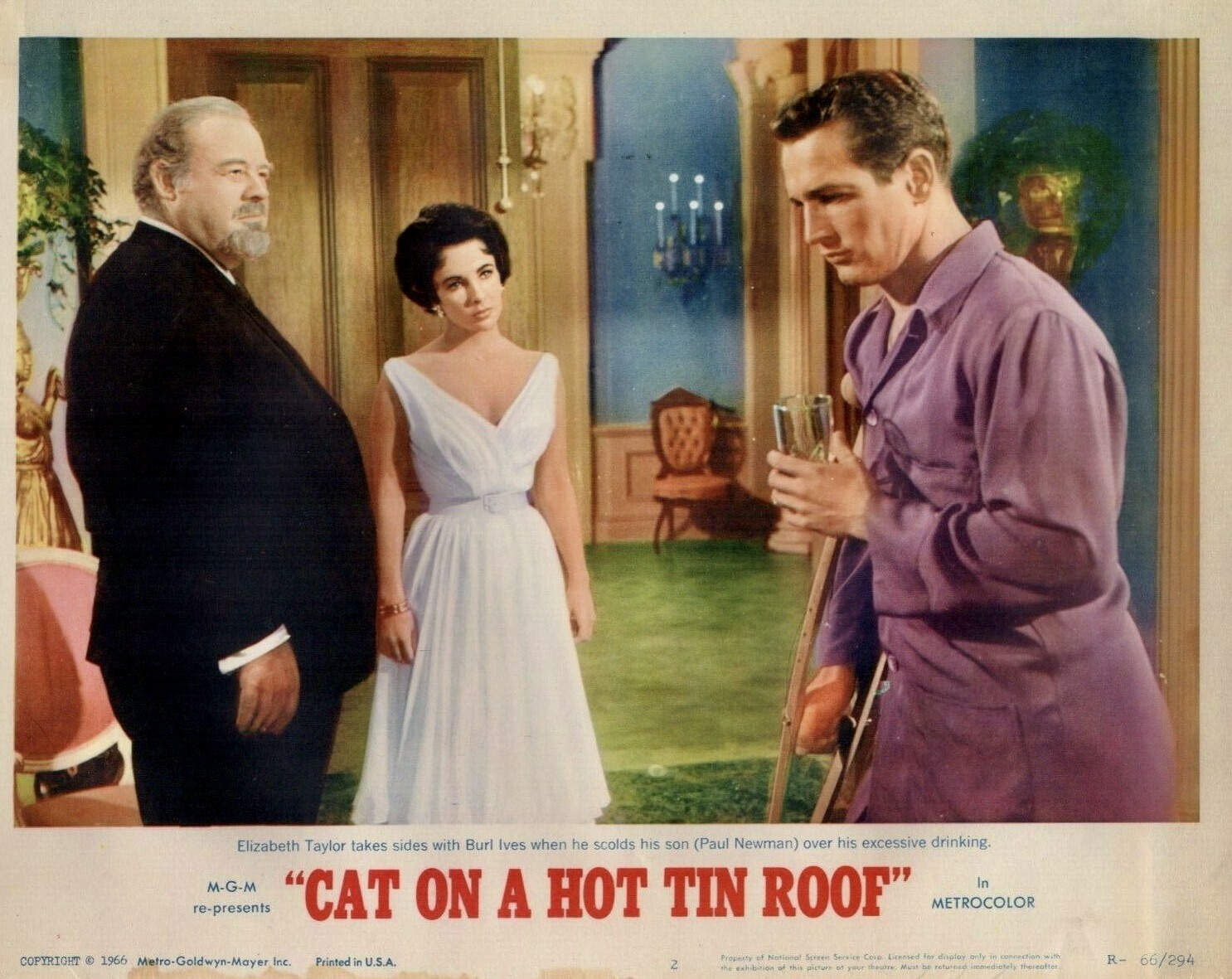
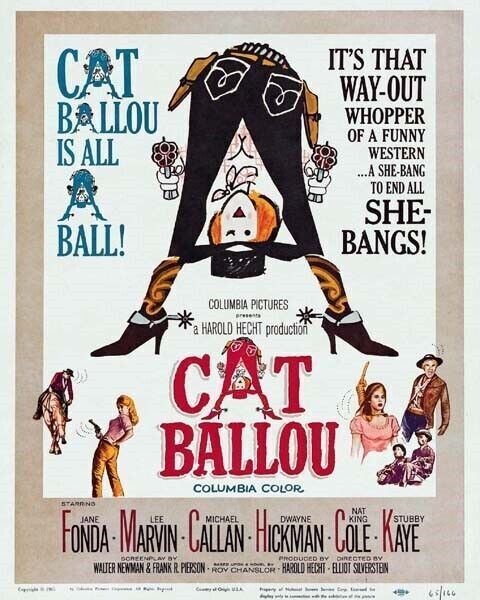
A few weeks later we were back at the West Shore Theater to see Cat on a Hot Tin Roof. Even at the time I knew the movie wasn’t appropriate for children because of the poster…and it was no animal picture. Instead, there were scenes of endless talking and yelling and lots of drinking and adults in their underwear, sweating and irritable. But Burl Ives as “Big Daddy” was a frightening presence and the scene on the stairwell when he begins a harangue on Paul Newman’s character brought on another wave of labor pains for my mom. This occurred sometime in late December of 1958 but my sister wasn’t born that night. It was another false scare and it wasn’t until the early morning hours of January 1959 that Priscilla emerged, becoming one of the first New Years’ Day babies in Harrisburg, Pa.
A year later we were living in Richmond, Virginia and I recall a Saturday matinee of Don’t Give Up the Ship starring Jerry Lewis. My brother Phil had a friend from out of town visiting – Johnny, who was from our old neighborhood in Memphis. Johnny and I wanted to see the movie but my brother had no interest so my mother dropped us off as Phil sulked in the front seat. Not long after the movie started – it was the flashback scene where we see Jerry as a kid in the bathtub with his toy boat – my brother appeared beside us in the isle and said we had to go. As we emerged into the bright sunlight outside, it became obvious that Phil’s plan for a softball game was going to happen after all due to my mother’s intervention.
The only other memorable moviegoing interruption was when I went with some neighborhood kids in Richmond to see Cat Ballou at the Byrd Theatre on Cary Street and the power went out during an electrical storm. The interior theatre lights and the projector shut off during the scene near the film’s beginning when Jane Fonda is traveling by train to Wolf City, Wyoming. For a brief second, we thought the train had entered a tunnel but that was the end of Cat Ballou. The theatre manager opened the lobby doors and told us the power could remain off for as long as an hour or more so we could get our money back if we wanted.
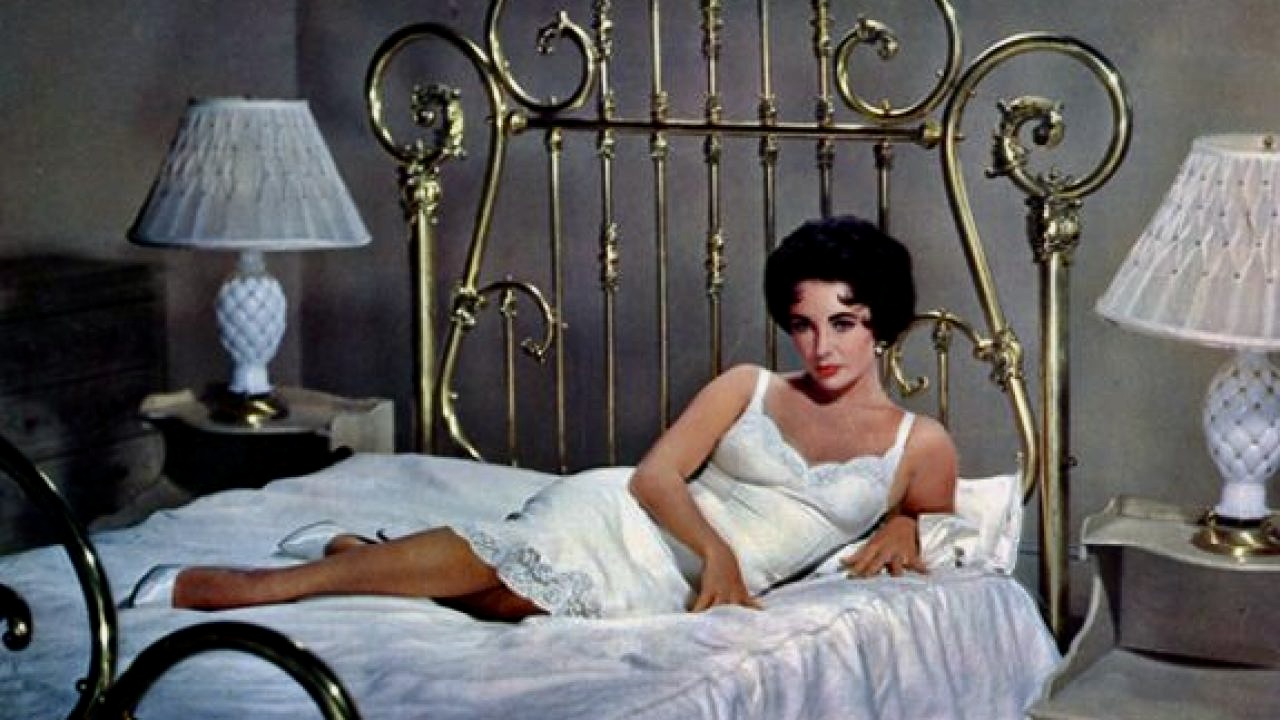
These interrupted scenes are what I remember most about these four movies but I have since rectified the situation (with the exception of Don’t Give Up the Ship) by revisiting three of the movies. Seen today, Cat on a Hot Tin Roof, directed by Richard Brooks from a screenplay by Brooks and James Poe, stands as a stellar acting showcase for its principal players, especially Elizabeth Taylor, who proved she was becoming an impressive dramatic actress (she already had a Best Actress Oscar nomination for Raintree County [1957] to her credit) and was as at the height of her beauty and sex appeal. Although the film was a diluted version of Tennessee Williams’s provocative stage play due to the demands of the Production Code office, Cat on a Hot Tin Roof was still an admirable attempt by a major studio (MGM) to tackle adult themes (alcoholism, homosexuality) and test the waters of censorship.
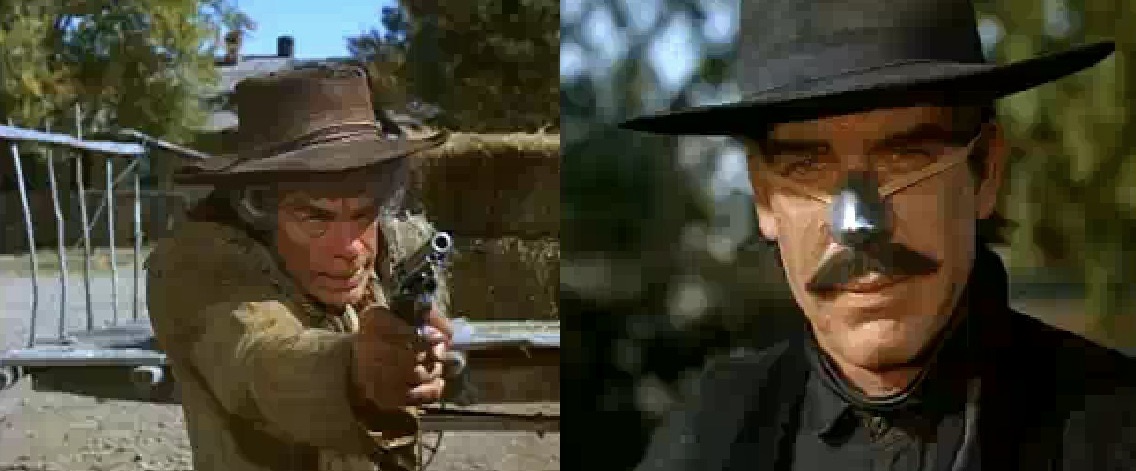
Cat Ballou continues to hold up as an amusing western spoof, buoyed by the clever casting coup of Lee Marvin in a dual role and the innovative pairing of singers Nat King Cole and Stubby Kaye as a kind of musical Greek chorus. Best of all, the film, helmed by TV director Elliott Silverstein making his feature film debut, proved that Jane Fonda had a flair for comedic material and honed that talent to perfection in Barefoot in the Park (1967) and Barbarella (1968).
Compared to Cat on a Hot Tin Roof and Cat Ballou, Around the World in 80 Days has not aged well and the fact that it was nominated for eight Oscars and won five of them including Best Picture seems like a joke now. (The other Best Picture nominees were Giant, Friendly Persuasion, The King and I and The Ten Commandments). Actually, an Oscar should have gone to producer Michael Todd’s promotion and marketing of the film which cautioned theater distributors: “Do not refer to Around the World in 80 Days as a movie. It’s not a movie. Movies are something you can see in your neighborhood theatre and eat popcorn while you’re watching them…Show Around the World in 80 Days almost exactly as you would present a Broadway show in your theatre.”
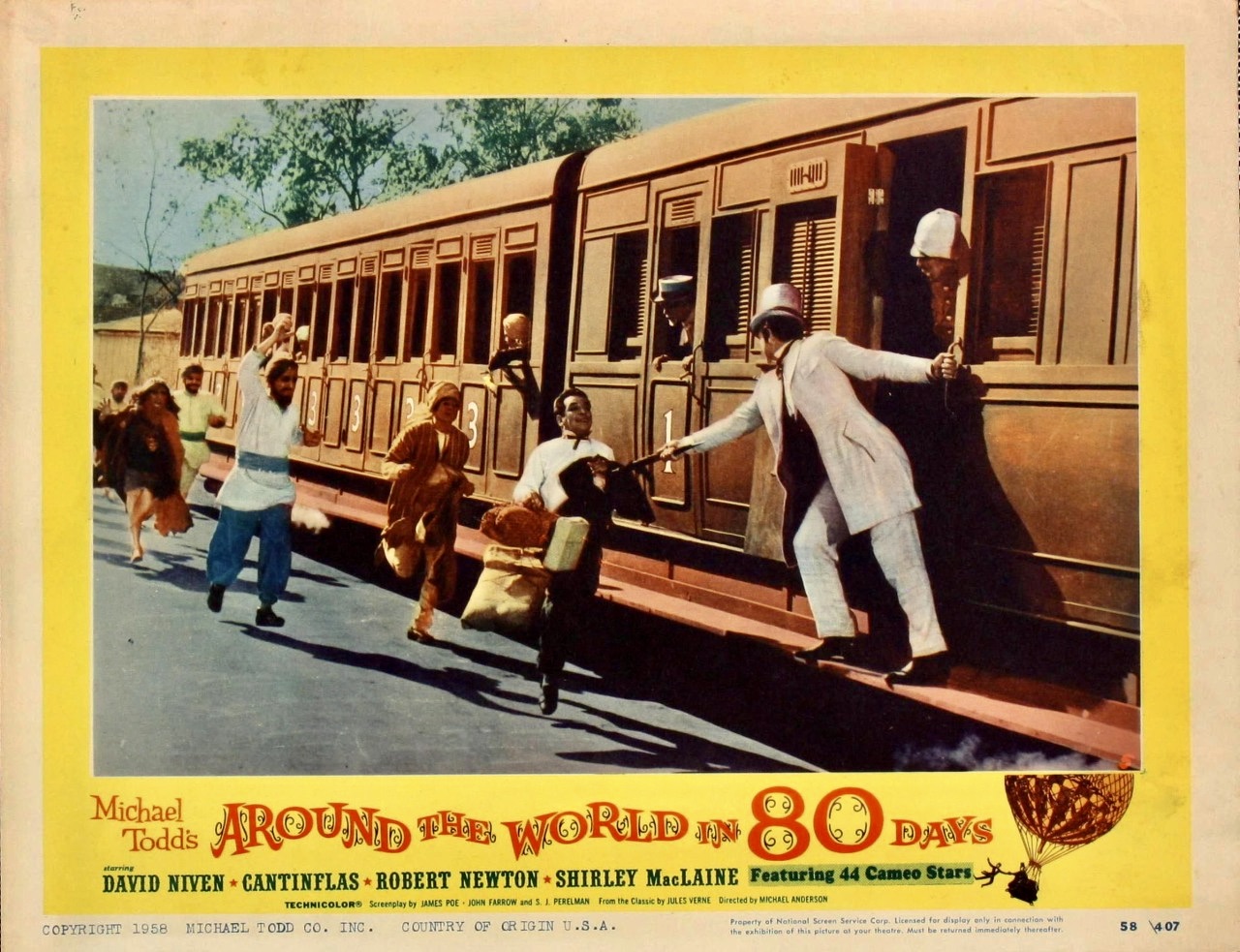
Critics of the time were apt to agree with Todd’s statement that Around the World in 80 Days was not a movie. It was an event and, for some, an unendurable one that lasted two hours and forty-seven minutes. Yet, the film deserves a place in cinema history for reasons that have nothing to do with the movie’s quality or artistry. It boasted the most people (68,894) ever photographed in separate worldwide locations; the greatest distance ever travelled to make a film (four million air passenger miles); the most camera set-ups ever used (200 more than Gone With the Wind, 1939); the most sets ever used (140 actual locations plus interiors on soundstages in London, Hong Kong, and Tokyo as well as six Hollywood studios); the most costumes ever used (74,685); and the most assistant directors (33).

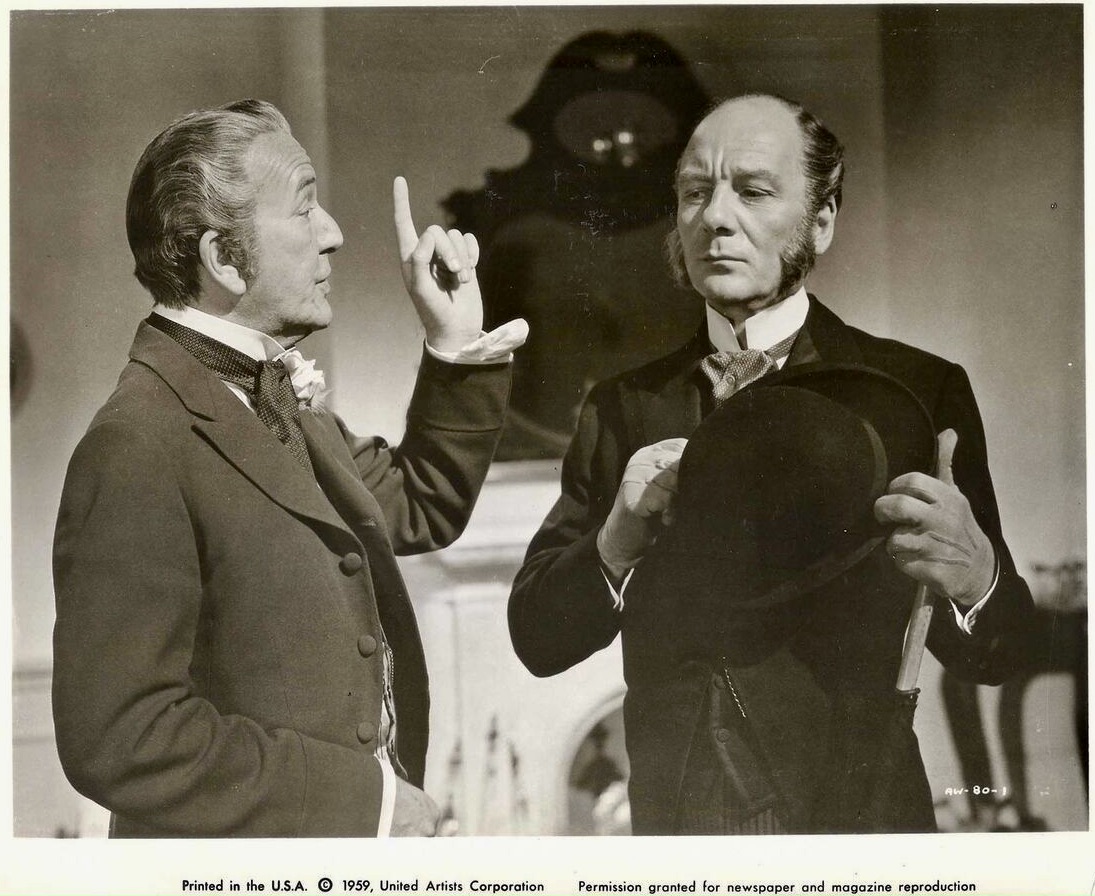
What you end up with is more like an international travelogue shot in widescreen Todd-AO with one of the largest guest star casts in movie history and a plot that is incidental to the sheer visual spectacle of it all. Shaving off that opening prologue narrated by Edward R. Morrow about Jules Verne and space travel would have helped reduce the tedium and the pacing but audiences of the day seemed to enjoy Around the World in 80 Days as a lightweight entertainment despite the excessive length.
Other links of interest:
https://elizabethtaylor.com/overcoming-grief-on-the-set-of-cat-on-a-hot-tin-roof/
https://www.loc.gov/loc/lcib/9618/80.html
https://www.filmsite.org/aroundtheworld.html
https://www.theguardian.com/uk/2005/jun/06/books.hayfilmfestival2005
http://www.westshoretheatre.org/about/theatre-history/
 Cinema Sojourns
When I saw 2 Fast 2 Furious at a local cinema, the fire alarm went off half-way in and a kid sitting near the front yelled “I’M GETTING OUT OF HERE!” and bolted up the aisle. A few minutes later (if that) it stopped and we all sat down again. The only memorable thing about that film, and probably the most entertaining too.
Real life impacts the cinematic experience! That is always memorable, whether it is the film struck in the projector gate and melting on the screen, someone in the audience talking back to the screen or being escorted out by the police or a fire alarm. Yes, the spell is broken and sometimes the interruption is better than the movie.