
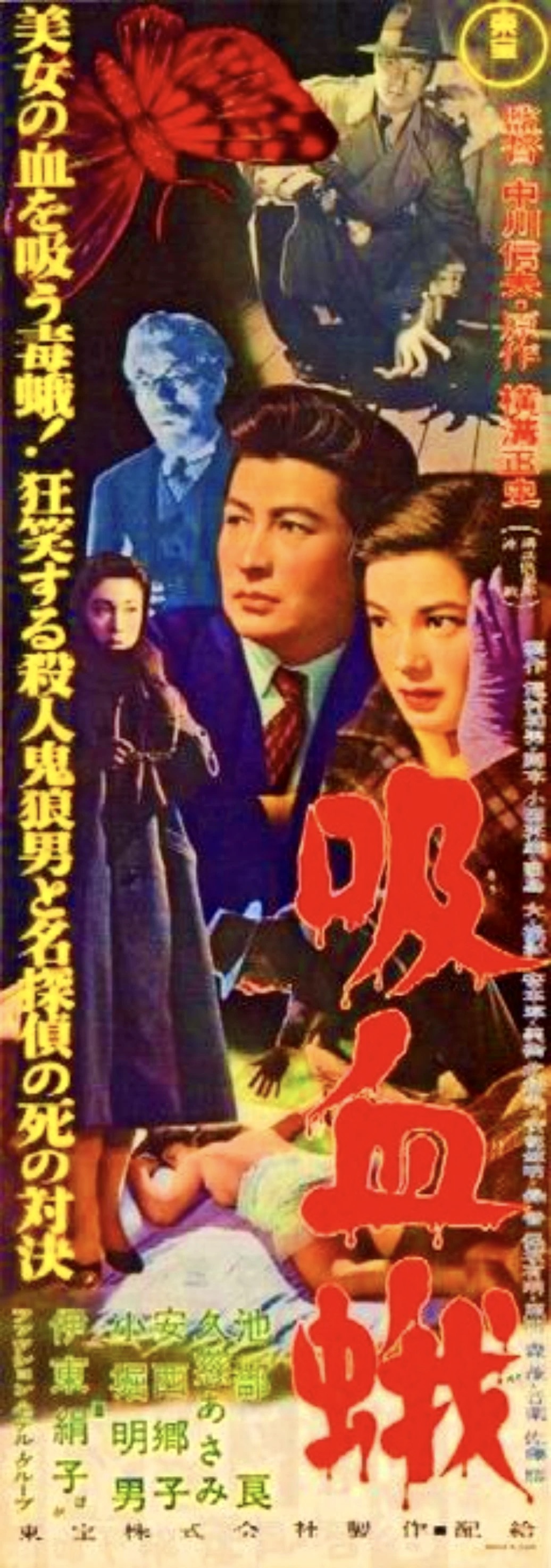
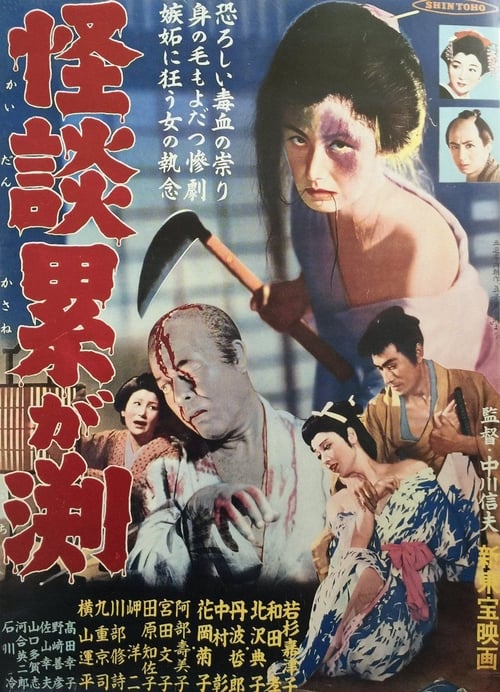
There are a number of classic Japanese horror/fantasy films from the fifties and sixties that genre fans in the U.S. have read about but never seen due to their unavailability on DVD or Blu-ray. In recent years a few of these have appeared in domestic release versions such as Nobuo Nakagawa’s 1960 allegorical masterpiece Jigoku (released by The Criterion Collection), in which a hit-and-run driver literally goes to hell, and the director’s 1968 supernatural tale Snake Woman’s Curse (released by Synapse Films). Many of the most famous examples of Japanese fantasy/horror from this period, however, still remain elusive for American viewers unless you own an all-region DVD/Blu-ray player and are willing to purchase import discs from Japan, often with no English subtitles. It is also true that many of these classic genre efforts were directed by Nakagawa who is famous for supernatural chillers as The Ghosts of Kasane Swamp (1957), Black Cat Mansion (1958), and The Ghost of Yotsuya (1959). But I have to admit that one of the director’s creepiest and least seen films is Kyuketsu-ga (English title: The Vampire Moth, 1956), which combines mystery thriller tropes with grotesque horror elements to achieve a delightfully macabre brew.
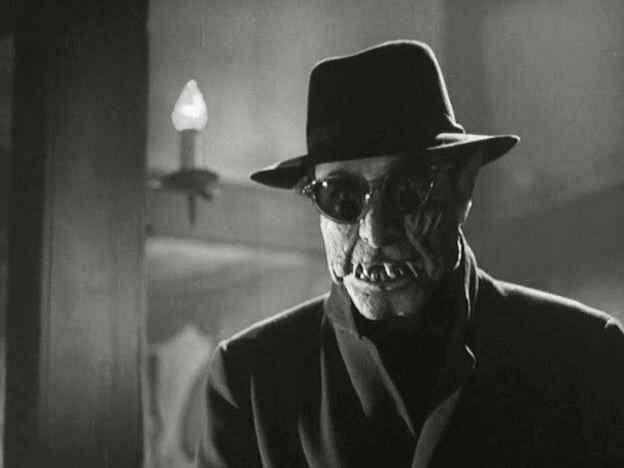
Based on a novel by Japanese mystery writer Seishi Yokomizo, The Vampire Moth is a bit of a misnomer. No vampire moths or vampires make an appearance in the film’s fast-paced, convoluted narrative. On the other hand, there is a maniacal killer on the prowl with a face of a wild animal baring hideous fangs, the possible recipient of a werewolf curse. There is also an eccentric Lepidopterology expert who lives in an isolated mansion with a vast collection of butterfly and moth specimens.
Yokomizo also co-authored the screenplay with Hideo Oguni and Dai Nishijima, which, in the original novel, showcased the exploits of detective Kosuke Kindaichi, the scruffy but intrepid hero of countless crime stories like The Honjin Murders, The Inugami Curse and The Village of Eight Graves. Kindaichi is not the main focus in The Vampire Moth and doesn’t even enter the film until the midpoint but he does end up solving what turns out to a diabolical murder spree that involves rivalry, deceit, theft and murder in the backstabbing world of high fashion. Actually, high fashion may be too highfalutin a term for the film’s setting, a downscale modeling studio that also functions as a dance hall featuring acts which are borderline burlesque/striptease performances.

Here is the basis setup: Asaji (Asami Kuji) is the number one fashion designer in Tokyo after winning the industry’s top design award and relegating rival and former queen bee Tazuko (Chieko Nakakita) to second place. During a modeling exhibition by Asaji and her employees, the company manager Murakoshi (Ichiro Arishima) receives a visit from a masked stranger who brings a gift for Asaji. When Murakoshi hesitates to accept the present, the stranger intimidates him by removing his mask to reveal a terrifying wolf-like face. Later, when Asaji opens the mysterious gift box, she finds an apple punctured by four fang marks and promptly faints.
It turns out that Asaji does indeed know the mysterious gift bearer and was once intimately involved with him during her studies in Paris. He goes by the pseudonym Tetsuzo Ibuki (Eijiro Tono) and has a twin brother Shunsaku Eto, who studies moths and butterflies. During a vacation together in Switzerland, Ibuki displays werewolf-like symptoms and attacks Asaji, leaving a scar of four fang marks on her breast. After Ibuki disappears into the Pyrenees region of Spain, Asaji returns to Japan and launches a successful career as a fashion designer. Now that she is the toast of the town, Ibuki shows up again with an insidious revenge scheme.
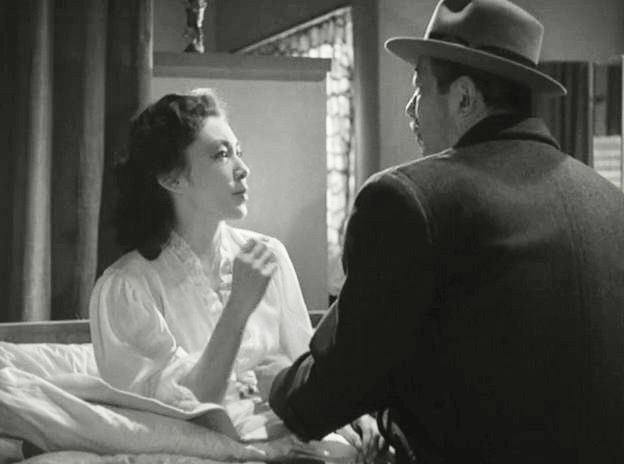
Asaji’s business is soon plagued by a series of bizarre murders in which some of her top models are targeted and slain in gruesome ways. As the bodies start to pile up, newspaper reporter Kawase (Minoru Chiaki) and Yumiko (Kyoko Anzai), one of Asaji’s models, do their own sleuthing and eventually call in detective Kindaichi (Ryo Ikebe) to help weed out the many possible suspects from the real serial killer.
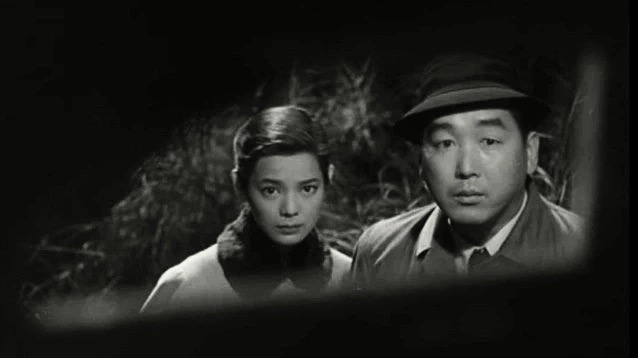
There are so many characters and red herrings introduced into the film’s breathlessly paced storyline that it can be confusing on a first or even a second viewing but what you will remember most will be the numerous set pieces featuring the demise and presentation of the murdered models, the gothic art direction, Jun Yasumoto’s moody black and white cinematography which recalls the horror films of Val Lewton and Masaru Sato’s terrifically weird music score which features a musical saw or is it a theremin? And, of course, the horrific makeup effects qualify this as a horror movie, even though the wolf-face turns out to be an ingenious disguise much like the fake creature on the loose in 1927’s The Cat and the Canary.
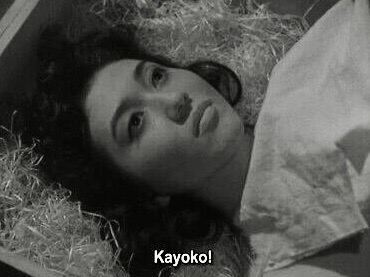
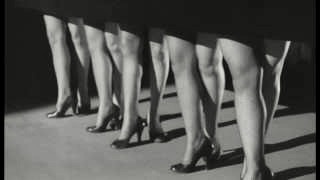
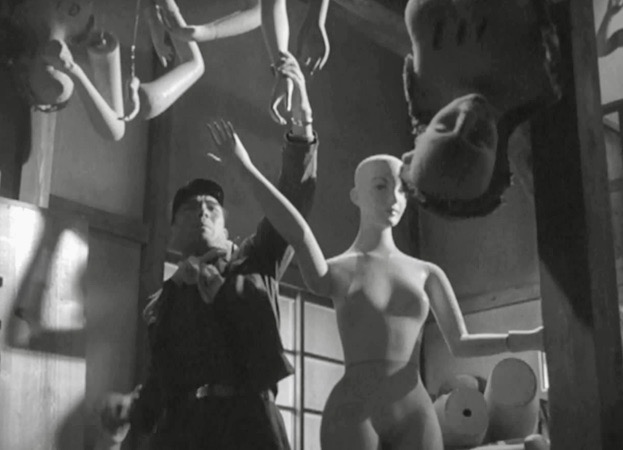
[Spoiler alert] Among my favorite moments in The Vampire Moth is a visit to a mannequin factory, which predates an equally freaky scene in Blake Edward’s thriller Experiment in Terror (1962), and culminates in a crate being opened at Asaji’s salon, revealing the corpse of model Kayoko (Toki Shiozawa) and her amputated arms. But where are her legs? They make a surprise appearance in one of the movie’s most delirious and surreal sequences. An audience watches as the curtain partially rises at a cabaret show and reveals five pairs of dancing legs performing a sexy routine. When the curtain is lifted higher, people scream and the chorus girls flee as Kayoko’s severed legs, manipulated from the rafters like marionettes, keep dancing. Totally nuts!
Credibility is not the film’s strong suit but who cares when you get outlandish scenes like one in which another model, standing beneath a fake palm tree as it rises on a revolving pedestal from the sunken stage, looks like she is pretending to be a mannequin. The music stops, an awkward silence begins and then her body topples to the ground, her eyes in a vacant stare. Another stylishly arranged murder victim!
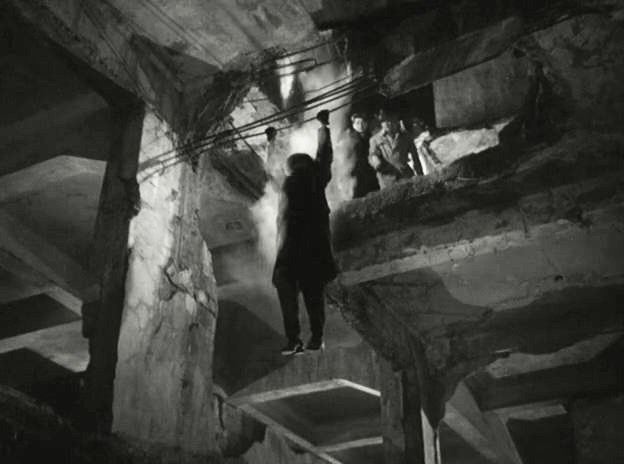
There are many other ghoulish delights to savor before the film ends in a suspenseful chase after the mad killer in the ruins of a bombed out building at night. The noir-like lighting of the scene looks inspired by the nocturnal hunt for Harry Lime in Carol Reed’s The Third Man (1949) and when the killer is finally unmasked, it feels like the ultimate Scooby-Doo ending (even if it is thirteen years before that cartoon series premiered on TV).
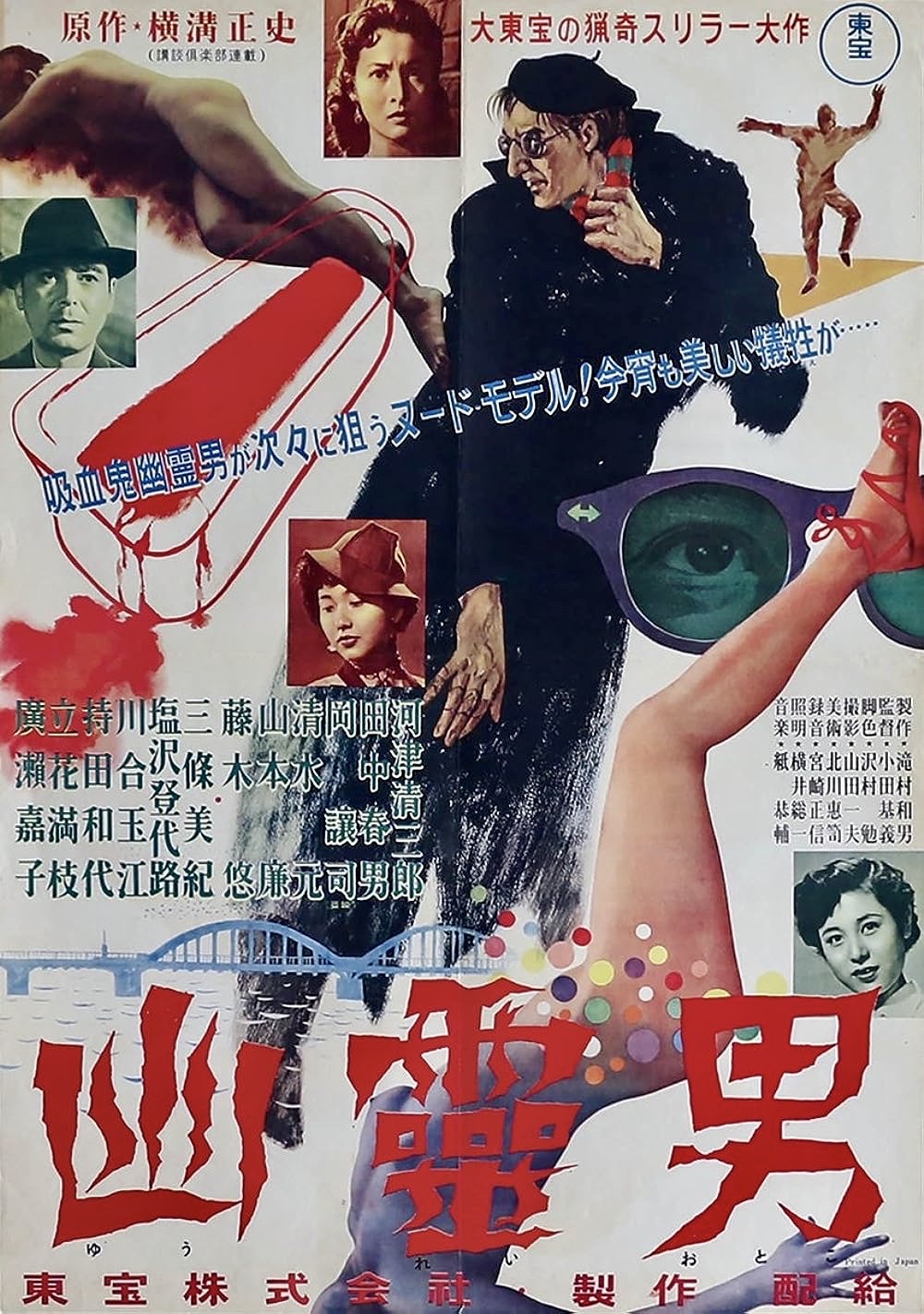
The Vampire Moth never received an official release in the U.S. and the only way movie lovers can see it is from bootleg copies or unauthorized streaming sites like Youtube in mediocre-to-poor prints. The film seems like an ideal future release for a hip distributor like Mondo Macabro, who have released other cult Japanese titles on DVD and Blu-ray over the years such as Kaidan Semushi Otoko (English title: House of Terrors, 1965) and Shin’ya Tsukamoto’s Hiruko the Goblin (1991). Let’s hope it makes an appearance in a beautifully restored print soon. And if The Vampire Moth sounds like your kind of flick, you should try and track down Motoyoshi Oda’s Yurei Otoko (English title: Ghost Man, 1954), which is also scripted by mystery writer Seishi Yokomizo with Tsutomu Sawamura, and shares some grisly similarities to The Vampire Moth with its plotline of a menacing spectral figure who lures models to their deaths and then poses their bodies for erotic photographs like a true necrophile.
Other links of interest:
http://www.midnighteye.com/features/strange-tales-of-nobuo-nakagawa/
https://tohostudiopedia.fandom.com/wiki/Nobuo_Nakagawa
https://variety.com/2010/film/news/japanese-thesp-ryo-ikebe-dies-1118025503/
 Cinema Sojourns